Finding Happiness Through Nature and Creativity by Judith Shaw

We live in difficult times. Daily we hear of culture wars, real wars, mass shootings, floods, fires and multiple other climate disasters and human clashes. 

How on Earth can one maintain a positive outlook and experience genuine happiness? I’ve discovered a few activities that effectively pull me out of dwelling on past challenges or worrying about future uncertainties. These activities consistently guide me back to a state of inner peace and contentment.

Continue reading “Finding Happiness Through Nature and Creativity by Judith Shaw”

Why We Need to Bring Back God as a Woman, part 1 by Caryn MacGrandle

26,000 years ago, life was precarious and dangerous.  And so the human race revered the Mother.  Mother Earth, who provided food amidst scarcity, protection from the dangers of the wild and healthy babies who grew to adulthood.

The Goddess.

In her many forms.

Some of these Goddesses.

Venus of Willendorf.  The artifact known as the Venus of Willendorf dates to between 24,000–22,000 B.C.E., making it one of the oldest and most famous surviving works of art.

Continue reading “Why We Need to Bring Back God as a Woman, part 1 by Caryn MacGrandle”

From the Archives: Sacred Water by Molly Remer

This was originally posted on August 9, 2017

“Drinking the water, I thought how earth and sky are generous with their gifts and how good it is to receive them. Most of us are taught, somehow, about giving and accepting human gifts, but not about opening ourselves and our bodies to welcome the sun, the land, the visions of sky and dreaming, not about standing in the rain ecstatic with what is offered.”

–Linda Hogan in Sisters of the Earth

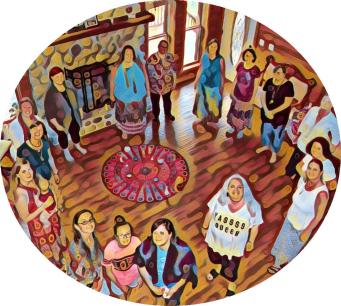
The women have gathered in a large open living room, under high ceilings and banisters draped with goddess tapestries, their faces are turned towards me, waiting expectantly. We are here for our first overnight Red Tent Retreat, our women’s circle’s second only overnight ceremony in ten years. We are preparing to go on a pilgrimage. I tell them a synopsis version of Inanna’s descent into the underworld, her passage through seven gates and the requirement that at each gate she lie down something of herself, to give up or sacrifice something she holds dear, until she arrives naked and shaking in the depths of the underworld, with nothing left to offer, but her life.

Continue reading “From the Archives: Sacred Water by Molly Remer”

Inanna’s Sisters, by Molly M. Remer

Sometimes I feel like my own Ninshubur. 
I set up a lamentation in the street. 
I call my own name,
beat the drum 
to lead myself back home,
prepare the temple
for my own arrival. 
I will not give up on myself,
will not abandon my own wholeness,
I refuse to sacrifice my Self. 
I will not stay in the underworld forever. 
We all need people in our lives who will say:
No, this will not do. 
I’m coming after you. 
I will help you to crawl back up, 
back out, back through. 
I will reach out to you. 
I will boost you up.
I will rise with you into becoming. 
You will not stay behind defeated 
and alone so long as I,
your Ninshubur,
draw breath.
I will beat the drum for you. 
I will call your name. 
You are not alone. 
Come back to me.
I see your power 
and your strength. 
I hear your longing. 
Return, 
return,
return.

I first met Inanna in the firelit darkness of a midwifery retreat in central Missouri. Toddler son at my breast, I watched, spellbound, as the charismatic, dark-haired midwife recounted the tale of Inanna’s descent into the underworld, through the seven gates we traveled, to the seat of our own wounding and our own medicine.

Continue reading “Inanna’s Sisters, by Molly M. Remer”

From the Archives: The Found Goddesses of Good Eats by Barbara Ardinger

This was originally posted on August 1, 2013. We usually do Carol Christ’s legacy posts on Mondays. Given the closeness of Lughnasadh, it felt appropriate to share the work of one of our other long-time writers today. Carol’s legacy posts will be back next week.

Lughnasadh (pronounced LOON-us-uh) or Lammas—is the first of the three traditional harvest festivals of the traditional Celtic calendar that most pagans follow today. And what naturally follows harvest? Feasting, fairs, and festivals. To help us celebrate the season, here are two Found Goddesses of good eating. The term “found goddesses” was created in 1987 by Morgan Grey and Julia Penelope, authors of a hilarious book titled Found Goddesses. After reading this book and having never met a pun I didn’t instantly love and being of a naturally satirical state of mind, I started Finding—i.e., inventing—my own goddesses shortly before the turn of the century. After I found a hundred of them, they were published in 2003 in my book, Finding New Goddesses.

Continue reading “From the Archives: The Found Goddesses of Good Eats by Barbara Ardinger”

Embracing the Dark Goddess – Empowering Paradigm Shifts, Part 2 by Judith Shaw

 The Dark Goddesses, with qualities that are mysterious, magical, chaotic, destructive, violent and transformational bring a wholistic understanding of ourselves and of nature. They are wild and untamed.  Today I finish up my initial dive into the Dark Goddesses which began yesterday with the publication of Part 1. Look for a more detailed look at these goddesses and more in the coming months.

Erishkigal, Underworld Goddess

Dark goddesses are wild, free, and sexual – Lilith, Erishkigal and Medb

Lilith and Erishkigal
Long before the rise of civilization, people lived together in very different ways and Goddess was understood as the force that encompasses all life – the light and the dark. It’s very interesting that two of the world’s oldest dark goddesses – Lilith and Erishkigal –  are found in the creation story of Sumer, considered as the world’s first civilization.

Continue reading “Embracing the Dark Goddess – Empowering Paradigm Shifts, Part 2 by Judith Shaw”

Embracing the Dark Goddess – Empowering Paradigm Shifts, Part 1 by Judith Shaw

I always approach the Dark Goddesses with trepidation, preferring to focus on the bright, life affirming aspects of the Goddess. Yet now I find that the difficult break-downs and violent conditions of these days are calling me to explore the terrifying aspects of the ones called “Dark Goddesses.” 

But who are the Dark Goddesses and why are they called dark? That question is one of controversy within the Goddess community. Carol Christ has written that the Dark Goddess only exists as a projection of patriarchal values onto the Goddess, turning the Goddess into a force of war and terror, in particular the War Goddesses found in various cultures. Christ views war as an abnormal desire for the Goddess. Whereas others view the Dark Goddess as a part of the one Great Goddess, who encompasses all. 

A painting I did in 2013 inspired by Kali and in response to the destruction caused by oil drilling. “Gaia Wields Her Sword of Justice”
Continue reading “Embracing the Dark Goddess – Empowering Paradigm Shifts, Part 1 by Judith Shaw”

From the Archives: Artemis As Artemisia: Ancient Female Spirituality & Modern Medicine by Stuart Dean

This was originally posted on November 29, 2015

Detail of Artemis from a 5th century BCE Attic Vase

The 2015 Nobel Prize for Medicine was awarded in part to a Chinese woman (Tu) for her identification and isolation to treat malaria of a chemical known as Artemisinin.  The name of that chemical derives from the fact that it is found in varying amounts in the ‘family’ (technically, genus) of plants known as Artemisia.  The name of that family derives from its association with the goddess Artemis.

Because Tu’s work began in China in the 1960s it is understandable that even if she knew this about Artemisia (a term I use to refer to any one plant or all of the plants of that family) it would not have been a ‘careerbuilder’ for her to point it out to those for whom she was working.  It was bad enough that she was a woman.  At that place and time, however, if she had said or done something that could be associated with Western culture her name might not even be known today.


Continue reading “From the Archives: Artemis As Artemisia: Ancient Female Spirituality & Modern Medicine by Stuart Dean”

Integrating Snake Medicine Part 1

This post describes some of the steps on my personal journey of soul recovery across many, many years. It can be traced back to when I was 3 or 4 years old. Each header reflects a significant moment towards finding my Medicine and embracing my Golden Shadow of stepping into an ancient lineage of Snake Healers.

Although many of the steps created an immediate shift in my consciousness, this kind of individuation usually doesn’t happen overnight. I’m sharing it to honour the unfolding trails across time, and to encourage people to surrender to their journey, while letting go of a specific outcome. Part 2 will be published tomorrow.

Continue reading “Integrating Snake Medicine Part 1”

Aviana, 20th Century Crane Goddess by Judith Shaw

People think that goddesses only came into being long, long ago. People think goddesses are only found in ancient mythology. But people are wrong.  I know because I am Aviana, the Wetlands Crane Goddess who helped create the Bosque del Apache Wildlife Reserve of New Mexico. I first manifest on Earth as an Otherworldly force in the early 1900s. It was the migrating birds and waterfowl, in particular sandhill cranes, who called me into being.  

You see before Euro-Americans arrived in the land of the American Southwest, the Rio Grande was a mighty river which flooded every year bringing life and renewal to the land. These wetlands were a favorite wintering habitat of the Sandhill Cranes. They left their summer nesting grounds of Alaska, Canada and the northern United States and headed south for the winter.  Every year in November hundreds of thousand of cranes arrived in New Mexico. Here they fed on grasses and small animals throughout the short winter days. 

Continue reading “Aviana, 20th Century Crane Goddess by Judith Shaw”