To Have and to Hold: Gay Marriage and the Religion Question

If a conservative religious traditions can’t give their mothers or sisters full equality, how can we expect them to give a GLBT individual the time of day?

John Erickson, sports, coming out.Outrage.  Anger.  Fear.  Hatred.  These are just a few of the words that flashed across my Twitter feed as I woke up on that fateful Wednesday, June 26 morning when the Supreme Court of the United States ruled that the Defense of Marriage Act (or DOMA) was unconstitutional and that supporters of Proposition 8, the hotly contested voter initiative in California that banned same-sex marriage, had no standing.   People were mad.  However, it wasn’t just the typical kind of mad that is associated with hatred, it was a type gay_marriage_81102178_620x350of mad that was met with impossible anguish because what I was reading and feeling was a result of one thing: there was nothing more they could do.

What does all this mean?  Questions from friends and family were filling up my inbox and although I wanted to take a moment to just hit “Reply All,” and input the words: Equality, I had to hold back and start to examine the notion that although equality may now be firmly on the proverbial table, there is still a lot of work to be done, specifically for gay marriage and those wanting to marrying inside the traditional church spaces they grew up in and not just the ones that have come out as open and affirming in recent years towards LGBT individuals. Continue reading “To Have and to Hold: Gay Marriage and the Religion Question”

“We Are Atheism” and Amanda Brown by Kile Jones

Kile Jones, atheistSo far, as a regular contributor to Feminism and Religion, I have interviewed a “pro-science” woman and one who started an online community for grieving unbelievers.  In this post, I will interview Amanda Brown, an atheist activist who co-founded a project called We Are Atheism.  Amanda grew up in Independence, MO, in the Assemblies of God and the Restored Church of Jesus Christ of Latter Day Saints. Since then, she has been involved in helping atheists “come out” and share their experiences.  So without further ado, here is the interview:

943021_10100185792782141_825478688_n

Why did you start “We Are Atheism”?

I started We Are Atheism because I saw a gap in the age of atheists coming out of the closet.  I also wanted a way for people to see for themselves that atheists are real people.  We Are Atheism is focused on the fact that atheists are mothers, fathers, teachers, brothers, friends, and so much more. When I was at the 2011 Secular Student Alliance Conference in Columbus, OH, I heard most of the leaders tell stories about their groups and how many of them didn’t know other atheists. I thought this was horrible, and being a person who was in the same position, I wanted to start something that would bring our community together.  Those who met on the internet could take their community from online to the neighborhood. Continue reading ““We Are Atheism” and Amanda Brown by Kile Jones”

God Doesn’t Live Here Anymore: Gay Bars and the Growing Divide Between Sexuality and Spirituality by John Erickson

oes God exist within the LGBTQ community anymore or has the community itself abandoned God for all-night raves, dance clubs, alcohol, and hypersexualized and over commoditized fetishized forms of femininity and masculinity? Oftentimes, I find myself answering yes to the above questions. After surviving hate crime after hate crime and endless batches of newly elected conservative politicians hell bent on ignoring medical and social epidemic plaguing the very country they were elected to serve and protect, why would a community, oftentimes linked to sin itself, believe in a holy entity?

John Erickson, sports, coming out.My good friend and fellow Feminism and Religion Contributor Marie Cartier’s forthcoming book, Baby You Are My Religion: Women, Gay Bars, and Theology Before Stonewall argues that American butch-femme bar culture of the mid-20th Century should be interpreted as a sacred space.  Specifically, gay bars served as both communal and spiritual gathering spaces where butch-femme women were able to discover and explore not only their sexuality but also their spirituality.  An opus of an academic accomplishment based off of the amount of in-depth interviews she conducted, Professor Cartier explores lived religion in an area that has become all too common within the LGBTQ community: the bar

The Palms, the last local and only lesbian bar to be found in city of West Hollywood, CA is closing its doors and I can’t help but wonder where its patrons or parishioners will now go? Continue reading “God Doesn’t Live Here Anymore: Gay Bars and the Growing Divide Between Sexuality and Spirituality by John Erickson”

Over the Rainbow or…“Over” the Rainbow? by Marie Cartier

What are the dreams that we dare to dream today?

I was sitting with a young queer student from my Gender Women’s Studies class at the gay coffee shop in Long Beach, California. I offer this option to my students—meet in

Long Beach on Friday of finals week if it helps — realize that I teach in Northridge, so on a Friday afternoon this means perhaps a 2 hour drive to do this. But many students do it—this one student included. It happened that he made this trek on the first day of Gay Pride activities in Long Beach—the Dyke March was that night.

of Gay Pride activities in Long Beach—the Dyke March, marie Cartier, feminism and religion, stonewall
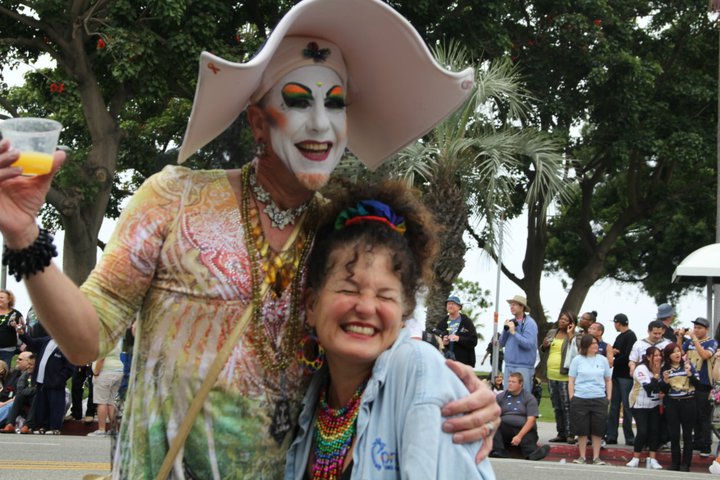
Marie with sister of perpetual indulgence—tippy tappy toes

I asked if he was going to any Gay Pride events while he was in Long Beach—perhaps even attending the Dyke March. He said, “I’m over Pride.” It felt like a game changing statement for a young queer activist.  I asked, “Why?” He said, “Why do I want to go somewhere and have someone try to sell me sheets or …a condo ….or buy pillows…it’s just about money, Professor. It’s got nothing to do with… what it was supposed to be about…?

I said, “Stonewall.” Continue reading “Over the Rainbow or…“Over” the Rainbow? by Marie Cartier”

It Was a Rainbow Graduation by Grace Yia-Hei Kao

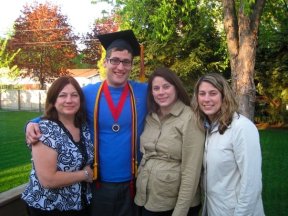
Distributing rainbow tasselsI have the privilege of serving as Co-director of the Center for Sexuality, Gender, and Religion at Claremont School of Theology. I am ecstatic that we just hosted our version of a “rainbow graduation” at this year’s Commencement.

Continue reading “It Was a Rainbow Graduation by Grace Yia-Hei Kao”

Third Time’s the Charm by Kecia Ali

dissertation, Advising, feminism and religionIn the space of a week, three obtuse remarks by non-Muslim men about Muslim women ticked me off.

First was a letter to the editor by Rabbi Howard Berman, published in the Boston Globe on April 21. The title (“Women’s Strides set Judaism apart”) was telling. According to Berman, strict religious hierarchy means that only in (his branch of) Judaism have women’s rights and roles advanced. Mormons and Catholics have no shot – never mind that Mormon women had recently raised the issue of women’s priesthood, or that lay and religious women among Catholics have long been fighting the good fight, sometimes with male allies. He then contradicts himself on the role of official hierarchy: Islam, where there is less centralization than in American or world Judaism, also gives women no chance of gaining authority.

I fumed and mentally composed a pithy refutation, which I never actually wrote. Continue reading “Third Time’s the Charm by Kecia Ali”

Betraying Bodies by Kelly Brown Douglas

Her name was Tricia Meili. Their names were Yusef Salaam, Raymond Santana, Antron McCray, Korey Wise and Kevin Richardson.  On April 19, 1989 all of their lives were irrevocably changed. They would never meet, but their lives would become forever linked.  When they entered into Central Park on that night, did they know that they were stepping into a haunting history of dismembered bodies?  Tragically, their bodies would become another story to be told in that history.

On that April day in history some 34 years ago one white female body went into Central Park for her routine jog. Five black and brown male teenage bodies went into Central Park to hang out, but soon became a part of a crowd engaged in mischievous if not dangerous and out-of-control harassment of other park visitors. As the night wore on, police were called and arrests were made. It would later be discovered that Tricia was brutally and sadistically raped, but not by Yusef, Raymond, Antron, Korey or Kevin. Yet, the five young teenagers were badgered into confessions, charged with the rape and sentenced to prison. Continue reading “Betraying Bodies by Kelly Brown Douglas”

The Catholic Church: Love Story or Scold Story? by Dawn Morais Webster

Dawn Morais Webster, the Pope off to his summer palace, Castel Gandolfo. He tells the world he will now become just a “humble pilgrim.”

 “We, the women and men of the church, we are in the middle of a love story: each of us is a link in this chain of love. And if we do not understand this, we have understood nothing of what the Church is.”   Pope Francis

Welcome words of love and acceptance.

Not so the words and actions of Cardinal Tim Dolan who shut of the doors of St. Patrick’s Cathedral in the faces of LGBT Catholics and their supporters on Sunday, May 5.

Leading a silent—but eloquent—protest in New York in response to the  Cardinal’s recent likening of LGBT Catholics to “dirty hands” that needed to be washed clean, Joseph Amodeo describes what happened when the group tried to quietly enter the Cathedral with symbolically charcoal-blackened palms:

We were greeted by four police cars, a captain, and eight uniformed officers. We were informed by the NYPD’s LGBT liaison that the Archdiocese was prohibiting us from entering the Cathedral, because of our dirty hands. When we tried to enter the Cathedral, security advised us that we could not enter. The representative for the Cathedral said that we could only enter the church if we washed our hands. I truly believe that Christ would have welcomed and embraced us. Instead, we stood vigil in front of the Cathedral for an hour. The Archdiocese’s response further reinforces the feeling of spiritual homelessness that many LGBT Catholics and their friends feel. Continue reading “The Catholic Church: Love Story or Scold Story? by Dawn Morais Webster”

Thanks for Coming (Out): Sexuality, Sports, and Spirituality by John Erickson

I have to be honest, Jason Collins’ admission that he was a homosexual, albeit brave, upset me. While coming out is an completely unique experience to every individual that does it, Jason Collins’ story was just another example of the rampant sexist and heteropatriarachal world that privileges male bodies and sexualities over women’s similar experiences. While I applaud Jason’s story and it’s timing, the first thing I asked to my colleagues was: Where was the hubbub over Sheryl Swoopes or Martina Navratilova?

John Erickson, sports, coming out. Like marking off items on a proverbial checklist, closeted LGBTQ individuals who exist within and outside of the world of professional sports, can recount the numerous things they struggle with in terms of their sexuality.  From fearing of the actual coming out process, dressing in their car or at home to avoid the subtle glances and whispers of individuals in the locker room, to wondering what coming out would mean not only for their game but also for their social and, if they choose, spiritual lives, closeted and out LGBTQ individuals within the multi-billion dollar professional sports industry must grapple with that age old question: what does it mean to be gay and open about it?

The Locker Room

I have to be honest, Jason Collins’ admission that he is a homosexual, albeit brave, upset me.  While I understand that coming out is an completely unique experience to every individual who does it, for me Jason Collins’ story was also an example of the rampant sexist and heteropatriarachal world that privileges male bodies and sexualities over those of women.  While I applaud Jason’s story and the timing, the first thing I asked to my colleagues was: where was the same hubbub over Sheryl Swoopes or Martina Navratilova? Continue reading “Thanks for Coming (Out): Sexuality, Sports, and Spirituality by John Erickson”

Lust in the Heart by Linn Marie Tonstad

Linn Marie TonstadLove the sinner, hate the sin. We are all familiar with the bludgeon this statement represents in Christian circles. It functions as a way to maintain one’s goodness and Christlikeness (supposedly!), while simultaneously condemning and persecuting those who find themselves drawn to live lives outside the constraints of heteronormativity in all its variations. The statement hardly needs to be deconstructed – it proves its own emptiness in relation to the way sexuality is understood as identity in the contemporary context. (There are Foucaultian reasons to be unhappy with this understanding of sexuality – one of the disciplinary functions of power on his account is the desire to find a name that will express one’s true identity – but we’ll save that for another day.)

Instead, I think we should consider a much more fundamental contradiction in the way Christian churches today speak and think about sexuality. In many mainline congregations in the US-European context, the debate has been framed around celibacy versus “practice” for persons identifying as gay and lesbian. Excluding the fringe ex-gay movement and its horrors, there are three typical positions that churches take up. One, celibate gays and lesbians may participate fully in church life. Two, married and monogamous gays and lesbians may participate fully in church life. Three, neither marriage nor monogamy are required for gays and lesbians (or anyone else) – the latter is perhaps not a frequent position for churches to take, at least officially, other than in the MCC. For most mainline denominations, the fault line lies between those who assert the ‘vocation’ of celibacy for gay and lesbian persons, and those who permit marriage. Continue reading “Lust in the Heart by Linn Marie Tonstad”