Stories from the Yoga Mat: Sleep as Spiritual Necessity (Part Three-Final)— Feminism, Sleep and On with the Revolution by Marie Cartier

This is a follow up to my summer 2013 blogs: “Stories from the Yoga Mat: Sleep as Spiritual Necessity” –  part one and part two.

“The nicest thing for me is sleep. Then at least I can dream.”
–Marilyn Monroe

In the past two months I have written extensively about “sleep as spiritual necessity.” The Dalai Lama believes spiritual practice suffers without sleep. Sleep is important—all things in life work better if you have a good night’s sleep under your belt before undertaking them. But—how many of us slog through the day without that good night’s sleep? In my first blog on this topic I posted information about how women get less sleep than men. And last month (August) I followed up with yoga therapy techniques to combat insomnia—postures, meditation, and helpful techniques such as the use of aromatherapy. Continue reading “Stories from the Yoga Mat: Sleep as Spiritual Necessity (Part Three-Final)— Feminism, Sleep and On with the Revolution by Marie Cartier”
Truths My Mother Taught Me by John Erickson

I never gave much credence to religion but through my mother, I met G-d, and through her I understood that I’m not a feminist because of the books I’ve read but rather because of the woman I call mom.

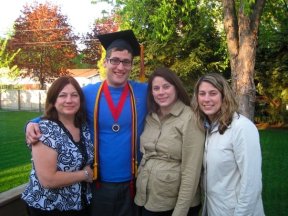
Graduation PhotoThe first question I always get asked when I’m in feminist spaces is: “What inspired you to become a feminist?”  Although I could go into the various histories revolving around men’s involvement in the early stages of the women’s movement to the similarities between the LGBTQ and women’s movements, my simple answer has always relied on one person: my mother.

I’ll be the first to admit (as well as many other people who will join me in the same chorus) that my mother deserves Sainthood for having put up with all the shenanigans I have, and still continue to, put her through. From running away from our local Catholic church the moment she dropped me off at Sunday School, to swearing like a sailor on leave at a very early age in front of Father Schmidt (who still fondly remembers me and the list I brought in with me to the confessional booth). Continue reading “Truths My Mother Taught Me by John Erickson”

Flidais, Celtic Earth Goddess, Lady of the Forest and Much More by Judith Shaw

gugg jude72This year the fall equinox occurs on September 22.  In the Pagan calendar it is a time for giving thanks called Mabon.  Mabon celebrates the end of the harvest season and is a time to honor our wild nature and nature spirits. It is a day of perfect balance when the hours of daylight and darkness are equal. Mabon ushers in our journey into the dark night of winter.

Flidais (pronounced flee-ish) is a complex Celtic Goddess with many differing stories and aspects.  She represents both our domestic and our wild natures and is an appropriate Goddess to call on on this day of balance.  She first appears in the ancient mythological cycles as an Earth Mother. She was the  mother of the Irish cultivator heroes, Arden, and Bé Téite and the “she-farmers” Bé Chuille and  Dinand.   From Her they gained the power to cultivate and work the earth for the community.

Flidais, Celtic Goddess painting by Judith Shaw Continue reading “Flidais, Celtic Earth Goddess, Lady of the Forest and Much More by Judith Shaw”

An Equinoctial Ritual for Balance by Barbara Ardinger

Day and night are in balance twice a year, at the spring and fall equinoxes. (The word “equinox,” of course, comes from Latin words meaning “equal” and “night.) I think most of us will agree that balance is a good thing—after all, many of us are writing these blogs at Feminism and Religion to bring some balance to the ideas and institutions of religion. Many spiritual teachers in many faiths tell us that it’s good to bring ourselves into balance—our physical, emotional, mental, and spiritual bodies are healthier and we’re happier when they’re in balance. This is one reason we try to live healthy lives. Note that the fall equinox is also the day the sun moves into the astrological sign Libra, the symbol of which is the scale with its balance pans.

Working on achieving personal balance is a way we can act locally as we think globally. If we can get ourselves into balance, then maybe our personal balance will ripple out into our family, our extended family, our community, our church, our workplace…heck, maybe eventually into local, state, and federal governments. In this age of civil wars, terrorists, drones, and what seems like universal spying, balance is something devoutly to be wished for. And worked for. To celebrate the equinox (September 22), therefore, let’s do a modest ritual of balance. Continue reading “An Equinoctial Ritual for Balance by Barbara Ardinger”

Painting Guanyin by Angela Yarber

As hundreds of thousands of people are dying in Syria and myriad individuals suffer from political unrest in Egypt, as we continue to debate the sexuality of young women (yes, we’re still talking about Miley Cyrus) in the face of America’s rape culture and as countless nameless victims are ravaged by war, poverty, racism, and violence, I sometimes find myself overwhelmed, as though my two hands are never enough to reach out, help, rage, change.  And I find myself—and our world—in need of mercy and compassion.  Since I always focus on one of my Holy Woman Icons with a folk feminist twist, I am drawn this month to the Goddess of Mercy.  So, Guanyin joins this great cloud of witnesses who inspire, embolden, and surround us: Virginia Woolf , the Shulamite, Mary Daly, Baby Suggs, Pachamama and Gaia, Frida Kahlo, Salome, Guadalupe and Mary, Fatima, Sojourner Truth, Saraswati, Jarena Lee, Isadora Duncan, Miriam, Lilith, and Georgia O’Keeffe.

In English we know Guanyin as the Goddess of Mercy and Compassion.  Generally regarded among East Asian devotees as originating from Avalokitesvara, her name is shortened from Guanshiyin, which means “One who hears the sounds/cries of the world.”  In the Lotus Sutra, Avalokitesvara is a bodhisattva who is androgynous and can take on the form of any female, male, adult, child, human, or non-human sentient being in order to teach the Dharma.  Typically she is depicted in female form and she is widely venerated by East Asian Buddhists.  Though she is particularly poignant for Buddhists, Guanyin is present in almost every facet of Chinese religion, from Buddhism to Taoism to shrines for local fishermen. Continue reading “Painting Guanyin by Angela Yarber”

September: Holy Month by Barbara Ardinger

The Venerable Bede (673–735), a Christian scholar and historian of Anglo-Saxon England who lived 200 years before Beowulf was written, describes the heathen beliefs and customs of his time. Because his interest is in converting the pagans, however, he says that Haligmonath is called “holy month” because that’s when “the heathens pay tribute to their devil.” The real reason the month is holy probably lies in the harvest and the thanksgiving feasts celebrated in honor of the gods and goddesses of the earth. Harvest Home (the final harvest) was celebrated in September in England and other lands.

Goddess Ceres-Demeter PlaqThe Angles, Saxons, and Jutes were pre-Christian tribes who lived in northern Germany and the Baltic lands. The most famous leaders of the Jutes were Hengist and Horsa, whose names roughly translate as “horse” and “mare.” These Germanic tribes were invading and settling in Britain about the time King Arthur (or whoever the tribal chief was who was amalgamated into the medieval legends of Arthur) might have lived. This was during the fifth and sixth centuries, about the same time as the Merovingians (of Holy Blood Holy Grail fame) were ruling the Franks of Germany and France and St. Brigit (also the goddess Brigid) was founding her abbey in Cill Dara (known today as Kildare) in Ireland. Starting with Edward Gibbon’s History of the Decline and Fall of the Roman Empire (published ca. 1776), historians have been calling the centuries following the fall of the Rome the Dark Ages. This is when civilization somehow came to a halt, they say, and barbarian tribes galloped around looting and pillaging and destroying cities. Peter S. Wells disagrees. Continue reading “September: Holy Month by Barbara Ardinger”

In Dreams I Trust by Annette Allen

AnnetteGrowing up in an agnostic family in 1950’s Britain, I did not hear religion discussed.  So it seemed odd that my parents sent my brothers and me to Sunday school.  At home, as I was battling my father’s constant criticism and jealousy towards Eric, my younger brother, learning about Jesus thrilled me.   Jesus seemed to love and value young children – what a hero!

Moving to Addis Ababa, Ethiopia, in 1962, deepened my faith.   At Nazareth School for Girls, I practised Catholicism, recited the rosary, and devoured books about female Catholic saints. But the American sisters taught that our bodies were impure, not healthy; lustful thoughts about boys were wrong, and husbands were masters.  Worst of all, heaven didn’t have any animals.  To an innocent girl, God was now judging and condemning.  I was very confused. Continue reading “In Dreams I Trust by Annette Allen”

Stories from the Yoga Mat: Sleep as Spiritual Necessity (Part Two) by Marie Cartier

This is a follow up to my July 2013 blog: Stories from the Yoga Mat: Sleep as Spiritual Necessity.

Last month I wrote about “sleep as spiritual necessity,” and posted information about how even the Dalai Lama believes spiritual practice will suffer without sleep—and compassion must be practiced for the self—by giving the self—sleep.

If you didn’t get a chance to read that column—there is some pretty compelling evidence gathered there from an informal search of recent web articles attesting to the importance of sleep.

But, for now, let’s assume that we all agree—sleep is important and without it life is much harder than with it.

“Sleep on it.” “Things will look better in the morning.” And other common place sayings show us how much we believe in this. And yet—sleep is elusive for so many of us. So–this month I am following up with tips– including a brief yoga therapy overview to combat insomnia. Continue reading “Stories from the Yoga Mat: Sleep as Spiritual Necessity (Part Two) by Marie Cartier”

Birth Warrior by Molly

editMollyNov 083“In this culture…a woman can be made to feel foolish for emphasizing the centrality of giving birth to her identity or her personal religiousness, her ‘womanspirit…’” –Stephanie Demetrakopoulos (Listening to Our Bodies)

After the birth of my daughter in 2011, I received a small package from a Birthing from Within mentor friend. In it was a sweet little t-shirt imprinted with the words, My Mama is a Birth Warrior. The words on the shirt surrounded a labyrinth image, which I love as a metaphor for birth and life

Written on the enclosed card was the following:

Imagine a tribe in which a woman is prepared for childbirth in the same way warriors are prepared for battle. Imagine a Ceremony for this woman before she gives birth, a grand send-off with holy songs and fire. Imagine a feast, prepared just for her.

Her tribe tells her, they say to her “Go to your journey, you have prepared. We have prepared you. If you fall from your horse once or a hundred times, it does not matter. All that matters is that you come back to us, that you come home.

Throughout your journey–your labyrinth of Great Love, Great Determination, Great Faith and Great Doubt—you rode on!

The Great Tribe of Mothers welcomes you back from your birth journey with honor.

Modeling her little t-shirt.

Imagine, indeed. After I read this note I reflected that I did feel I embarked on a mighty journey during my last pregnancy, I did pass through those Gates, and I did ride on. I AM a birth warrior!  Continue reading “Birth Warrior by Molly”

On Fasting and Feminism by Ivy Helman

headshotOn July 16th, I fasted for Tisha b’Av, when Jews commemorate the destructions of the temples in Jerusalem among other events.  On July 23rd I attended, as a member of GLILA, iftar, hosted by the Tolerance and Dialogue Student Association of UMass Lowell.  Iftar is the traditional nightly break-fast dinner during the month of Ramadan.  On Saturday, July 27th, I read in the Boston Globe an obituary of a sixteen-year-old girl who lost her battle with anorexia nervosa.  That small paragraph obituary gave me pause.  I have literally spent this last month steeped in mine or my friends’ religious practices of fasting.  That young woman spent much of her last years of her life fasting to the point of death.   How does a religious feminist respond?

Religious fasts regularly praise the virtues of self-denial and self-sacrifice.  Abstention from food is thought to be spiritually purifying.  The theology of fasting frequently seeks to humble the adherent in which the practitioner seeks to garner favor or be seen as worthy in the eyes of the divine.  Fasting, especially in Christianity, also separates body and mind. Continue reading “On Fasting and Feminism by Ivy Helman”