

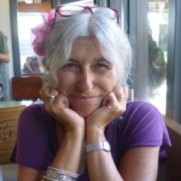
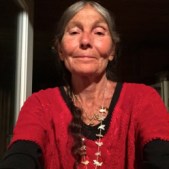
 Donna Henes, familiarly known as “Mama Donna,” is a national treasure. From her “House of Many Altars” in what she mischievously calls “Exotic Brooklyn,” she serves as an exuberant, irrepressible urban shaman: holding outdoor public rituals at each solstice and equinox for over forty years; blessing and leading New York City’s annual Halloween Parade; creating meaningful, personalized ceremonies for funerals, weddings, new babies, new homes, and new businesses. In 2009, the governor of New York State called on her to bless the fleet during the quadricentennial celebration of Henry Hudson’s voyage to the New World. She is the author of five books, including The Queen of Myself and Celestially Auspicious Occasions, and publishes a monthly e-newsletter, The Queen’s Chronicles, that offers “meaning, moxie, and magic for midlife women.”
In her most recent book, Bless This House: Creating Sacred Space Where You Live, Work & Travel (Ixia Press, 2018), Mama Donna generously shares her house-blessing “secrets”—revealing that they are not secrets after all. Demystifying the blessing process, the book details everything you need to know to “claim and consecrate” your own house with “authority and aplomb.” Continue reading “Bless This House: Creating Sacred Space Where You Live, Work & Travel by Mama Donna Henes – A Book Review by Joyce Zonana”
 It was Sunday, April 1, with grilled corn and veggie-dogs and a day gardening with friends and neighbors. Each household with their own raised bed. We started seeds and planted starter plants. We spent all day outside, various friends and neighbors stopping by at different times of the day. This was my effort at a new practice of spirituality – to touch something green every day. Perhaps not the most obvious starting point, but it was what I could do.
 The passing of my mother was very sudden. At the young age of fifty-six, I thought I had many years to spend with her so I hadn’t worried that any conversation with my mom would also be our last. Now when I look back, I wish I would have treated every word I spoke to her so delicately, as if those words would be the last she would ever hear from me, but I suppose that is why they say hind sight is 20/20.
 When the word “matriarchy” is spoken, the first question that comes up is: what about men? Most people imagine that matriarchy must oppress men—just as patriarchy oppresses women. Sadly, concern about the oppression of women in patriarchy is less automatic.
 My birthday was last Wednesday. Perhaps more than any other time of the year (yes, even more than Rosh Hashanah and Yom Kippur), the days and weeks leading up to my birthday are filled with personal reflection. Not that religious and secular new years don’t give me pause to reflect, but I think the lack of buzz around this personal event seems to offer me more space and time to think.
 It seems to me to be appropriate that since I’ve received so many ideas to consider, wondrous gifts, and thought-provoking insights from many of the essays, poems, and stories in the Feminism and Religion blogs, I should also give something in return. One of the most precious gifts that I can offer is my writing. So. . .
 How do we respect materialistic/mechanistic science – the myth of our time – when it continues to use non-human sentient beings for it’s own gain?
 Feminism and Religion