


It started with Pelé, the Hawai’ian Volcano Goddess who governs fire, lightning, volcanoes, and the flow of lava. When my little family set off on a big adventure in June 2015, I knew I’d research and paint her as a Holy Woman Icon, but I wanted to get to Hawai’i first so that I could experience her power firsthand. After three months volunteering without running water in Vermont, a month in southern Virginia’s finest fall foliage, and a holiday season traversing the country from east to west in a camper named Freya, we crossed the Pacific in search of Pelé.
The long-term goal of nearly two years of full-time travel was to discern next steps for our queer little family, and to find land to open an intersectionally ecofeminist retreat center. We always imagined returning to the southeast, likely buying land and creating the retreat center in the North Carolina mountains. Pelé had something else in store.
After three wild months volunteering on the Big Island, we fell in love, enlivened by this place we now call home: its beauty, the diversity of people, access to living off-grid, access to growing your own food, its rich culture and history, access to a vegan lifestyle, and the ability to live the majority of our life outside. In short, all of our plans were upended and recreated in the most beautiful and challenging ways because we knew Hawai’i must become our home. Continue reading “Painting, Privilege, and “Going Tiny” in Hawai’i by Angela Yarber”
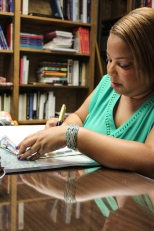

 One of the first things my American friends and family ask me when they learn I used to be married to an Indian man is: was it an arranged marriage? I understand the intrigue, the bewilderment and even horror that the phrase “arranged marriage” can conjure up in unfamiliar Western minds. Images of forcing women to marry strangers encountered upon the street or child betrothals or women being dragged to the wedding site to be married off to mustachioed men are likely to flash before one’s eyes. While such incidents may have occurred from time to time, and in the past, as with child marriages, the long-established concept of “arranged marriage” is very different and not as frightening as may seem.
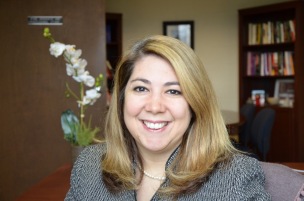 The Handmaid’s Tale on Hulu has become my latest guilty pleasure. I rarely watch television and when I do my channel is set to MSNBC. But the news has been almost too much to handle. I still find myself living in disbelief that we are a nation under the Trump Administration. And it seems that if you miss one day of the news cycle, you’ve missed a year with all the Trumptastic failures that continue to arise.
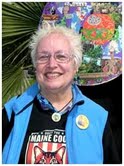 This year the summer solstice occurs on Tuesday, June 20 in the Northern Hemisphere. (In the Southern Hemisphere, it’s the winter solstice and it occurs on June 21.) For us in the Northern Hemisphere, the summer solstice is the longest day of the year. The word “solstice” means “sun stands still.” It’s when the sun reaches its highest point in the sky and seems to stand in the same place before it begins moving toward the winter solstice. We like to think that the primary solar deity is Apollo, but there’s a whole crew of solar gods who are born near the winter solstice and live for a season in great honor, after which they’re sacrificed, spend a season underground, and are reborn.
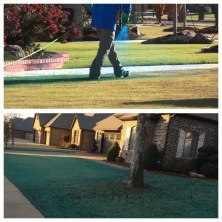 If Gaia is a living body, why are we painting her blue? Whether it is public parks or residential lawns, when there is that special odor in the air, I know to look down and there it is, an endless dye job on the grass indicating treatment. My city is concrete and blue dye for miles. Furthermore, I have sales people knocking at my door monthly asking if I want to spray pesticide around the house to decimate wasps, ants and spiders.
 Parvati is a gentle mother goddess. But as Kali, she also wields enormous power. The daughter of Himavan, the king of the Himalayas, consort of Lord Shiva, and mother of Ganesha, the Elephant-Headed Lord, Parvati is the embodiment of all the energy in the universe. Her seat is on a lion or a tiger. In the words of a hymn to this goddess, she is “the auspiciousness of all that is auspicious.”
 Last month, I attended a series of workshops on self-care, family dynamics, and recovery from complex trauma. In one session, someone asked the facilitator, a counselor with over 30 years of experience in mental health fields, how to balance faith, confidence, and belief in recovery with the reality that sometimes healing can be a rocky road, with missteps, false starts, and restarts. The counselor noted that one of the key concepts he’s reinforced in working with people on their recoveries is that to keep moving forward – to forgive ourselves when we make mistakes, to not give up on ourselves when old patterns resurface, to sustain the energy needed to continue The Work in the face of obstacles, doubt, and fear – we need to be able to hold two truths at once. We need to expand ourselves such that we can hold two realities – that our hope in ourselves is not misplaced, that we are strong and can overcome adversity, and that we can move through our lives with grace and skill; and also that we may slip up and fall short of our ideals, that we sometimes may feel fragile and overwhelmed, and that recovery (from trauma, grief, substance abuse, or illness) may include steps backward intermixed with the forward movement.
 PART II

