
Woman in religion is a story. This means that all that is said about women in all religions, as well as from social and natural sciences, institutions and the media is a story, a story that is the product of the interaction of mechanisms of power, authority, and performative actions. If gender is a discourse with cultural signifiers, then the “feminine” and “women” in the religious field are too. Speech about women has functioned in patriarchal structures historically, and still now, as a mechanism of control, discipline. and punishment.
In my experience, the situation of women in Islam is generally addressed from two opposing and dominant discourses that I call: The “Idealization of Inequality” and “Demonization.” The “Idealization of Inequality” view argues that the Quran elevated the position of women from a terrible condition of objectification in the pre-Islamic Arab society, also called the age of ignorance or Jahiliyya, a time in which many girls were killed at birth, to a state of full equality and recognition of rights. According to this approach, feminism has no place in Islam. Nothing should be changed. No new hermeneutics must be allowed, since the only differences between men and women stem from biology: women can conceive, men have more physical force. But this does not mean that one is below the other, because, under the “cosmological equality” established by the revelation, the lives of women and men are equal before Allah.
The “Idealization of Inequality” view represents a hegemonic discourse that lacks a strong and coherent response to the prevalence of discriminatory practices against Muslim women based on differences beyond their biological nature: such as the prohibiting women from entering or speaking in some mosques, not allowing women to hold positions of spiritual and administrative leadership, and requiring women to worship in segregated spaces with separate entrances. None of these are related to the “equality” they attribute to the Quran. Nor does the “Idealization of Inequality” standpoint provide real and concrete answers to the other issues affecting Muslim women: institutional violence, racism, stereotypes, and the sexist burden of common narratives.
The “Demonization” view, on the other hand, argues that, with respect to religion, it is not possible to speak of the liberation of women. So all kind of activism or feminist initiatives coming from or seeking background in religion are oxymorons. Accordingly, there would not be Catholic, Muslim, or Mormon feminism or the possibility to develop feminist hermeneutics that can be taken seriously. An important feature of the “Demonization” argument is the assumed axiom of a fundamental difference between East and West, pitting the rationality of “we” against the irrationality of “them,” and the analysis of “our” development versus “their” underdevelopment: reaffirming the western identity as superior. And here lies its most egregious shortcoming: “Demonization” acts as judge and jury in regard to the description of the oppression of all women perceived as “other.” First, it places them in the category of otherness, and then it defines the causes of discrimination suffered by them in their societies. Finally, it gives “us” the messianic ability to save “those” women. Continue reading “Islamophobia and Two Tales about Muslim Women by Vanessa Rivera de la Fuente”


 “All children are our children.” As I was posting my recent blog about the shooting of black men by the police, these words came into my mind with the force of revelation. At the time I was looking at a photograph of Philando Castile, taken at his place of work. Yes, I thought, my heart opening: “he is my child too.” This widening of the heart is at the center of the maternal values of ancient and contemporary matriarchal cultures around the world. It is a feeling some of us who were mothered well enough or who mothered children—including children not our own—carry within us. Is this the healing balm our world needs today?
 Since beginning her posts for FAR four years ago, Elizabeth has featured an excerpt from my
  I have entitled this post
 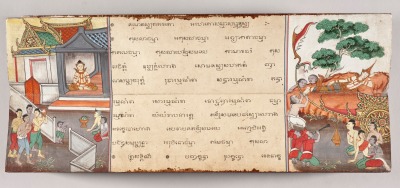 One of the most popular texts in Thai Buddhism (which is of Theravada tradition) is called
  I often recall the time many years ago when a relative sympathized with the fact that my kittie had been spayed. Pigou was one of five girl cats we had and rather than face the difficult task of having to find homes for all of their offspring, or worse, put their lives in danger for lack of adequate care, we decided to get Mama Cat along with her four daughters fixed. My aunt’s words still resonate in my ears: “That is so sad. After all, every woman nurtures a desire to be a mother.” I remember feeling terrible. My parents and I had just committed the grave sin of severing Pigou (along with her sisters) from her identity – her natural role of mother. As I have gotten older, my views on Pigou and her lack of choice in the whole matter have changed, although I acknowledge that it may remain an ethical issue for some. Much as I empathize, however, Pigou and animal rights are not the center of this post, although a related topic is – that of motherhood.

 My book club recently read
 When I was in high school, I once gave a speech summarizing what I had learned about G-d through my dog. I still chuckle at the idea. I cringe sometimes and wonder what others thought of the piece. Oh, the seeming immaturity of such an idea and perhaps naiveté. I’m still embarrassed by my high school self.
 Feminism and Religion