“The Language of the Goddess” In Minoan Crete by Carol P. Christ

While the “war against Marija Gimbutas,” rooted in what my friend Mara Keller calls “theaphobia,” is being waged in the academy, her theories continue to unlock the meaning of hundreds of thousands of artifacts from the culture she named “Old Europe.”

According to Gimbutas, the Neolithic and Chalcolithic cultures of Old Europe c. 6500-3500 BCE were peaceful, sedentary, agricultural, matrifocal and probably matrilineal, egalitarian, and worshipped the Goddess as the power of birth, death, and regeneration in human and all forms of life.  The cultures of the Old Europe contrasted with the Bronze Age cultures of the Indo-Europeans who brought the Indo-European languages and value systems to Europe and India and to all of the European colonies.  The Indo-European cultures were patriarchal, patrilineal, nomadic, horse-riding, and warlike, and worshipped the shining Gods of the sky. 

“The language of the Goddess” includes a series of signs and symbols that the people of Old Europe could “read” as surely as you and I know that a cross on top of a building marks it as Christian or that a woman wearing a star of David pendant is Jewish.  Gimbutas identified the meaning of these symbols through a painstaking process that involved comparison of artifacts, attention to where they were found, and clues from the recurrence of similar symbols in later cultures.  In twenty years of leading Goddess Pilgrimages to Crete, I have found Gimbutas’ theories an indispensible “hermeneutical principle” which unlocks the meanings of the artifacts we encounter.
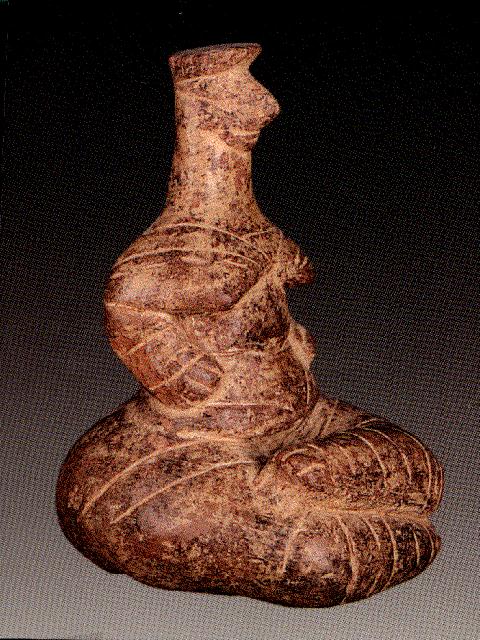
  Continue reading ““The Language of the Goddess” In Minoan Crete by Carol P. Christ”

Like Rain on Dry Land by Marcia Bedard

When first I moved to a rural mountain community near Yosemite, I was spiritually parched, and my soul felt  dry as a bone. Desperate for the rich conversations of my sisters, after taking an early retirement from the CSU Fresno Women’s Studies Program, I had an intuitive sense that I might find some like-minded women friends in a small group that met weekly at our local church, led by Diana, our courageously and outrageously feminist pastor, who has since moved on to what I hope are friendlier communities for feminist pastors.

If PFLAG, and similar marginalized groups, had found an oasis there, in what was called (in order to please the church fathers) a Women’s Bible Study Group, so could I. A year before, this would have been my last choice of groups to join, but in a town where fundamentalist churches thrived, and Starbucks was the only place you could find a copy of literature as subversive as The New York Times, it was my only choice. It was in the church basement, amidst a thinly disguised knitting/bible study group, that we gathered weekly to receive what turned out to be a truly holy (meaning wholly) communion of spirit, enriched by various reading that Diana generously shared with us. Continue reading “Like Rain on Dry Land by Marcia Bedard”

Smells Like Homeness by Erin Lane

“Tell me why it can’t be that simple,” I plead with my husband. “He needs a bed. We have a guest room.”

I am desperate for an answer that will assuage my guilt and brighten my mood. It’s more than that, though. I want an answer that will fix the problem of Michael’s homelessness, one that will ease both his pain and mine. Continue reading “Smells Like Homeness by Erin Lane”

Monthly Highlight: Mary E. Hunt

As a Catholic feminist theologian, activist, teacher, and writer Mary Hunt has made a massive impact in the field of feminism and religion.  Following the completion of her graduate education (MA, Harvard Divinity School, M.Div., Jesuit School of Theology, Ph.D., Graduate Theological Union), Mary recognized a strong need for theological, liturgical, and ethical development by and for women and responded by co-founding WATER (The Women’s Alliance for Theology, Ethics, and Water) in 1983.  Over the last 3+ decades, she has been instrumental in addressing social injustice and creating change in religion and community. Continue reading “Monthly Highlight: Mary E. Hunt”

Validating the Gospel of “Jesus’ Wife” is not Necessary to Prove Female Discipleship by Michele Stopera Freyhauf

The Gospel of “Jesus’ Wife” is certainly at the center of a battle that was last seen when questions of authenticity were raised about the James (Jesus’ brother) ossuary.  In a New York Times article, September 30th, Judith Levitt states that this document adds weight to theological and historical flaws surrounding the issue of the ordination of women.  The Vatican believes that their theology is still sound, calling the document a forgery.

The Gospel of “Jesus’ Wife.” [www.boston.com]
Frankly we do not need this document to validate the existence of female deacons and disciples – we have the biblical text and writings of the early church to validate this position.

Nor do we need this document to show that the standing from the Vatican’s point of view of ordaining women is theologically and historically flawed.

“In 1976, experts of the Pontifical Biblical Commission determined that there were no scriptural reasons preventing women’s ordination. The Congregation for the Doctrine of Faith overturned the commission’s judgment and instead wrote its own statement (Inter Insigniores, 1976) stating that women do not image Jesus who was a man; and therefore only male priests can adequately represent Christ.” – Women’s Ordination Conference

John Ortberg, in the Huffington Post, addressed a bigger issue surrounding female leadership in the Church brilliantly:

“perhaps what matters most in this discussion is the impact Jesus had — not on one woman — but on the status of women as a whole.”

Continue reading “Validating the Gospel of “Jesus’ Wife” is not Necessary to Prove Female Discipleship by Michele Stopera Freyhauf”

IN THE NEWS: Health Care, Contraception, and Religion

A case brought forth by a mining company challenging the required coverage of contraception without a copay by employer health care plans was dismissed Friday in a Missouri court.  The mining company argued that the requirement was conflicting with its owners religious beliefs.  Continue reading “IN THE NEWS: Health Care, Contraception, and Religion”

Impotent* Rage by Sara Frykenberg

Rage, for me, feels intrinsically connected to instinct, like an uncontrollable urge to fight and fly all at the same time but with no place to flee and a need to literally, physically restrain myself from the “FIGHT,” or violence I don’t want to create. 


Many feminist theorists talk about the value of anger and particularly, “women’s (diverse experiences of) anger” for consciousness raising, community building and healing.  I remember considering this concept for the first time early in graduate school.  I was both scared because I associated anger with abusive control; and curious, as I was finally learning to express this “bad” emotion.  Overall, embracing anger taught me to speak up and break out of abusive spaces.  But sharing this concept with students last semester and discussing the Bible’s descriptions of “God’s Wrath” this semester, I find myself considering levels of anger.  When is or is rage appropriate? Some of the feminist theology I have read definitely advocates for a constructive relationship to rage.  But many of my students, who can embrace the creative space of anger, had difficulty embracing this positive valuation of rage (even understanding that it is ‘what we do with our anger’ that counts).  I have recently found myself facing my own rage… And I am not sure what to think.

I often consider anger a teacher.  It shows me where my boundaries are being crossed or where injustices are rising.  I have experienced mild anger that, when mediated through humor, has helped me laugh at life and struggle.  I have experienced white-hot anger that left me unable to sleep or function “normally.”  Betrayals have dragged me out of my bed early in the morning, seeking to run/ walk so that I could breathe and think at a pace that matched the beating of my heart.  Continue reading “Impotent* Rage by Sara Frykenberg”

Why a Goddess Pilgrimage? by Carol P. Christ

What is a Goddess Pilgrimage and why are so many US, Canadian, and Australian women making pilgrimages to ancient holy places in Europe and Asia?  The simple answer is that women are seeking to connect themselves to sources of female spiritual power that they do not find at home.

Traditionally pilgrims leave home in order to journey to a place associated with spiritual power.  “Leaving home” means leaving familiar physical spaces, interrupting the routines of work and daily life, and leaving friends and family behind.  For the pilgrim, “home” is a place that has provided both comfort and a degree of discomfort that provokes the desire to embark on a journey.  The space of pilgrimage is a “liminal” or threshold space in which the supports systems of ordinary life are suspended, as Victor Turner said.  A pilgrim chooses to leave the familiar behind in order to open herself to the unfamiliar—in hopes that she will return with new insight into the meaning of her life.  Continue reading “Why a Goddess Pilgrimage? by Carol P. Christ”

Yom Kippur as Seen (With Respect) by a Pagan By Barbara Ardinger

No matter which or how many gods we believe in, thinking about what we’ve done wrong and how we can set it straight is useful. The Day of Atonement, the Talmud says, “absolves from sins against God, but not from sins against a fellow man unless the pardon of the offended person is secured.”

 Back in the Stone Age, otherwise known as the early 1980s, I had jobs as a technical writer and editor in five different industries, including aerospace and computer development. Hey, I was trained as a Shakespearean scholar, but in those days—pretty much like today—there were almost no jobs in the academy for newly-hatched Ph.D’s. So I tried technical writing. At one of the aerospace jobs, I sat in the “bullpen”—me and nineteen middle-aged white guys—whereas all the other women slaved—on typewriters in that pre-computer age—in the typing pool. There was a major class distinction in that aerospace firm, and I was glad to be with the guys. (Yes, shame on me.) Those were the days of 9 to 5. As far as I’m concerned, that movie is nonfiction. Continue reading “Yom Kippur as Seen (With Respect) by a Pagan By Barbara Ardinger”

Who is She? The Existence of an Ontological Goddess By Molly

I do feel Her presence directly in my life—call it an energy, call it the sacred feminine, call it the divine, call it source, call it soul, call it spirit, call it the great mystery…I perceive a web of relatedness and love within the world and I choose to put a feminine form to that energy—to name it and know it as Goddess.

To me, Goddess is found in the act of specifically naming that ineffable sense of the sacred that we all, universally, experience or perceive at some point during our lives. Whether it be in gazing at the ocean or in climbing a mountain, in the births of our children or the hatching of a baby chick, almost all humans experience transcendent moments of mystery, meaning, wonder, and awe. We can call these experiences by different names and I feel that the Goddess arises when we have the courage and capacity to name Her as such, rather than stay hazy, generic, or afraid.  In my own life, I call these numinous experiences Goddess and through this I know She exists in, of, around, and through the world that I live in. It is in these experiences that I touch Her directly. Continue reading “Who is She? The Existence of an Ontological Goddess By Molly”