Gratitudo et Fortitudo by Natalie Weaver

One of the bigger problems with being the only Classics major at a Jesuit university is that all my friends were fairly old men before I had even reached drinking age. Now, they are pretty much gone back to the cradle of the grave, save one, who is on his way to a remote retirement home. As a young woman, my coterie wasn’t a terrible problem for me because some deep part of my psyche had been convinced, since I was about nine years old, that I myself was an old man. I sort of felt at home reading about the Second Punic War and identifying with the sexual ramblings of the naughty old Latin poets, noting between me and my teacher-purveyors of such materials only the occasional, modest differences in skin elasticity and dental sheen.

I never felt like a girl, although, to be sure, one’s ability to assess such a thing is limited to one’s observations and conceptions about what, for example, a girl is or does or thinks. I found myself “ungirlike” in comparison with my conceptions of “girl-ness,” perhaps most notably in the operations of my mind. I felt “old” and “serious.” I remember contemplating with enormous focus the abstractions of total being and absolute nothingness from my nursery room. My big wheel was solid black, and my Dad got me into fishing and hooking live bait. I had read Nietzsche’s Beyond Good and Evil by eighth grade; my favorite book was Camus’ The Plague until it was replaced by Hesse’s more romantic investigations in Narcissus and Goldmund; and I spent my days writing philosophical poems and trying to teach myself to paint in the style of Chinese ink and wash painting. I couldn’t stand Sweet Valley High novels, and even my doll play was odd. I had a gay Ken doll, whom I named David, and his best friend was a shaven-headed Western Barbie, whose backstory was a woeful tale of drugs and topless dancing.   Continue reading “Gratitudo et Fortitudo by Natalie Weaver”
Painting Our Lady of Sorrows: Mother’s Day and Resurrection by Angela Yarber

The month of May finds those within the Christian tradition solidly within Easter season, reveling in the promise of resurrection, while simultaneously celebrating Mother’s Day. To be honest, I’d never seen much of a correlation between these two events in the past. But since my brother’s death in March, I’m viewing everything through the lens of grief, likely a new perspective that will color the way I see the world forever. Namely, until this year, I’d never really given much thought to what Jesus’ mother, Mary, was feeling in a post-resurrection world. Of course, the suffering, sorrow, and sadness of a mother who watched her child die is something that most Christian churches highlight during Holy Week, on Good Friday, or even on Easter Sunday. But then our liturgy shifts, as though Mary transitioned from weeping at the gruesome death of her child one day and then suddenly celebrates the reality of resurrection the next. At the risk of extreme blasphemy—a place where I consistently reside—when I place myself in Mary’s shoes as a mother, resurrection kinda sucks. Continue reading “Painting Our Lady of Sorrows: Mother’s Day and Resurrection by Angela Yarber”

The Bird No Longer Perches by Esther Nelson

esther-nelsonExcept for a couple of Dr. Phil shows, I have not watched TV since last November’s presidential election. I don’t want to be assaulted by the images of men (and a few women) occupying positions of power and leadership in the United States. I’m still outraged that so many inept, mean people are at the helm, being led, at least symbolically, by the “tweeter-in-chief.” I struggled for weeks after the election to achieve some balance. I cried. I raged. I signed petitions. I marched in protest. After the frenzy of all that physical and emotional activity, I have calmed down.

I’ve accepted the inevitable (and unnecessary) suffering—animals, humans, the Earth—that the new administration appears inured to and hell bent on continuing. I’m not hopeful things will improve. Continue reading “The Bird No Longer Perches by Esther Nelson”

Painting a Goddess of Grief by Angela Yarber

In many ways, I’ve thought of the myriad Holy Women Icons I’ve painted as mediators, guides who accompany us, women who have shown us the way. Whether they enliven us to create, inspire us to sustain, or embolden us to empower, these holy women have taught me to rage, praise, hope, endure, persist, love, and laugh. Recently, though, I discovered that none of the Holy Women Icons I’ve researched, written about, or painted have helped me to grieve. Surely, many have experienced grief, or give us tools for coping with the grieving process, but no Goddesses of Grief filled my heart when I needed it most.
Last month, amidst my worries about walls and bans and words that exclude, grief came along and sucker punched me in such a way that I continue to grasp for mediators, guides, and ways to cope amidst tremendous sadness. On March 6, 2017 my little brother, Carl, died. An addict for much of his adulthood, his recent addiction began spiraling out of control over a year ago and he refused to go to rehab. My family worked hard to try and reach out to him, to open him up, to offer him support, but he refused to let anyone in, drowning his anguish in blackouts and overdoses. Though we filled his life with tremendous love, he also experienced pain—externally and internally—that he never shared with anyone. The drug of choice for the past year—duster—runs the risk of cutting off the oxygen to the brain every time it is used; in fact, there are instances of people dying the first time using duster. And this is precisely what happened when my mother found my brother. My beloved single-mom, Mary, became Our Lady of Sorrows, as she held the lifeless body of her 33 year-old son. Our lives will never be the same and the grief is overwhelming. Continue reading “Painting a Goddess of Grief by Angela Yarber”

A Letter to Those I’ve Lost by John Erickson

Out of all of these things, the one thing that has kept coming to my mind is G-d. What is he (or she) thinking? I feel like I’m back in one of my Old Testament classes discussing the harsh and cruel G-d that thrust so many horrible things onto their believers. Maybe, the worst part about the election isn’t Donald Trump, but it is the realization that G-d may be dead after all.

Dear [Insert Name Here],

Something died on November 8, 2016, and I do not think I’ll ever be able to get it back. I sat there, walking back to my house, in disbelief and utter shock and scared about the next 4 years of my life.

For weeks leading up to the election, I had found myself praying in the copy room at my work almost daily. I would sit there, silent and alone, having just read some misleading article or alt-right post from a family member that called Hillary Clinton the devil, and wonder: when did everything go so off the rails?

Although we’ll spend years trying to figure the answer to my above question out, for me, it is a question I have been asking myself ever since election night and specifically knowing how certain members of my family would, and ultimately did, vote. Continue reading “A Letter to Those I’ve Lost by John Erickson”

The Reason for Hope Is the Creative Process of Life by Carol P. Christ

carol p. christ photo michael bakasIn these these days when many of us are gripped by paralyzing despair as we come to terms with the election as President of a racist, sexist bigot who has created a climate of fear and promises to undo much of the progressive legislation of the past fifty years, I find it appropriate to reiterate an insight that has sustained me through many years of sadness and disappointment about the state of our world.
“Hope is not to be found in optimism so much as in a primal understanding of what matters most.” In other words, the reason for hope is not to be found in the knowledge or rational calculation that our efforts will succeed in saving life on earth but rather in the conviction or inner knowing that it is right to try. Continue reading “The Reason for Hope Is the Creative Process of Life by Carol P. Christ”

Priestess as Shamanic Path – Part 2 by Molly Remer

This is a continuation of Molly’s piece from Wednesday, 10 August 2016. You can read Part 1 here.

After explaining that the homebirth of her second son was her, “first initiation into the Goddess…even though at that time I didn’t consciously know of Her,” Monica Sjoo writing in an anthology of priestess essays called Voices of the 567bGoddess, explains:

The Birthing Woman is the original shaman. She brings the ancestral spirit being into this realm while risking her life doing so. No wonder that the most ancient temples were the sacred birth places and that the priestesses of the Mother were also midwives, healers, astrologers and guides to the souls of the dying. Women bridge the borderline realms between life and death and in the past have therefore always been the oracles, sibyls, mediums and wise women…

…the power of original creation thinking is connected to the power of mothering. Motherhood is ritually powerful and of great spiritual and occult competence because bearing, like bleeding, is a transformative magical act. It is the power of ritual magic, the power of thought or mind, that gives rise to biological organisms as well as to social organizations, cultures and transformations of all kinds… (page unknown).

I have been a childbirth educator since 2006 and I have given birth five times. Each birth brought me the gift of a profound sense of my own inherent worth and value. It was the shamanic journey through the death-birth of my tiny third child, however, that ushered in a new sense of my own spirituality and that involved a profound almost near-death experience for me. After passing through this intense, initiatory crisis, the direction and focus of my life and work changed and deepened. Shortly after the death-birth of my third son, I wrote: Continue reading “Priestess as Shamanic Path – Part 2 by Molly Remer”

Priestess as Shamanic Path – Part 1 by Molly Remer

It is late autumn, 2009. I am 30 years old and pregnant with my third baby. He dies during the early Mollyblessingway 045part of my second trimester and I give birth to him in my bathroom, on my own with only my husband as witness. The blood comes, welling up over my fingers and spilling from my body in clots the size of grapefruits. I feel myself losing consciousness and am unable to distinguish whether I am fainting or dying. As my mom drives me to the emergency room, I lie on the back seat, humming: “Woman am I. spirit am I. I am the infinite within my soul. I have no beginning and I have no end. All this I am,” so that my husband and mother will know I am still alive.
I do not die.

This crisis in my life and the complicated and dark walk through grief is a spiritual catalyst for me. A turning point in my understanding of myself, my purpose, my identity, and my spirituality.

It is my 31st birthday. May 3rd. My baby’s due date. I go to the labyrinth in my front yard alone and walk through my labor with him, remembering, releasing, letting go of the stored up body memory of his pregnancy. I am not pregnant with him anymore. I have given birth. This pregnancy is over. I walk the labyrinth singing and when I emerge, I make a formal pledge, a dedication of service and commitment to the Goddess. I do not yet identify myself verbally as a priestess, but this is where the vow of my heart begins.

I do not know at the time, but less than two weeks later, I discover I am in fact pregnant with my daughter, my precious treasure of a rainbow baby girl who is born into my own hands on my living room floor the next winter. As I greet her, I cry, “you’re alive! You’re alive! There’s nothing wrong with me!” and feel a wild, sweet relief and painful joy like I have never experienced before.

Continue reading “Priestess as Shamanic Path – Part 1 by Molly Remer”

#OrlandoStrong: Yes, Baby, the Gay Bar is Still Our Church – Still Our Religion by Marie Cartier

Marie Cartier photo by: Greg Zabilski

The worst gun massacre in United States history happened in a gay bar, PULSE, Sunday, June 12, 2016 in Orlando, CA.

It happened during the United States Pride month of June which commemorates the Stonewall riots of June 1969. The Stonewall riot was the first televised riot over a period of time (approximately one week) allowing members and supporters of the LGBTQ community to join the protests against police violence and harassment.

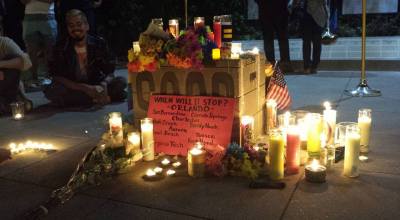
Today’s many social media platforms allow us to respond more quickly than they were able to in 1969. By the eve of June 12, 2016 memorials and vigils were happening around the country. I attended one in Long Beach, CA, at which a couple hundred folks lit candles, sang and mourned. By the following evening I was at a vigil for Orlando in Los Angeles attended by many thousands at which, in Los Angeles style, the reading of the victims’ names began with an emotional tribute to the victims by Lady Gaga. I have included here a video of the reading of the names.

Long Beach vigil
Long Beach vigil

Continue reading “#OrlandoStrong: Yes, Baby, the Gay Bar is Still Our Church – Still Our Religion by Marie Cartier”

Remember by John Erickson

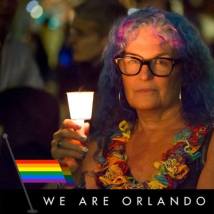
Remember the loss, because we’re going to need it for the tomorrows to come and for those that need our protection the most: the next generation. Remember, we are Orlando; now, tomorrow, and always.

WEHO CA (June 7, 2015)©2015 Rebecca Dru Photography All Rights Reserved http://www.rebeccadru.com

I want to tell you a short story about the small town of Ripon, WI. On May 19, the local newspaper, The Ripon Commonwealth, which has served as the town’s paper since 1864, published a story regarding the political right’s uproar concerning President Barack Obama’s executive order that all public schools must allow transgender individuals to use the bathroom which matches that of their gender identity. Angry and upset, the paper’s education reporter wrote an article expressing his clear disdain for the President and also expressing a clear lack of empathy, understanding and sheer bigotry towards the transgender community.

Growing up in Ripon, I always read the paper when it came out on Wednesday evenings. Those of you who grew up in a small town can attest to the luxury of seeing friends, family members, and even the smallest ongoings in one’s town in print for the entire town to see and talk about. However, one thing I never saw in the paper was the clear hate I read in Mr. Becker’s article (the author of said piece). Enraged, I immediately asked myself: what can I do? Having connections back in Wisconsin, I immediately turned to friends who owned businesses, a friend who is the Director of a vocal and important group in the town, and community organizations and friends to begin to write letters. Continue reading “Remember by John Erickson”