Pretzels: The cruelty behind patriarchal women in positions of power by Sara Wright

” I would say it’s not just patriarchal men in power. The patriarchal women in power are doing plenty of damage as well. The cruel choices are deliberate and to see the pretzels they turn themselves into to justify the cruelty is a sight to behold.”
Janet Rudolph

During the last year I have been repeatedly betrayed by women. In retrospect my mother initiated me into woman betrayal by terrorizing a sensitive little girl by threatening to send her away if she wasn’t ‘good’. My terror of all women and my mother’s skepticism/dismissal of my grandmother as an ‘old woman’ whose opinions didn’t matter eroded my relationship with my grandmother that followed me into adulthood with catastrophic effects.

 My fear kept me separate from the comfort of developing friendships with any woman until I became a feminist (yet I felt like an orphan when my grandmother died so my love for her survived).

 I came to feminism through the back door through my love for Nature, the only real mother I have ever known. My love for animals, plants, trees, did their best to sustain me although I was very lonely. It is important to acknowledge that I also chose to be alone because I seemed to have so little in common with women in general (my 50 percent). 

Continue reading “Pretzels: The cruelty behind patriarchal women in positions of power by Sara Wright”

Medieval Bhakti Women Saints: Early Voices of Feminism by Sonal Jakhar

Long before the first wave of feminism in the mid-nineteenth century had its initial launch, a well-established religious movement sparked a socio-political awakening in India. The processes of social and cultural integration in the bhakti tradition have significantly reshaped medieval Indian society. To understand the reclamation inherent in the bhakti movement, one must first acknowledge the ‘dominant power structure’ that prevailed.

The orthodox Brahmanical hierarchy (the priestly class) enforced a strict monopoly over religious ceremonies, temple access, and sacred texts. On the other hand, spiritual knowledge was bound within Sanskrit, a language only upper-class men could learn. The bhakti movement arose from a desire for a direct relationship with God while rejecting society’s rules and rituals. Women and marginalised castes were heavily oppressed and restricted from public spheres. Since religious space was the only space available to women in the early medieval period, many women embraced bhakti (devotion), and it eventually provided them space to define their own voices that revised society, relationships and religions.

The bhakti movement, since its emergence in the 7th century in South India, had a seismic impact on women and marginalised groups. Ideas of inclusivity, accessibility, and connectivity were running through reforms and resistance. A small but steadily growing group of thinkers called for the democratisation of the Divine against the social hierarchy in religious practises. Many women supported this reform with resilience, as they knew that change, whether conservative or revolutionary, would inevitably shape gender relations and advance women’s rights.

Continue reading “Medieval Bhakti Women Saints: Early Voices of Feminism by Sonal Jakhar”

The Turning of the Wheel by Sara Wright

Today Grace enters. The air is clear, the window open. One hummingbird hovers at my window. Every twig is covered with lush green leaves and every time I gaze into the green, I feel that gratitude pulsing through me – the wonder of being alive. A brilliant green frog inhabits my toad pond. Last night a Datura blossom literally opened before my eyes etched with pale lavender – a moonflower of exquisite fragrance and beauty. If anything, I appreciate these moon blossoms more than I did in the desert.

My bee garden is humming, saturated with crimson, deep orange, yellow, pink, a cacophony of color and sound. I say sound because I also imagine that I can hear the flowers singing their song of abundance, gratitude, and praise to all there is…

The first lemon lily pods are ripening, green apples bend the trees low, grapevines are heavy with new fruit, and columbine spikes are bursting with seed that I scatter between the cracks of   stones. Diminutive pale pink poppies keep popping out of a tangle of ajuga runners and fledglings hug the cabin.  The forest birds have quieted. Some will soon be migrating but stillness blotted out the forest trills when the deadly smoke first filtered in. Little gold birds flit back and forth, sunbursts singing up the dawn. The Mourning Dove waits for me at twilight…

Continue reading “The Turning of the Wheel by Sara Wright”

Maiden, Mother, Crone: The Anthology by Madeleine White

Introduction: When I last wrote for Feminism and Religion, I shared some of the experiences that led me to write Maiden Mother Crone, a memoir in verse exploring trauma, motherhood, addiction, recovery, hope and the search for more inclusive forms of spiritual expression.

That personal journey has now opened into a wider conversation.

Maiden Mother Crone: The Anthology, published by Sea Crow Press and co-edited by me and Sea Crow Press founder and publisher Mary Petiet, is the third and culminating volume in my Crossing Places series. Drawn from around 150 submissions and developed through workshops in the UK and internationally, it brings together poets from across cultures, generations and geographies to explore body, memory, land, love, loss, motherhood, daughterhood, ageing, renewal, courage and hope.

While responding to Mary’s questions about the anthology, I found myself returning to Bosorka, a statue I encountered recently in Bratislava. Created in memory of the women and men persecuted and killed after being accused of witchcraft, she seemed to embody many of the questions at the heart of the collection: whose voices are heard, whose experiences are mistrusted or erased, and how poetry and storytelling can help us remember, bear witness and create connection.

Continue reading “Maiden, Mother, Crone: The Anthology by Madeleine White”

THE COURAGE TO BE HATED by Esther Nelson

Carla Power, a prolific journalist, has written a long-awaited, insightful biography of amina wadud (b. 1952) titled THE LADY IMAM HOW AMINA WADUD’S LIFE AND FAITH CHANGED THE WORLD (One World 2026).  (Because the Arabic alphabet uses no capital lettering, amina chooses to be consistent with that script by not capitalizing her name.) 

amina and I were colleagues from the mid-1990s through the mid-2000s at Virginia Commonwealth University, Richmond, Virginia, where she was a Professor of Islamic Studies.  In this essay, I want to highlight some anecdotes from Carla’s book as well as offer some of my own reflections about amina.  This essay is not intended to be a book review, but a tribute to someone who learned to navigate her life with grace in spite of myriad  difficulties which included diagnoses of bipolar disorder and ADD/ADHD.

Notwithstanding the many words written and videos made about amina, she herself (in addition to chapters in books and essays) has written the following two books:

QUR’AN AND WOMAN  REREADING THE SACRED TEXT FROM A WOMAN’S PERSPECTIVE, Oxford University Press 1999.

INSIDE THE GENDER JIHAD:  WOMEN’S REFORM IN ISLAM, a book that demonstrates that “jihad” (to struggle) encompasses something well beyond the popular understanding of “holy war.”  Oxford: Oneworld, 2006.

Continue reading “THE COURAGE TO BE HATED by Esther Nelson”

Congratulations to Comunidad: LGBTQ Catholic Ministry by Marie Cartier

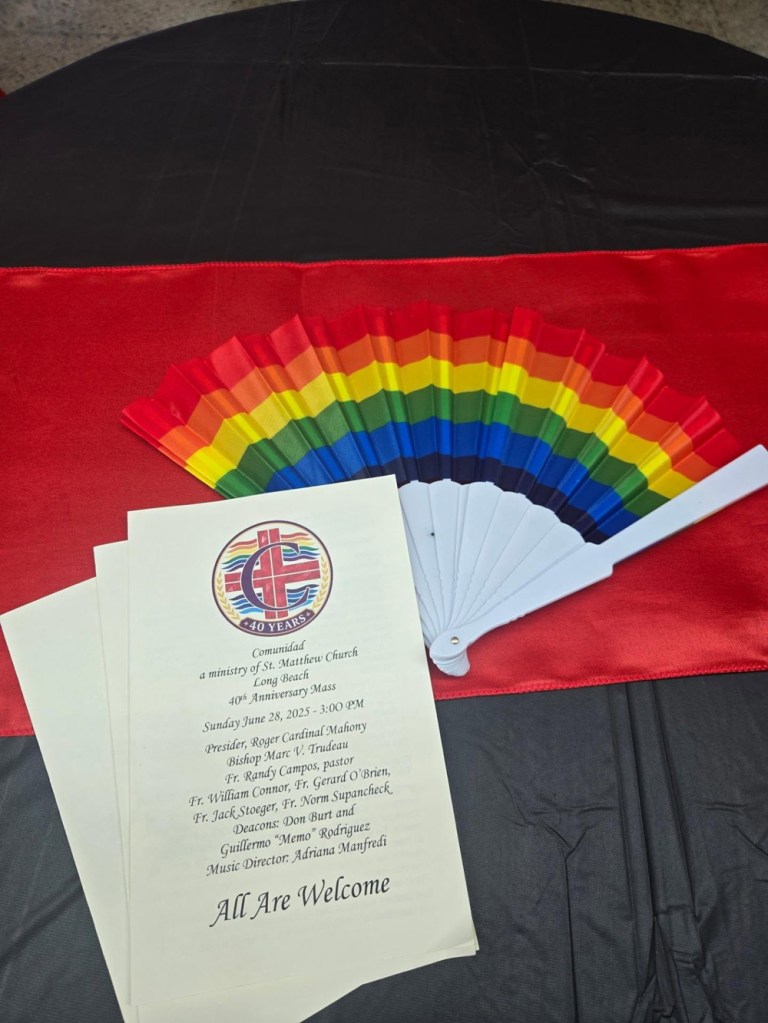
Congratulations to Comunidad ministry for LGBTQ+ Catholics at Saint Mathews in Long Beach, CA, Saint Mathews Church – for forty years of service!!! I have been involved with them (and even on the board for over two terms) for two of those decades.

Cardinal Mahony presided at the Anniversary Mass. I cried while singing, with everyone, “And I will raise you up.”  It is just so moving as a queer Catholic to be *recognized*. ☆○☆ To be seen. “Here I am , Lord.” To be seen.

And I am also an ordained priestess in the Temple of Isis, have practiced Buddhism and other spiritual traditions…but the faith tradition of my birth has a huge cultural pull. ♡ And was crucial to my work on my book Baby, You Are My Religion: Women, Gay Bars and Theology Pre-Stonewall. (Note: The book is coming out in 2027 as a completely revised 2nd edition with a new subtitle: Baby, You Are My Religion: The Lesbian Bar as Sacred Space. )

Continue reading “Congratulations to Comunidad: LGBTQ Catholic Ministry by Marie Cartier”

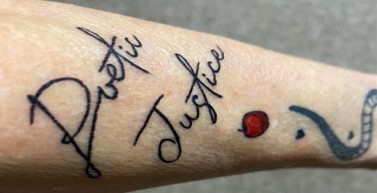
Soul-Fully Scripting Flesh: Poetic Justice & Joy by Margot Van Sluytman

Ours is a city of abundant tattoo shops. Places, I was to learn, where art and heart are rife. Places in which rich conversations occur. Conversations that linger long after the ink has begun to settle.

Wending my way to find the place to begin the process of scripting my skin, I spoke with a young man. His back was bent as he focussed on his animal friend and for a short while, before approaching him with my questions, I read the ink that covered his arms and legs. So many designs, descriptors, expressive strokes of thought and meaning known only to him. Hieroglyphs wherein his voice, his many selves, were revealed, yet hidden unless conversation were struck and desire to speak forthcoming. Wherefrom grew his choices?

I decided to cross the street and to ask him the meaning of some of his tattoos, the ones that spoke most vocally to me. As I moved closer, I spotted the script on his wrist. Script among an array of the colours and images. That script struck me. A fragment from The Tempest. Caliban’s words.

Be not afeard; the isle is full of
noises,
Sounds and sweet airs that give
delight and hurt not.
 

Continue reading “Soul-Fully Scripting Flesh: Poetic Justice & Joy by Margot Van Sluytman”

She Changes Everything She Touches: A Reflection on Love and Loss, part 2 by Sara Wright

part 1 was posted last week, you can read it here.

How much I like clipping by hand. Surprised by this realization I feel satisfaction rising. I was bored by this task as a child. I am delighted to meet a bevy of fat nubbly toads who appear out of the overgrown ground covers and in between sun warmed stones. Both child and ‘old woman’ feel happy that none will get mowed down by a polluting gas guzzling machine. The Peace of this Land that we belong to steals over us. Less is more. I’ll tackle the patch of bracken later, or maybe not until tomorrow. In this weather   accomplishing one simple chore a day is enough.

Well not quite. I am creating a serpentine path of fieldstone that stretches from my front door to meet the path that climbs the hill. My original intention was to have someone ‘more professional’ do the work, but they were too busy so here I am, an almost eighty-one-year-old woman, creating a mosaic out of cracked stone! ‘I am the artist’ I say, as I carry a few more irregular rocks down from the huge pile sitting in front of the garage eyeing the mosaic for the perfect fit. Illumination strikes when wind hits the stones. Blowing seeds, withered crabapple bits, pine needles and leaves into the cracks I see what is happening. Small plants like violets, creeping charlie, ground ivy, and catmint will find niches in the soil that is being created before my eyes.  Mosses will follow in the shade. Ah, Nature is going to help me craft a unique and imaginative fieldstone floor. Each time it rains the stones flatten out becoming more stable. That same feeling of satisfaction steals over me again. Vaguely I think that I may be doing something else besides laying stones in an artistic way and trusting that Nature will fill in the cracks, but I am not clear just what this might be. All I know is that it doesn’t matter how long this project takes. Process has taken precedence. This much feels just right.

Continue reading “She Changes Everything She Touches: A Reflection on Love and Loss, part 2 by Sara Wright”

Smoke by Beth Bartlett

Perhaps we all are standing on the borderlands – left standing in the debris of our consumptive and violent past, walking toward a future we cannot see but can feel in every cell of our bodies as this global fever is creating a world on fire that is reaching each one of us. How do we find our way home? What will it take to change us and, in so doing, change society?

-Terry Tempest Williams

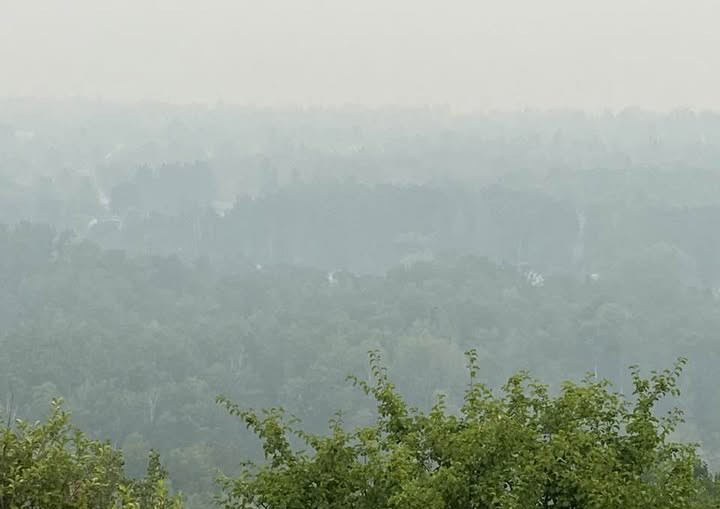
Photo by Beth Bartlett

We awoke Wednesday morning to thick, thick smoke.  It looked like the more typical fog that often engulfs us in the early morning, but the faint whiff of smoke even inside with windows closed was unmistakable.  One step outside and the smoke was overwhelming – like sitting next to a large campfire with the wind blowing the smoke in my direction.  As I was starting to cough, I put the baby in his highchair and headed to the basement to get the air purifier.  As soon as I plugged it in the indicator light turned red, meaning very dirty air.  Fortunately, it quickly cleared the air, but any time we opened a door the light immediately turned purple. 

At the moment, in this land of clean water and clear skies, we are experiencing some of the worst air quality anywhere in the world.  In the past few days, the Air Quality Index (AQI) on my EPA app has registered over 1100, far higher than the threshold for “Hazardous” air, which is 301.  The entire east coast and Midwest have been under air quality alerts from the fires in Canada, but where I live — Duluth, Minnesota — has had the worst air from the fires just a hundred miles to our north.  Oddly, the air here is actually worse than in the towns that have been evacuated due to the fires.  It’s the worst air ever experienced here.  Even inside, the air purifiers are struggling to keep up.

Continue reading “Smoke by Beth Bartlett”

Grief, Grace, and the Eco-Feminist Legacy of Katherine Paterson’s Bridge to Terabithia, part 2 by Elanur Williams

Part 1 was posted yesterday.

The Fridging Paradox

Jesse and Leslie’s autonomy is structurally threatened by the narrative’s conclusion, and Leslie’s sudden death invites a critique of the “fridging” trope, a term derived from the comic book industry describing the practice of injuring or killing a female character primarily to serve as a plot device for a male character’s emotional development. Named after a 1994 comic book scene in The Green Lantern where a hero discovers his murdered girlfriend in a refrigerator, the term critiques the tendency in fiction to treat female characters as disposable tools for male growth rather than as autonomous individuals with their own arcs.

In Bridge to Terabithia, this sacrifice unfolds in three critical movements:

  1. The Intersection of the Boundary: When the narrative notes, “The rain had been falling all night… the creek would be angry,” it signals the reassertion of the physical world. The creek acts as the boundary between the wild sanctuary and the dangerous, restrictive reality. By having the creek kill her, the text suggests that the “wild” or “feminine” space is inherently dangerous and incompatible with long-term survival.
  1. The Reduction to Catalyst: In the aftermath, the text frames Leslie’s existence through her utility to Jesse. He realizes “it was up to him to pay back to the world in beauty and caring what Leslie had loaned him in vision and strength.” This is the core of the “fridging” critique; Leslie is explicitly framed as a “loaned” object, and as a resource for Jesse, rather than a person with her own trajectory.
  2. The Post-Death Domesticization: Finally, Jesse assumes control: “He had to teach May Belle, for he was the king of Terabithia, and it was his duty to pass on the crown.” This shift in language marks the institutionalization of their anarchic space. By bringing May Belle in, Jesse settles the “frontier,” turning a radical, feminist space into a legacy for the next generation, effectively cementing Leslie as a relic of the past.

This tension is most visible in how the forest is described. When Leslie is alive, the forest is an active, creative force. Paterson describes how “Leslie had turned into a beautiful wild creature.” Yet, after she is dead, the forest becomes a site of mourning and memory, described as “still, and the creek was clear and cool.”

Would the novel have been more or less feminist if Leslie had lived? Does her death (within the context of a 1970s children’s book) actually provide the only way for a “non-conforming” girl to be fully accepted by the patriarchal structures of Lark Creek?

To view Leslie solely as a plot device is to overlook the novel’s sophisticated, often brutal, exploration of grief as a catalyst for moral maturity. While the “fridging” critique highlights a structural reliance on her death, one might argue Paterson is engaging in a deeper inquiry regarding the necessity of loss in the formation of the self. In this light, Leslie’s death serves not to diminish her agency, but to transition the novel from a fantasy of escapism into a somber, realistic lesson on the burden of growth. She is not merely a tool for Jesse’s development; rather, her death forces the permanent integration of her radical, imaginative spirit into the “real” world. By “loaning” him her vision, Leslie ensures her feminist influence survives her physical body, compelling Jesse to carry that disruptive, egalitarian force into a resistant, patriarchal landscape. She becomes an internalized mentor, suggesting that a true feminist impact is measured by how deeply one’s vision survives in those who remain. Terabithia ceases to be a secret getaway and becomes a foundation for the transformation of others.

It’s also important to keep in mind Paterson writes from a place of deep, personal vulnerability. She began the novel to help her son process the sudden death of his best friend. When we realize this, the “fridging” trope takes on a different hue. While the structural critique holds, it is also an attempt by an author to offer healing for her son.

The Secular Saint: Aesthetic Grace and Mentorship

Some may argue Miss Edmunds serves as the narrative’s secular saint of aesthetic grace. By treating Jesse’s art with profound respect, she acts as a bridge to a wider world, a living testament that one can exist within a rural community without being confined by its rigid gendered expectations. She provides institutional permission for Jesse to value his own sensitivity, effectively acting as the precursor to the creative sanctuary he will later build. While Leslie represents the collaborative, anarchic spirit of childhood, Miss Edmunds offers a glimpse of that same autonomy realized in adulthood. She is the professional, self-actualized woman of the story, and her presence proves to Jesse there is an alternative way to be, an existence defined by the pursuit of beauty and individual purpose.

Looking back, I can see how Leslie’s golden room and her expansive approach to faith taught me one of my first lessons in feminism, religion, and spirituality. It showed me that the borders we build, whether between countries, genders, or theological doctrines, are often artificial. Although the narrative’s reliance on “fridging” reveals a patriarchal constraint, the legacy of Leslie’s vision remains, and continues to inspire.

This piece is part of a series of explorations on children’s literature, spirituality and feminism by Elanur Williams. FAR has posted several of them.
Two pieces on The Chronicles of Narnia which you can read here and here.
Anne of Green Gables which you can read here.

Bibliography and Recommended Reading:

Escaping to Nature: Ecofeminism in the Children’s Book Bridge to Terabithia, by Anandayu Suri Ardini (2023):

https://www.researchgate.net/publication/372862789_Escaping_to_Nature_Ecofeminism_in_the_Children’s_Book_Bridge_to_Terabithia

BIO: Elanur Williams writes from Dublin, Ireland. She holds an MPhil in Children’s Literature and a MS Ed in Literacy Studies. She is a teacher who specializes in reading and writing instruction, as well as a poet whose work has appeared in Eunoia Review, the Ekphrastic Review, Halfway Down the Stairs, and Cosmic Daffodil, among others. Above all, she is inspired daily by her daughter, whose presence imbues her life with joy, magic, and a sense of limitless possibility.