“Free-Speech or Speech-Free?” by Kile Jones

Kile Jones, atheist[This post is written in response to the chilling effect taking place in the U.K. since the Woolwich Attack.  It is also in response to the uses of the Public Order Act of 1986.]

In any “liberal democracy” that has constitutional protections for “free speech,” there will also be laws against “inciting violence,” “hate speech,” “threats,” “slander,” “libel,” “harassment,” and other “speech codes.”  This is because the government, or those who voted on the passing of such laws, worry about the potential threat un-regulated speech will have on the levels of violence and disharmony in society.  They worry about people being able to yell “fire!” in a theatre, which can cause (which is a key word here for legal reasons) physical harm, not being held liable for such speech.  As much as I understand these worries, I am of the opinion that the potential evils brought about by a lassez-faire approach to speech morally outweigh the evils of blasphemy laws and censorship. Continue reading ““Free-Speech or Speech-Free?” by Kile Jones”

Thanks for Coming (Out): Sexuality, Sports, and Spirituality by John Erickson

I have to be honest, Jason Collins’ admission that he was a homosexual, albeit brave, upset me. While coming out is an completely unique experience to every individual that does it, Jason Collins’ story was just another example of the rampant sexist and heteropatriarachal world that privileges male bodies and sexualities over women’s similar experiences. While I applaud Jason’s story and it’s timing, the first thing I asked to my colleagues was: Where was the hubbub over Sheryl Swoopes or Martina Navratilova?

John Erickson, sports, coming out. Like marking off items on a proverbial checklist, closeted LGBTQ individuals who exist within and outside of the world of professional sports, can recount the numerous things they struggle with in terms of their sexuality.  From fearing of the actual coming out process, dressing in their car or at home to avoid the subtle glances and whispers of individuals in the locker room, to wondering what coming out would mean not only for their game but also for their social and, if they choose, spiritual lives, closeted and out LGBTQ individuals within the multi-billion dollar professional sports industry must grapple with that age old question: what does it mean to be gay and open about it?

The Locker Room

I have to be honest, Jason Collins’ admission that he is a homosexual, albeit brave, upset me.  While I understand that coming out is an completely unique experience to every individual who does it, for me Jason Collins’ story was also an example of the rampant sexist and heteropatriarachal world that privileges male bodies and sexualities over those of women.  While I applaud Jason’s story and the timing, the first thing I asked to my colleagues was: where was the same hubbub over Sheryl Swoopes or Martina Navratilova? Continue reading “Thanks for Coming (Out): Sexuality, Sports, and Spirituality by John Erickson”

(Femen)ism? by Kile Jones

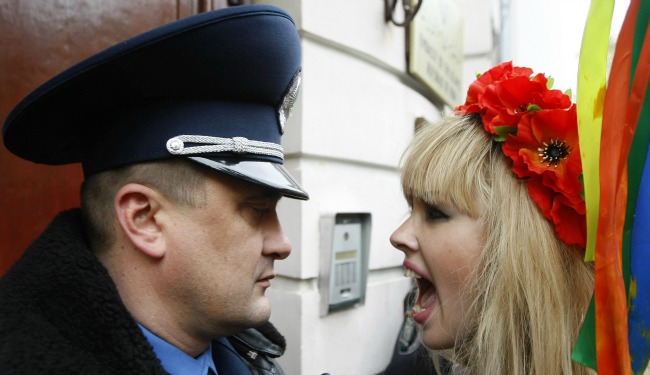
Kile Jones, atheistAs most of us are aware by now, there is a “feminist-sextremist” group from Ukraine called “Femen.”  This group has been very controversial by their public demonstrations of nudity, the words they paint on their bodies, and their explicit condemnations of political structures and organized religions.  They were started by Anna Hutsol in 2008 and have now spread throughout Europe and the Middle East.  The question I pose for this post is: Does Femen harness or hinder the power of the feminist critique?

Image from Konstantin Chernichkin/Reuters

Femen is precisely the kind of movement that pushes us in our understanding of feminism, the means by which it is best expressed, and the issues surrounding moral condemnation and religious sensitivity. Continue reading “(Femen)ism? by Kile Jones”

Birth Announcement: Baby, You Are My Religion by Marie Cartier

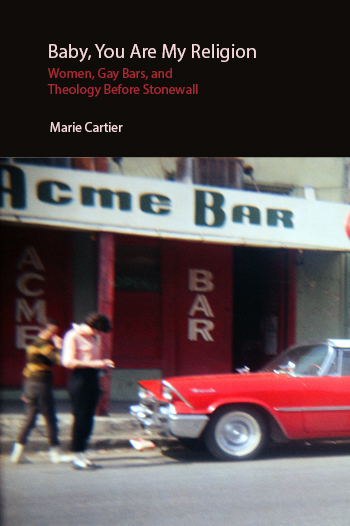
I want to proudly (not shamelessly) announce the upcoming birth of my book! Baby, You Are My Religion: Women, Gay Bars and Theology Before Stonewall will be published by Acumen Press, fall 2013 (October). However, it will not have the cover that is on the book as it is advertised now. I had problems with this cover as it depicts gay contemporary women in a country setting, not pre-Stonewall women in an urban setting, or identity. The photo below is the proposed (and accepted) new cover image, designed by my wife Kimberly Esslinger. And while we don’t know if the book cover will look exactly like this, the publishers are excited about this cover choice image.

 I realized as I advocated for another cover—that my book is my baby. As I sought out another image and worked to negotiate and obtain the rights for it, I realized how protective I was of my book/my baby. I am giving birth to the projects I’ve stored inside myself—I, who never gave birth to biological children, give birth now to this book. I want to have this baby and I want to protect it and set it free to do its work in the world; nurture it and cheer it on as it sets forth to do great things; hold it close and watch it fly.
New Proposed Book Cover: Carolyn Weathers in front of the ACME bar, gay bar in San Antonio, Texas, 1961.

I realized as I advocated for another cover that my book is my baby. As I sought out another image and worked to negotiate and obtain the rights for it, I realized how protective I was of my book/my baby. I am giving birth to the projects I’ve stored inside myself—I, who never gave birth to biological children, give birth now to this book. I want to have this baby and I want to protect it and set it free to do its work in the world; nurture it and cheer it on as it sets forth to do great things; hold it close and watch it fly.  Continue reading “Birth Announcement: Baby, You Are My Religion by Marie Cartier”

Incarnating the Mystery with Psychological Awareness by Jean Benedict Raffa

image010As a college professor I taught Children’s Literature. Mythology, stories about humanity’s relationship with the gods, always raised a few eyebrows. Students tended to feel uncomfortable when this term was applied to their own faith traditions since it generally connotes “untrue.” So I found it helpful to note up front that myths are not necessarily literally or historically true, but they’re always psychologically and spiritually true.

From his extensive study of myths, psychologist Carl Jung concluded that we are all born with a “religious function,” an inherent sense of awe about, and longing to connect with the Sacred Mystery of life. He saw it as a faculty of our central archetype, the Self: our core and circumference, our god-image.  Myths, rituals and religious symbols are our attempts to incarnate the Self so that we can be infused with love, hope and holy wonder. Some myths are helpful in this endeavor. Others are dysfunctional; for example, myths which justify the dominance, exclusion or destruction of others considered less worthy or entitled.

When our primitive ancestors reflected on the miracle of life, the Self prompted the thought that because humanity is gendered, the Mystery must be as well.  Since Earth was the foundation of existence and had an inexhaustible fruitfulness, it felt like a Mother. This shaped our earliest images of God. Mircea Eliade noted: “In some cases, the sex of this earth divinity, this universal procreatrix—does not even have to be defined. A great many earth divinities…are bisexual. In such cases the divinity contains all the forces of creation—and this formula of polarity, of the coexistence of opposites, was to be taken up again in the loftiest of later speculation.” Continue reading “Incarnating the Mystery with Psychological Awareness by Jean Benedict Raffa”

A Pro-Science, Skeptical Woman Speaks by Kile Jones

Kile Jones, atheistIn my last post, “Feminism and Religion: Where Do I stand?” I talked about how I support an atheistic, secular, and liberal feminism that criticizes organized religion and certain religious beliefs.  After reading the comments and responding to them, I figured that having a brief interview with a woman who holds these sorts of views would be a good way to introduce them to this blog.  I met Anondah Saide at a course at Claremont Graduate University titled, “Evolution, Economics, and the Brain,” taught by the Executive Director of the Skeptics Society and Founding Publisher of Skeptic Magazine, Dr. Michael Shermer.  Anondah was the TA for the course, and I found her comments in class to promote science, reason, and skepticism towards religious and spiritual claims of all kinds.  So without further ado, here is the interview: Continue reading “A Pro-Science, Skeptical Woman Speaks by Kile Jones”

Second Class Rape Victims: Rape Hierarchy and Gender Conflict

Deconstructing masculinity isn’t the key to solving social, sexual, and domestic violence across the world but it is a step worth taking when attempting to engage men in affecting change to stop these violent actions since men, statistically are the perpetrators of such crimes that both cause such outcry as well as perpetual silence.

johnThe most disturbing part of the 2006 documentary Deliver Us from Evil isn’t the fact that Father Oliver O’Grady is rewarded by the Catholic Church with a new congregation in Ireland after his short stint in prison for the rape of dozens of children in the 1970s, but rather the hierarchy of gendered victimization which is often created throughout the various rape cases that are both reported and unreported throughout history.

I am often troubled by the ways in which rape cases are discussed and deconstructed via mediums such as blogs, online communities, social media networks, the news, and popular culture.  No series of events troubled me more than the Jerry Sandusky trial, but more importantly, the ways in which the young boys and adult men who were subjected to Sandusky’s abuse quickly overshadowed the other rape cases that are reported on a daily basis, specifically those involving young girls and women. Continue reading “Second Class Rape Victims: Rape Hierarchy and Gender Conflict”

Bringing African American Churches into Reproductive Justice by Mariam Williams

Mariam WilliamsI don’t expect to hear anything in church about the 40th anniversary of Roe v. Wade during the month of January,  the month marking 40 years since the U.S. Supreme Court made the decision to legalize abortion in this country. This is for a number of reasons: 1) it’s January, and at my church the pastor always starts off the year with a series of sermons that illustrate the church’s mission statement, and women’s choice may be off the subject; 2) Martin Luther King Jr. Day is this month, and if a black church is going to honor something or someone besides Jesus in the month of January, it should probably be MLK; and 3) I haven’t heard anything about abortion from the pulpit in a long time.

A local pro-choice movement leader asked me recently about how black churchgoers feel about abortion. I didn’t know what to say. The last time I heard it mentioned was in a Sunday School class in which a woman said that she almost aborted her daughter. It wasn’t a big confessional moment, just part of a longer testimony as to why she was happy her daughter was around, and it wasn’t received with any shock or fanfare. I can remember hearing once from the pulpit of my current church that while abortion might be wrong, the law shouldn’t interfere with what a woman chooses to do with her own body. Many years before that, in the church I grew up in, a preacher said that we would never find a cure for AIDS because the person who would have grown up to discover the cure was aborted. (What made him so sure of that? Who knows.) Continue reading “Bringing African American Churches into Reproductive Justice by Mariam Williams”

The Next Liberal Prophet: What Will She Look Like? By Amy Levin

Amy2

This past Martin Luther King, Jr. day, I was privileged enough to attend the 57th presidential inauguration at the U.S. Capitol.  Spirits were high and it seemed as if we were breathing recycled air infused with the hope of four years past.  As the President approached the stage, he appeared with the confidence of a second term sage, and yet there was a newer, fresher quality about him – purified and politically born-again. As he began to speak, the religious undertones leaped out into the pews.  Beautifully crafted in diction, rhetoric, and reference, Obama pleased and inspired his dedicated supporters. Guiding us historically through Seneca, Selma, and Stonewall, we understood the meaningful tributes toward women, African Americans, and the LGBT communities. But there was an excess – another constituent represented – God had entered the stage.

Continue reading “The Next Liberal Prophet: What Will She Look Like? By Amy Levin”

And Thus God made a Covenant with Hagar in the Wilderness by Michele Stopera Freyhauf

Freyhauf, Feminism, Religion, Durham, Old Testament, Blogger, BibleWe are familiar with the covenant God made with Abraham and Moses, but are you aware that God also made a covenant with Hagar?

In the wilderness Hagar encounters a deity at the well named Beer-lahai-roi (Genesis 16). Water and wells are important because they symbolize fertility and life. Wells for women are common places where they met their future spouses. Because wanderers in the desert need water to survive, water itself becomes a symbolic of life-giving or life.

In the seemingly barren dessert, the fertile Hagar finds out that she is pregnant and going to be the mother of many children. Hagar is promised progeny in a motherless state.  According to Pamela Tamarkin Reis, this is called the “after-me” descendants, which guarantees Hagar that her children will live for “immeasurable generations;” a pattern that fits within the scope of this promise. This same promise of progeny is also given to Eve in Genesis 3:20, providing and interesting parallelism between Eve and Hagar.

It is worth pointing out the irony exists in this promise.  Sarai uses Hagar to “build her up.” According to Nahum Sarna, to be built up in terms of the number of children that you have, implies that you are mother to a dynasty.  In this pericope, however, it is Hagar, not Sarai that is built up through this divine promise.

This patterns of promise exists within the birth narrative through the annunciation of Ishmael and the promise of progeny.  It is through this narrative that Hagar enters into a covenantal relationship with the deity.  According to J. H. Jarrell, birth narratives have six common elements that establish this relationship:  mother’s status, protest, offer, son’s future forecast, Yahweh naming, and acceptance of the contract. Hagar’s story contain these elements:

  1. Mother’s Status:  Hagar is without child because she is a virgin (16:1).
  2. Protest:  Hagar flees from her mistress (16:8).
  3. Offer:  Return to your mistress and submit to her authority (16:9).
  4. Son’s Future Forecast:  He will live at the east of all his brothers (16:12).
  5. Yahweh Naming:  You will bear a son Ishmael because the Lord has given heed to your affliction (16:11).
  6. Acceptance of the Contract:  She called the name of the Lord (16:13).

Continue reading “And Thus God made a Covenant with Hagar in the Wilderness by Michele Stopera Freyhauf”