This past Martin Luther King, Jr. day, I was privileged enough to attend the 57th presidential inauguration at the U.S. Capitol. Spirits were high and it seemed as if we were breathing recycled air infused with the hope of four years past. As the President approached the stage, he appeared with the confidence of a second term sage, and yet there was a newer, fresher quality about him – purified and politically born-again. As he began to speak, the religious undertones leaped out into the pews. Beautifully crafted in diction, rhetoric, and reference, Obama pleased and inspired his dedicated supporters. Guiding us historically through Seneca, Selma, and Stonewall, we understood the meaningful tributes toward women, African Americans, and the LGBT communities. But there was an excess – another constituent represented – God had entered the stage.
We are familiar with the covenant God made with Abraham and Moses, but are you aware that God also made a covenant with Hagar?
In the wilderness Hagar encounters a deity at the well named Beer-lahai-roi (Genesis 16). Water and wells are important because they symbolize fertility and life. Wells for women are common places where they met their future spouses. Because wanderers in the desert need water to survive, water itself becomes a symbolic of life-giving or life.
In the seemingly barren dessert, the fertile Hagar finds out that she is pregnant and going to be the mother of many children. Hagar is promised progeny in a motherless state. According to Pamela Tamarkin Reis, this is called the “after-me” descendants, which guarantees Hagar that her children will live for “immeasurable generations;” a pattern that fits within the scope of this promise. This same promise of progeny is also given to Eve in Genesis 3:20, providing and interesting parallelism between Eve and Hagar.
It is worth pointing out the irony exists in this promise. Sarai uses Hagar to “build her up.” According to Nahum Sarna, to be built up in terms of the number of children that you have, implies that you are mother to a dynasty. In this pericope, however, it is Hagar, not Sarai that is built up through this divine promise.
This patterns of promise exists within the birth narrative through the annunciation of Ishmael and the promise of progeny. It is through this narrative that Hagar enters into a covenantal relationship with the deity. According to J. H. Jarrell, birth narratives have six common elements that establish this relationship: mother’s status, protest, offer, son’s future forecast, Yahweh naming, and acceptance of the contract. Hagar’s story contain these elements:
Mother’s Status: Hagar is without child because she is a virgin (16:1).
Protest: Hagar flees from her mistress (16:8).
Offer: Return to your mistress and submit to her authority (16:9).
Son’s Future Forecast: He will live at the east of all his brothers (16:12).
Yahweh Naming: You will bear a son Ishmael because the Lord has given heed to your affliction (16:11).
Acceptance of the Contract: She called the name of the Lord (16:13).
No longer having to deconstruct the larger cultural and sexual narratives, heterosexuals who do not support marriage equality or feel threatened by homosexuals return to their one source of power that reinforces the ideology that they are on the right path: the Bible. “Marriage is between a man a woman,” or “A man shall not lie with another man as he would a woman,” becomes the newly reinforced heterosexual rallying cry and the progressive progress that occurred in the past becomes nothing more than a joke.
I must say, I will be the first to admit that the recent outbreak of videos promulgating the idea that gay men will marry a straight guy’s girlfriend or lesbians will marry a straight girl’s boyfriend all for the sake of marriage equality left me stifling my laughter as I attempted to pay attention in class.
On Thursday, November 29, 2012, the United Nations officially recognized the Palestinian Authority as a sovereign state and granted its petition for observer status within the international decision-making body. Sixty-five years before the United Nations had approved a two-state solution for the region, UN Resolution 181, that officially ended the British occupation of the territory and sanctioned the possibility of two states. It says:
“The resolution recommends that the United Kingdom (as mandatory power for Palestine) evacuate; armed forces should withdraw no later than August 1, 1948; independent Arab and Jewish States and the Special International Regime for the City of Jerusalem administered by the United Nations should come into existence; the City of Jerusalem should preserve the interests of Christian, Jewish, and Muslim faiths.”
While the Palestinian Arab population disagreed with that solution, when British forces left on August 1, 1948, Israel declared statehood. The United States recognized its statehood the same day. Russia was soon to follow suit.
I remember the election season of 1984. At the 1984 Democratic National Convention on July 18 in San Francisco, California, Jesse Jackson delivered the Keynote address, entitled “The Rainbow Coalition.” The speech called for Arab Americans, Native Americans, Asian Americans, youth, disabledveterans, small farmers, lesbians and gays to join with African Americans and Jewish Americans for a political purpose. My lover at the time woke me up very early in the morning to tell me that Jesse Jackson had said the words “lesbians and gays” as part of his speech at the Democratic Convention. I started to cry and called my mother and she cried, too. We both cried. It was a moment I will never forget…because in that moment I as a lesbian existed on national television and in the imagination and spoken word of the country’s political system where I live and pay taxes—in a way I never had before—I was spoken out loud. Continue reading “Out of the Bars and Into the Streets and ….by Marie Cartier”
It was a humid yet windy day in Broward County, South Florida. My long pants and sleeves were becoming hostile towards me as I proceeded to slip off my shoes, don my borrowed headscarf, and set up shop just outside the modest mosque in Pembroke Pines. I waited patiently for prayers to end, hoping that my “Register to Vote” sign was placed in optimal eyesight of the female worshippers as they exited the prayer hall. All of my hope to expand the Florida electorate to help re-elect President Barack Obama was bundled in my mix of clipboards, voter registration forms, pens, and volunteer sign-up sheets. Just moments after the Imam wrapped up the Friday afternoon prayers, two young women wearing full hijab sauntered out. “Oh, I’ve been meaning to register to vote,” one of them said. “Perfect.” Continue reading “Blessed Are The Organized, by Amy Levin”
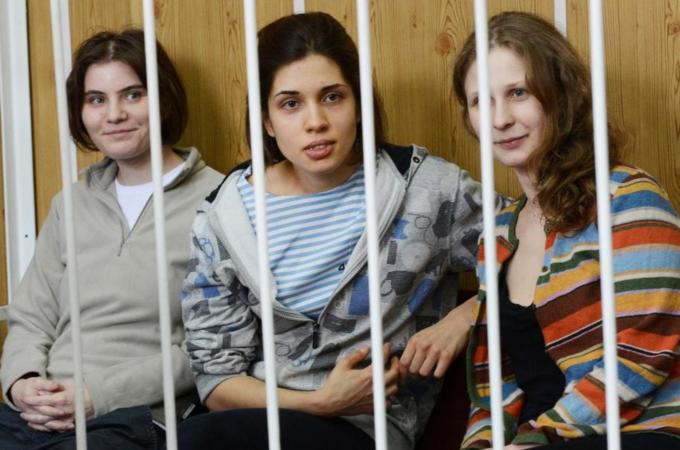
In a country that was willing to [sic] its secular court on a “religious” cause, Pussy Riot are true revolutionaries. Nonetheless, it was not until they delivered these closing statements that their supporters—and opponents—heard what these three brave women stand for. Although they are being crushed in the jaws of the system—and know it!—their courage and steadfast sincerity are sufficient cause for (impossible) hope. If not for the Russian state, then at least for the Russian people. —Bela Shayevich
“When religion puts people in jail it’s unjust” – David Gross
The intermix of religion and politics are familiar, especially after this year’s presidential election. Many supported Mitt Romney out of concern for religious freedom; a stance that had the potential to marry religion and politics in a dysfunctional union. We also witnessed a veiled attempt by the Catholic Church to emphasize and sway the faithful to vote for the one true moral candidate; a stance contradicted by Obama’s ability to carry the Catholic vote. I believe what we see in Russia is a shining example that shows what happens when regulations and laws do not segregate between secular law and church law. Freedoms do not exist, rather, rules and restrictions are imposed creating an institutional prison.
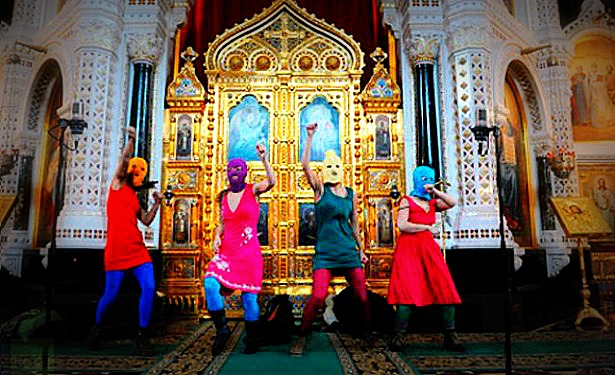
The prosecution of an all girl punk band named Pussy Riot [i] demonstrates a “complete fusion of the institutions of the state and church,” which devalues “women’s rights and freedom of speech.”Members of Pussy Riot are serving a two year sentence of hard labor for “hooliganism motivated by religious hatred.” What was their crime? They went into a Cathedral in Moscow and started singing a punk prayer – “Mother of God, Chase Putin Out!”
They danced, kneeled, and crossed themselves in front of the Church’s high altar. This occurred the day before the re-election of Vladimir Putin. While I do not support going into a sacred space with relics to make a protest, what I find problematic is their harsh sentence. However, it should be noted that with the coverage of the trial and the outpouring of support received from many organizations, and musicians, they did manage to bring to the forefront issues surrounding the government and the Church.
Male feminists must be aware that we not only engage in an ongoing struggle against sexual and gender inequality, but more importantly an ongoing fight with ourselves.
I have often struggled with that little voice, call it my conscience if you will, that speaks to me during times of distress. Although I consider myself a proud feminist, I still struggle with aspects of what I call, internalized misogyny, or more aptly defined as a male born characteristic trait that imparts the idea that men are not only dominant but also more powerful than the other 50% of the species.
On Tuesday, President Obama’s acceptance speech included the following statement about coming together as a country across differences of opinion. He said, “We will disagree, sometimes fiercely about how to get [toward the future we hope for]…by itself, the recognition that we have common hopes and dreams won’t end all the gridlock or solve all our problems or substitute for the painstaking work of building consensus and making the difficult compromises needed to move this country forward…”
How do we really do this work? How do we come together across difference to make change? How do we foster productive dialogue that produces genuine and real results? In this dialogue, what principles do we use? What values do we honor? What criteria do we use to judge opinions of others? When is an opinion wrong or when is an opinion just different from our own? Continue reading “Building a Bridge toward the Future: Will You Meet Me in the Middle? By Ivy Helman”
From there he (Jesus) set out and went away to the region of Tyre. He entered a house and did not want anyone to know he was there. Yet he could not escape notice, but a woman whose little daughter had an unclean spirit immediately heard about him, and she came and bowed down at his feet. Now the woman was a Gentile, of Syrophoenician origin. She begged him to cast the demon out of her daughter. He said to her, “Let the children be fed first, for it is not fair to take the children’s food and throw it to the dogs.” But she answered him, “Sir, even the dogs under the table eat the children’s crumbs.” Then he said to her, “For saying that, you may go–the demon has left your daughter.” So she went home, found the child lying on the bed, and the demon gone. (Mark 7. 24-29)
By the time Ohio went to Obama, with his win barely confirmed, journalist and pundits were churning out commentary and statistical findings on the demographics of his larger-than-life electoral college and just-over-the-top popular vote win. Even after Fox news called it for Obama, an awkward lapse of time ticked by as the country waited for Mitt Romney’s concession speech. Turns out he had not prepared one. This political gaffe was one strategic error among many, not with-standing the entire ideology of the Republican platform that became glaringly apparent Tuesday night. While the GOP/Romney camp took the male white vote (59%), this shrinking demographic failed to be enough to secure the win. It seems along with a high Latino/a, African American, women’s vote (especially single women), in addition to a higher turnout of young people than 2008, Obama demonstrated the changing face and influence of a diversified United States of America. Continue reading “What the GOP can learn from The Syrophoenician Woman by Cynthia Garrity-Bond”