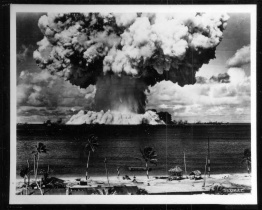
 I wish that in our pursuit of finding cures for illnesses we would do more as a collective species to prevent the causes, sometimes environmental ones. Why do we vote for people to make decisions that represent us but that we would never in a million years agree to? Bombs and the consequences of them raise questions of health and power. In the Yoga Sutras, 2.30, we read that “Yama consists of non-violence, non-lying, non-stealing, appropriate use of vital energy, and non-possessiveness.” The yamas are our social restraints. They are a negation of behaviors we might usually partake in.
Ahimsā, or non-violence, is listed first. It is the first element of the first limb of yoga; it is the basis for every other ethical aspect of our lives. Bombs are an example of a common and frequent behavior of violence that make the land, water, and sky increasingly uninhabitable. According to Micah Zenko of the Council on Foreign Relations, in 2016 alone, the U.S. is estimated to have dropped 26,172 bombs. Zenko says that this estimate is “undoubtedly low.” (1) This is one year and the bombs from one nation. (2) What is the environmental impact of all of the bombs dropped from every nation since the beginning of bombing history?
When a bomb is detonated, there is not only harm to the immediate life in that vicinity but life in the future and far away. According to the International Campaign to Abolish Weapons (ICAN) website, “the International Physicians for the Prevention of Nuclear War has estimated that roughly 2.4 million people will eventually die as a result of the atmospheric nuclear tests conducted between 1945 and 1980, which were equal in force to 29,000 Hiroshima bombs.” (5)
According to a statistic updated March 2016 on the Ploughshares Fund website, nine countries in the world have a total of 14,900 nuclear weapons, the U.S. and Russia holding 93% of them. (3) They have been used twice, both times by the United States, in war, but additionally they have been used in tests over 2,000 times in more than 60 locations over the globe, according to ICAN. (4) There are already unavoidable consequences to the earth and humans because of this irresponsible behavior that is ongoing. These tests occur in the atmosphere, under the earth, and under water. (6) Continue reading “The Trees and We Breathe Bombs Long Gone by Elisabeth Schilling”


 There is a very big elephant in the room. Apparently it is invisible because even the left is not discussing it. This elephant is the civil war in Yemen to which Saudi Arabia has contributed 19,000 (19,000!) deadly (deadly!) air strikes that have been alleged to have caused 60,000 (60,000!) civilian (civilian!) deaths (deaths!). These air strikes have been carried out with arms purchased from the US and its allies. The UN estimates that 22.2 million Yemeni civilians are in need of immediate humanitarian aid and that 13 million are at the risk of starvation. Yet a Saudi-led blockade is preventing food and other supplies from entering the country.
 This is the first part of a series of reflections on the weekly Torah portions. For those of you unfamiliar with Judaism, we read the Torah in sections. There are 52 parshot (or portions), one parshah (portion) is read each week (most often during Shabbat morning services). It is common for rabbis, prayer leaders or someone of the congregation to offer reflections on the week’s parshah at Shabbat services.
 Recently I need to take a deep breath every time I glance at the news headlines. There are terror attacks and military conflicts. People kill each other and cause each other immense suffering. The worst thing is that so many of these conflicts are between people who have lived side by side for centuries: between related ethnic groups or neighbouring people.
 Just last week I was dumbfounded when an acquaintance told me that his philosopher partner calls a woman leading a workshop on labyrinths “a tree hugger.” “What,” I wanted to say, “is wrong with being a tree hugger? Are we not all interdependent in the web of life? Why should we imagine that trees or the cells of trees have no feelings at all?” But the tone of contempt and dismissal in the man’s voice told me that I would only be creating another “fuss,” the kind that can make me persona non grata among the ex-pats in my village.
 In these these days when many of us are gripped by paralyzing despair as we come to terms with the election as President of a racist, sexist bigot who has created a climate of fear and promises to undo much of the progressive legislation of the past fifty years, I find it appropriate to reiterate an insight that has sustained me through many years of sadness and disappointment about the state of our world.
 It is now Monday morning, five days after the new President was elected, despite losing the popular vote.
 When I was a little boy I was terrified that I would live to experience the end of the world. Whether it was by an asteroid, Y2K, or a zombie plague, I would make myself sick by picturing these horrible things that could befall me and my family. Although I was a precocious child, the crippling fear that would lurch its way up my stomach and into my head would sometimes make it impossible to sleep at night. While I like to think I grew out of that phase, I now sit here feeling that way again. I’m crippled with fear that the end of the world is at hand and there may be nothing we can do to stop it. How will the world end? No, it isn’t Lucifer himself coming from hell to bring in the end times, it is someone far worse, and his name is Donald Trump.
 Killing us slowly with your rules.
