Bent on Kindness by Esther Nelson

Recently, with some fear and trepidation, I underwent spinal surgery.  When the surgeon visited me the day after my operation, he assured me that the procedure was a success, even though it will take several weeks to ascertain whether or not the surgery relieved my symptoms.  Healing from such a procedure takes time.

I have nothing but praise for the dozens of people responsible for my care during my six-day hospitalization.  Nurses, nursing care helpers, my surgeon along with the team in the operating suite, doctors-in-training, physical therapy workers, occupational therapy people, cleaning personnel, and the folks who regularly brought me healthy and delicious meals—all of them were respectful, empathetic, and kind.  And they were not kind just to me.  I overheard several hospital employees reply thoughtfully and considerately to a pugnacious patient in the room next to mine.

Continue reading “Bent on Kindness by Esther Nelson”

Liam Neeson and White Toxic Masculinity by Janet Maika’i Rudolph

Several weeks ago, Liam Neeson was doing a press tour for his latest movie. He caused quite a stir by bringing up an event from his life from 40 years ago. Actually, it was an event that happened not to him but to a female friend. She had been raped and characterized the rapist as “a black man.” In typical male bravado, he took offense and set off to act out a what has been called “a racist revenge fantasy” by taking a weapon and looking for a black man to beat up and/or kill.

Here is a link to an article of his interview.

I am in a fairly unique position to respond as I myself was raped at knifepoint also about 40 years ago. On second thought, and truly sadly, it is unlikely that I am in a unique position. Rape is the coin of violence. It is used in war, arguments, power plays, where our bodies become the battlefield on which such violence is played out. There is truly nothing sexual about it.

Here is what rape does to the psyche. It tells us that our bodies are for someone else’s ephemeral pleasure, not our own. It tells us that we are not safe in the face of someone, usually a male’s violent whims. It tells us that we are objects without full personhood. It slashes a hole in our core selves that fills with rage and pain instead of love and wholeness.

Continue reading “Liam Neeson and White Toxic Masculinity by Janet Maika’i Rudolph”

Dear Mary by Sara Wright

This piece was written in response to Gina Messina’s recent Feminism and Religion piece “Who is God?”

Dear Mary,

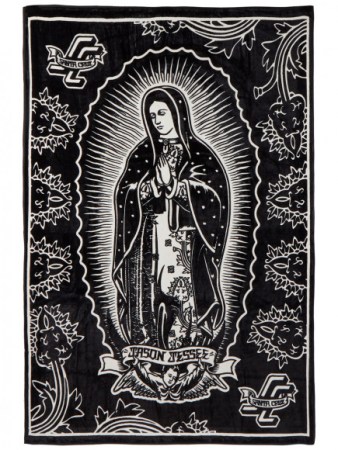
When I responded to a post on feminism and religion this morning I wrote that you were my first goddess. As a child I knew little beyond that you were the “Mother of God,” and I found your presence immensely comforting, even seeking you out in secret, entering your rose garden in a local monastery. I needed you so.

Early in adolescence I learned that your life was one of purity, sacrifice, and loss. Your purity left me bereft. How could a young Victorian girl be “good enough” to serve such a figure? I was fierce and passionate – a thorny red rose – with an empty hole in my heart.

Sadly, I released you and chose your sister the whore, the Black Goddess in disguise… but I didn’t know that then; I only knew that the “black” woman succumbed to her flesh as I did, covered herself in shame…What lies Patriarchy tells…

Continue reading “Dear Mary by Sara Wright”

A Meditation on Revolution In the Vagina Monologues by Marie Cartier

Photos by Kimberly Esslinger

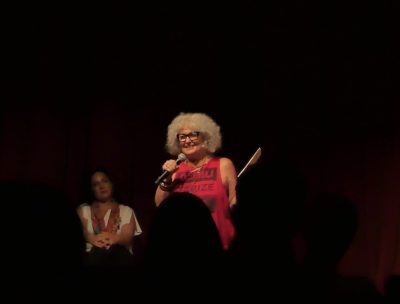
“It’s like feminist summer camp, except it’s in February,” said Shaina, the director, “I’m not sure how to re-enter the world.”

I agreed. How to re-enter the world where vaginas have little voice? Where asking a woman what her vagina would wear does not make sense. Or what would it say? It’s not just what would it say, it’s not having a voice at all.  My vagina.

I have performed in West Hollywood, California’s production of the Vagina Monologues (to benefit Planned Parenthood, check it out here and here) for the past three years. This year we raised over $5,000.

Continue reading “A Meditation on Revolution In the Vagina Monologues by Marie Cartier”

Generosity and Community: the Alternative Worldview of Women’s Ritual Dance, Part 1 by Laura Shannon

My life’s work with traditional women’s circle dances of Eastern Europe and the Near East has been a natural interweaving of feminism, activism and Goddess spirituality. In more than thirty years of experience, my students and I have gained valuable insight into their potential as tools for healing and transformation.

These simple and ancient dances connect us with women’s ritual practices from the past which are rooted in a Goddess-reverent paradigm honouring the earth, the body and the female face of the divine. In the present day, the practice of mindfully dancing traditional circle dances which embody this worldview can help us imagine and create a more equitable society in the future.

Continue reading “Generosity and Community: the Alternative Worldview of Women’s Ritual Dance, Part 1 by Laura Shannon”

The Three Mothers: Feminine Elements and the Early Kabbalah by Jill Hammer

For over ten years, I’ve been teaching a work of early Jewish mysticism known as Sefer Yetzirah, or the Book of Creation.  There are widely differing opinions on the book’s origin and dating, but many scholars date it to the sixth century.  Its core concept can be described simply: the Divine used the Hebrew letters as metaphysical channels to create the different aspects of reality: the directions, the elements, the planets, the months of the year, and so forth.  Each letter is a channel by which God creates a unique form or entity, and meditating on the letters provides us with a connection to divine creative power. In its discussion of the letters, Sefer Yetzirah shows a strong connection to feminine imagery, and thus helps the later kabbalah develop its own link to the feminine.

Sefer Yetzirah shows influences from Aristotle to Gnosticism, and is often viewed as a work of Jewish philosophy.  However, it is also a work of meditation, giving the reader instruction on how to focus and connect to the divine. Scholars such as Richard Hayman and Marla Segol have noted that the book’s structure and content connect it to magical literature: for example, the book has a deep concern with “sealing” the space of the world: letters of the Divine Name are used to seal the six directions of the universe.  In a similar way, ceremonial magicians of the ancient world used sealing ritual, including the incantation bowls that were buried in the corners of a home to keep out evil forces.  The book, like much ceremonial magic of the region, also discusses the elements.  However, Sefer Yetzirah has a three-element system rather than a four or five-element system.  The three formative elements are air, water, and fire.

Continue reading “The Three Mothers: Feminine Elements and the Early Kabbalah by Jill Hammer”

Celtic Myth, Moon Blood, and the White Beauty Standard by Marisa Goudy

My woman’s body is entering the dark time of the moon, even with blinding white snow lashing the windows, even with a full moon tracing its way far above thick clouds. My mood is black and soon I’ll be flowing red, and the snow will just drive on white, white, white.

In The White Goddess, Robert Graves tells us: “…the New Moon is the white goddess of birth and growth; the Full Moon, the red goddess of love and battle; the Old Moon, the black goddess of death and divination.”

The Celt in me feels cradled by this imagery, even if, as Judith Shaw and Carol P. Christ have pointed out elsewhere on this site, the idea of maid, mother, and crone is a modern invention, not gift from the past. I agree with Christ:  “My suggestion is that we give up the idea that the details of contemporary Goddess Spirituality are rooted in and authorized by tradition. We can instead acknowledge that though we are inspired by the past, we are the ones who are creating contemporary Goddess Spirituality.”

Continue reading “Celtic Myth, Moon Blood, and the White Beauty Standard by Marisa Goudy”

If You Can’t Flirt, Don’t Have Sex by Trelawney Grenfell-Muir

If you don’t know how to flirt, you shouldn’t be having sex with anyone.
I admit it… I used to love flirting. It can be incredibly fun. I flirted outrageously with guys I had no intention of dating, and guys flirted with me who weren’t interested in dating me. It wasn’t about sex, either. It was just awesomely fun. The only time I minded was if it turned out they were married/in a committed relationship.
Flirting is like dancing. Both people have to agree to participate. It involves a lot of asking the other person what s/he is comfortable with. Sometimes it is kind of sexual, sometimes it is beautifully spiritual or exciting intellectually. Sometimes it’s tequila body shots, sometimes it’s holding a gaze just a little longer than normal, sometimes it’s making witty but not cruel jokes at the other person’s expense. But it has to be fun, it has to be happy. Like sexual intimacy. If at any point, one party becomes uncomfortable, the other party has to back up and figure out why, and what is needed now.

Continue reading “If You Can’t Flirt, Don’t Have Sex by Trelawney Grenfell-Muir”

Why Not Me? by Marcia Mount Shoop

My “me too” went out for all to see way before Facebook existed, way before there were hash tags and internet pages for unveiling our secrets to the world. In all the years that have passed since I first spoke publicly and published about my experiences with sexual violence, there has been a steady stream of people (mostly, but not all, women) who have come to me with their #metoo.

Survivors tend to hold lots of secrets—they become heavier with time and the more the secrets stay secret, the more power they have to distort and rupture and isolate. I held mine for many years and I planned on never telling anyone. But, those memories began to disrupt my life more and more—and finally they had to come out. That was the only way I could ever be free, that is the only way I could truly be alive.

Continue reading “Why Not Me? by Marcia Mount Shoop”

The Last Time, by Molly Remer

I lie in bed with him, cementing the details in my memory. The way the morning air is heavy and green. The sound of last night’s raindrops continuing to drip from the overfull gutters on the roof. The insistent stab of a single-note bird song in the air. His head nestles in the crook of my arm the way it has done every morning for three years. Blond hair against my nose, breathing in the slightly baby smell of him. “This is the last time,” I whisper softly. “We are all done after this. This is the last time we will have nonnies.”

This is not the first last time for me, but it is the last, last time.  The first baby was born 14 years ago and gathered to my breast with all the tenderness and uncertainty and instinctiveness of a first, first. “Do you want nursies?” I whisper to that new little boy, and we begin the next steps in our bond, nursing for nearly three years, until one day, six weeks away from the birth of the next baby boy, I decide that we truly have to be done. I am a breastfeeding counselor for other nursing mothers and I feel like I should want to tandem nurse my two boys. I fondly envision their hands joining across my body, the easy love and camaraderie between them blossoming through this shared time with their mother. But, I feel an intense irritation with nursing while pregnant, nearly a sense of revulsion and the almost irresistible urge to shove away my sweet little boy as I prepare to greet the life of another. I talk to my midwife about my feelings and she explains that with her own two daughters, the agitated feeling at nursing the older one did not go away with the birth of the second, but instead became dramatically worse. After hearing this, I feel panicky and I decide we do, in fact, have to wean. He is a very verbal and precocious toddler and I am easily able to explain to him that it is time to be finished nursing. One night though, he lies in bed with me crying and begging to nurse. He says he really needs to. I tell him, “remember, we’re all done, but if you really, really need me, if you really, really still need to have nursies, you can.” He doesn’t nurse, but instead falls asleep, reassured that while our nursing relationship might be over, I’m still here.

Continue reading “The Last Time, by Molly Remer”