Legacy of Carol P. Christ: The Sacred Feminine or Goddess Feminism?

This was originally posted on January 25, 2016

Carol Molivos by Andrea Sarris 2

In recent years “the Sacred Feminine” has become interchangeable with (for some) and preferable to (for others) “Goddess” and “Goddess feminism.” The terms Goddess and feminism, it is sometimes argued, raise hackles: Is Goddess to replace God? And if so why? Does feminism imply an aggressive stance? And if so, against whom or what?

In contrast, the term “sacred feminine” (with or without caps) feels warm and fuzzy, implying love, care, and concern without invoking the G word or even the M(other) word–about which some people have mixed feelings. Advocates of the sacred feminine stand against no one, for men have their “sacred feminine” sides, while women have their “sacred masculine” sides as well.

Nothing lost, and much to be gained. Right? Wrong.

Continue reading “Legacy of Carol P. Christ: The Sacred Feminine or Goddess Feminism?”

Free Write at the Turning of the Wheel by Sara Wright

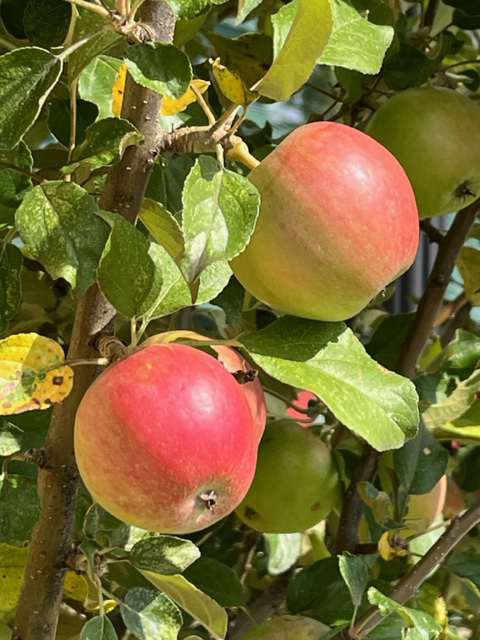
Pink plastic barbies in a pink plastic world they said it was great it was garbage insulting every feminist I know – as for ecofeminism – well it must be dead am i dead too? – how could an earth lover survive in a plastic world with plastic pink barbies I barely made two hours? -oh yes a few colors they had to didn’t they? And the hourglass figures dominated the dolls that tip over because they are so tall even without high heels – an insane movie full of patriarchal lies and this is our culture – constructed out of lies – i left in confusion – people i trusted said a “must see” – turns out one, a professor that recommended it hadn’t seen it – had been seduced by reviews – who doesn’t believe the new york times besides me ?– thick humidity greeted me at the door after the pink charade – oh something alive captures me from a ten inch tree – two rosy apples ignite a soul dead corpse – yet another torrential downpour blurred my

Continue reading “Free Write at the Turning of the Wheel by Sara Wright”

Re’eh: When Turning to Monotheism Requires Violence.

I have covered all of the Torah portions for the month of August except for Re’eh (Deuteronomy 11:26-16:17), which was the parshah for yesterday the 12th of August, 2023.  It contains discussions of idolatry, the inheritance of the land, what counts as kosher animals, the prohibition against eating blood, the sabbatical years, and a list of festivals and their observance.  As one reads, it becomes clear that the main concern of the parshah is threefold: observance; idolatry; and place.  Re’eh is more or less an argument for monotheism, one that acknowledges the existence of other gods, institutes a series of rewards and punishments to convince people to join in, and resorts to violence when people are unconvinced.  What does that mean for feminism?  We will see.

Continue reading “Re’eh: When Turning to Monotheism Requires Violence.”

Embracing the Dark Goddess – Empowering Paradigm Shifts, Part 2 by Judith Shaw

 The Dark Goddesses, with qualities that are mysterious, magical, chaotic, destructive, violent and transformational bring a wholistic understanding of ourselves and of nature. They are wild and untamed.  Today I finish up my initial dive into the Dark Goddesses which began yesterday with the publication of Part 1. Look for a more detailed look at these goddesses and more in the coming months.

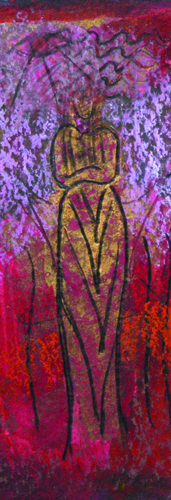
Erishkigal, Underworld Goddess

Dark goddesses are wild, free, and sexual – Lilith, Erishkigal and Medb

Lilith and Erishkigal
Long before the rise of civilization, people lived together in very different ways and Goddess was understood as the force that encompasses all life – the light and the dark. It’s very interesting that two of the world’s oldest dark goddesses – Lilith and Erishkigal –  are found in the creation story of Sumer, considered as the world’s first civilization.

Continue reading “Embracing the Dark Goddess – Empowering Paradigm Shifts, Part 2 by Judith Shaw”

Who Gets to Define What it Means to be Pro-Life? by Janet Maika’i Rudolph

The sky and sun on June 7th in the afternoon on Long Island.

Today I am coughing and choking here on Long Island because of our unhealthy air quality.  The smoke from the wildfires of Canada have reached us. We, here in NY, are not alone in dealing with air so polluted that breathing is at risk. I think of the CA wildfires, the SpaceX rocket that exploded in April, the Ohio train derailment in Feb. No place is safe.

While coughing and thinking about this, two bits of news came into my consciousness, The first was the Supreme Court ruling narrowing the scope of the Clean Water Act.

My first thought was, do they and their children not have to live in this world too?  Do they think they can buy a clean environment for themselves and their families and the rest of us be damned? 

The next report I heard was from a prominent conservative commentator who explained how “prolife” he is and went on to describe his “deep concern” for life.

Continue reading “Who Gets to Define What it Means to be Pro-Life? by Janet Maika’i Rudolph”

To Stand in the Presence of the Ancients! – Enheduanna, Part 2 by Janet Maika’i Rudolph

Yesterday I wrote about the priestess/scribe Enheduanna and her warrior/king father Sargon. I posited their connection to the codification of patriarchy. They did not invent it, as war and the diminution of women had been happening in some circles. I do wonder, however, if they furthered it along to a point of no return.

Another king of the time, Urukagina from circa 2350 bce[1] codified laws under the guise of reformation.  Some of his reforms were progressive in that they sought to protect the poorer classes against aristocracy and the priesthood.  But they also were clear to let women “know their place.” Here are the translated words from his laws:

“If a woman to a male has spoken . . .[bad] words(?) which exceed (her rank?), onto the teeth of that woman a baked brick shall be smashed, and that brick will be hung at the main gate.”

Continue reading “To Stand in the Presence of the Ancients! – Enheduanna, Part 2 by Janet Maika’i Rudolph”

To Stand in the Presence of the Ancients! – Enheduanna, Part 1 by Janet Maika’i Rudolph

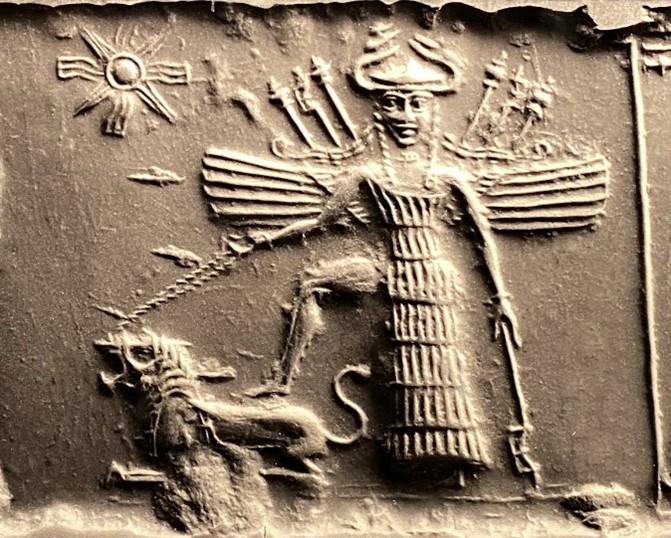
Ishtar controlling a lion ca 2334-2154 BCE

To be in the presence of antiquities is powerful. They carry an energy which is palpable.  I found this to be true at the recent exhibit at the Morgan Library in Manhattan that ran from October 14, 2022 through February 19, 2023. 

Enheduanna is a fascinating woman who lived in the lands of Mesopotamia circa the 23rd century BCE. She was a priestess who was also a writer and chronicler of her times. She named herself in her writings making her the first known author of any written works in history. She was so influential that for centuries after her death, scribes learned their craft in scribal schools by reading and copying out her work. Scholars have referred to her as the Sumerian Shakespeare[1]

Her main temple was in Ur, the very city that hundreds of years later gave rise to the biblical priestess Sarah and her husband, Abraham. We can only image how much they had been influenced by her.

Continue reading “To Stand in the Presence of the Ancients! – Enheduanna, Part 1 by Janet Maika’i Rudolph”

The Crow’s Nest by Sara Wright

 Bare tree

shadowy veil

old snow

won’t let go.

Beaded Judges

shift

spring tides

 hide

  predators

with eyes.

Crows

 reveal

 old bones…

March is the month when crows scream, screeching and mobbing as they soar through indigo skies – their harsh declarations hurt my ears though I know they are mating and nesting.

Continue reading “The Crow’s Nest by Sara Wright”

The Patriarchy Strikes Back by Janet Maika’i Rudolph

I suppose no one is all that surprised but it is still stunning how quickly certain politicians are rushing to pull back women’s rights. It’s become a race to regulate women’s bodies of with draconian and cruel laws.

Each law is more extreme than the next. In South Carolina it has even been proposed to make abortion a crime subject to the death penalty.

Commentators say the bill isn’t going anywhere.  But it was still proposed. It is now in the eco-system of abortion politics. It is being imagined and that opens up all possibilities of where it can go from here. We never thought, after all, that Roe would be overturned.

Continue reading “The Patriarchy Strikes Back by Janet Maika’i Rudolph”

Vayak’hel-Pekudei: On the Contributions and Gifts of Women by Ivy Helman.

This week’s Torah portion is a double one, Vayak’hel-Pekudei (Exodus 35:1 – 40:38 and Exodus 12:1-20).   Vayak’hel covers the construction of the Mishkan, or the temple that traveled with the Israelites while in the desert, and Pekudel outlines the requirements for Pesach, particularly the sacrificial lamb, the blood on the doorposts, and the requirement to eat unleavened bread. For this post I will focus on Vayak’hel as it is the only portion that makes direct mention of women.  It reminds us of the ways in which religion and religious institutions would not be possible without the contributions of women.

 Vayak’hel centers on the construction of the Mishkan beginning with the general assumption that everyone (here men and women) will donate the items needed to construct the Mishkan.  The text also contains verses in which women are specifically mentioned.  They donate their gold jewelry (35:22) and mirrors (38:8) as well as  spin wool and linen into yarn to be used for the Mishkan’s copious amounts of curtains  (35:25-26).  

Continue reading “Vayak’hel-Pekudei: On the Contributions and Gifts of Women by Ivy Helman.”