I am a child of the Earth.
I live and breathe, walk and dance upon Her face.
She is my source and I learn from Her each day. This I know…Life begins in the dark as Desire.
Deep in that dark place life begins to form, taking root and becoming…..As life stirs…… deep in the Mother’s Belly,
there is a gentle quickening, movement
that alerts us to a “knowing”
of the presence of something yet to come.As the Earth prepares Herself with warmth,
the rains and waters come to flood the land,
nourishing the soil in which She is creating new life.Earth and Water and Fire
come together and Form continues to take shape.One last thing is needed.
Just as new form emerges,
She breathes Air upon it.
Her Breath, giving Life to all. Continue reading “The Breath of Goddess by Deanne Quarrie”
Category: Body
Betraying Bodies by Kelly Brown Douglas
Her name was Tricia Meili. Their names were Yusef Salaam, Raymond Santana, Antron McCray, Korey Wise and Kevin Richardson. On April 19, 1989 all of their lives were irrevocably changed. They would never meet, but their lives would become forever linked. When they entered into Central Park on that night, did they know that they were stepping into a haunting history of dismembered bodies? Tragically, their bodies would become another story to be told in that history.
On that April day in history some 34 years ago one white female body went into Central Park for her routine jog. Five black and brown male teenage bodies went into Central Park to hang out, but soon became a part of a crowd engaged in mischievous if not dangerous and out-of-control harassment of other park visitors. As the night wore on, police were called and arrests were made. It would later be discovered that Tricia was brutally and sadistically raped, but not by Yusef, Raymond, Antron, Korey or Kevin. Yet, the five young teenagers were badgered into confessions, charged with the rape and sentenced to prison. Continue reading “Betraying Bodies by Kelly Brown Douglas”
Are Buddhist Women Happy? Part II by Oxana Poberejnaia
In Part I of this post I started asking questions about whether Buddhism in the West is part of patriarchy. Today I offer a possible link between practices of men’s Initiation Rites and some of the elements of Buddhism.
Men’s Initiation Rites
When we consider principle practices of Western Buddhists, primarily daily meditation and meditation retreats we might enquire something like this: since monastic practice is a model for our Western lay practice, do Buddhist monasteries constitute an extension and continuation of men’s long houses, places of men’s initiation rites?
Continue reading “Are Buddhist Women Happy? Part II by Oxana Poberejnaia”
(Femen)ism? by Kile Jones
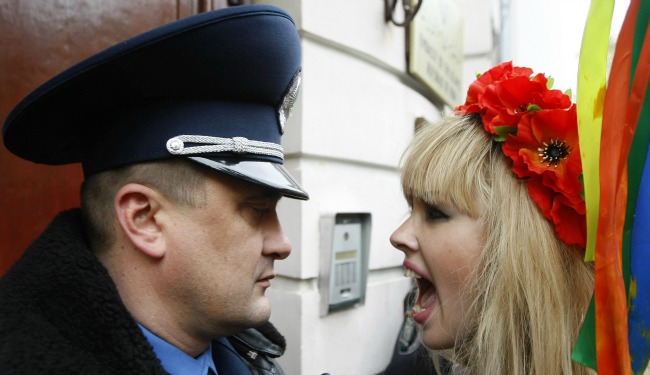
As most of us are aware by now, there is a “feminist-sextremist” group from Ukraine called “Femen.” This group has been very controversial by their public demonstrations of nudity, the words they paint on their bodies, and their explicit condemnations of political structures and organized religions. They were started by Anna Hutsol in 2008 and have now spread throughout Europe and the Middle East. The question I pose for this post is: Does Femen harness or hinder the power of the feminist critique?

Femen is precisely the kind of movement that pushes us in our understanding of feminism, the means by which it is best expressed, and the issues surrounding moral condemnation and religious sensitivity. Continue reading “(Femen)ism? by Kile Jones”
For the Love of Gaia by Jassy Watson
On January 26, 2013 a rare, devastating tornado hit our community in Queensland, Australia, a coastal town on this sub-tropical coast. My family experienced nature’s elemental force firsthand and hopefully will never again. The tornado viciously shattered houses, peeled away roofs, uplifted cars and trees, and took down power lines, tearing apart everything in its path. With absolutely no warning, literally out of the blue, it formed over the churning sea, rapidly intensifying before striking land, awakening the vulnerability and fragility of all life in its midst.
When it struck, our four kids and I were waiting in our car while my husband ducked into a mate’s house to borrow a tool. We heard the sound of a roaring jet plane overhead, as my husband came running, screaming at us to get out of the car. Turning to my left, in a vision imprinted forever, a spiral of debris flew toward us. Scrambling, we got the kids out of their harnesses and safely indoors. I lagged behind, taking care of the children first, and fell out of the side door of the van with the wind’s impact. As I got up to run, a large piece of roofing tin flew straight for my head. I dove, seeking safety under the front of our running car. My life flashed before my eyes. All of us in a state of shock, the tornado was gone as quickly as it had come, we were unscathed except for a few minor cuts and bruises. It was only a few moments before the immediate danger passed. We ventured outside to inspect the damage, destruction surrounded us. Continue reading “For the Love of Gaia by Jassy Watson”
Orientations: Body, Space, Authority by Linn Marie Tonstad
In her book Queer Phenomenology, Sara Ahmed investigates how we orient ourselves in space with respect to tables – the tables around which we sit, at which we eat with friends and families of choice and birth, and at which we write. She describes moving into a new place and arranging the furniture. “After the kitchen, the room I hope to inhabit is always the study. Or the place that I have decided is the place where I will write. There, that will be my desk. Or it could just be the writing table. It is here that I will gather my thoughts. It is here that I will write, and even write about writing. … Making a place feel like home, or becoming at home in a space, is for me about being at my table. I think fondly of Virginia Woolf’s A Room of One’s Own. How important it is, especially for women, to claim that space, to take up that space through what one does with one’s body. And so when I am at my table, I am also claiming that space, I am becoming a writer by taking up that space.” (11) Ahmed goes on to discuss how certain possibilities are opened up, and others foreclosed, by the way we orient ourselves (or find ourselves oriented) to others and to objects. She describes the bodily postures that result from orienting oneself to the writing table – the way one might hunch over one’s computer, or find oneself with ink-stained fingers.
In a very different context, the queer theologian Marcella Althaus-Reid describes a scene from her childhood in Argentina. She kneels in front of a priest for confession. But instead of kneeling to the side, aslant, as she ‘ought’ to have done, being a girl, she kneels directly in front of the priest, as if she were a boy. Kneeling here too is a form of orientation, a form of direction, a bodily habit of becoming. “Kneeling is troublesome and it has a theological referent in the church’s also troubled waters of sexuality and power. A whole symbolic sexual order is obviously manifested in kneelings as positions of subordination and sites of possible homo- and hetero- seductions, because these are theologically distributed around the axis of the priesthood’s male genitalia. The priest’s penis carries the sacred connotations of the phallus as a transcendental signifier of the theological discourses to everyday Christianity, and kneeling is a liturgical positing designed to centralise and highlight this.” (The Queer God, 11) To kneel in the right (gendered) position in relation to the priest is also to kneel in the right relation to God. Continue reading “Orientations: Body, Space, Authority by Linn Marie Tonstad”
Grief Beyond Belief and Rebecca Hensler by Kile Jones
In my last post, “A Pro-Science, Skeptical Woman Speaks” I interviewed a woman with whom I share many views in common. One of my goals here at Feminism and Religion is to introduce different secular, atheistic, liberal feminists who share many of the same ethical views as regular contributors and readers, but not the same “religious” or “spiritual” ideas. In this post I examine an online support network for unbelievers, Grief Beyond Belief, and ask a few questions to its founder, Rebecca Hensler.
I met Rebecca in February in San Francisco while on a visit I made to meet with the Unitarian Universalist Association in regards to my ordination. My girlfriend and I met Rebecca in North Beach, San Francisco for dinner and drinks. I experienced her as a compassionate, friendly, and genuine person. Her experiences and insights inspired me to think more about the role of grief and pain among unbelievers. I mean, atheists cry, agnostics experience loss, skeptics lose family members, and we do it all without a “God” or “spirit” to help us. And if we were to meet C.S. Lewis, we would make
sure to exclaim, “No…pain is not some megaphone for God to rouse a deaf world.”
Why did you start Grief Beyond Belief?
The original idea was born of my own grief. After my son died, I found a group in which to share comfort and compassion with other grieving parents: The Compassionate Friends, a mainstream parental grief support organization with a strong online presence. It was so close to exactly what I needed, but I frequently felt alienated by the religious and spiritual content — not just the offers of comfort that depended on beliefs I do not hold, but the assumption that everyone there held some sort of belief in life after death. And the assumption, so common in mainstream grief support, that even if I am not the same religion as you are, I have a religion, and I believe in some sort of afterlife was equally alienating and hurtful. Continue reading “Grief Beyond Belief and Rebecca Hensler by Kile Jones”
Your Body is the Body of the Goddess by Marie Cartier
My body is the body of the goddess—witches and shamans and other magical beings (including humans) chant this in spring ritual …and other times of the year as well.
But as we prepare for spring equinox, I thought I would use my blog this March to give the Feminism and Religion community a chakra mediation for spring ritual and renewal. Spring is here. Your body is the body of the goddess. If desired, please say the following aloud or silently, participate in the suggested breathing exercise and allow yourself to sink deeply into the body that is yours and is part of the season– the awakening of spring.
Breathe deeply: in and out; in and out; and in and out. Continue reading “Your Body is the Body of the Goddess by Marie Cartier”
Dialogues With Our Children by Kelly Brown Douglas

Son: My friends and I were stopped for going 61 mph in a 55 mph zone, frisked and had our car searched. We thought the police were going after the car of white boys in front of us going at least 70, but they stopped us instead.
Mother: It’s not the first time.
Intergenerational dialogues are key to Alice Walker’s womanist definition. This definition includes a dialogue between a mother and a daughter in which the daughter announces that she is going to Canada and taking others with her. The mother replies that she would not be the first one to make such a journey. During this Women’s History Month, I as a womanist am reminded of the dialogues that haven take place between black women and their children. These inter-generational dialogues have been fundamental to helping black children to “survive and be whole” in a world that looks down on their blackness and attempts to limit their ambitions. Continue reading “Dialogues With Our Children by Kelly Brown Douglas”
Second Class Rape Victims: Rape Hierarchy and Gender Conflict
Deconstructing masculinity isn’t the key to solving social, sexual, and domestic violence across the world but it is a step worth taking when attempting to engage men in affecting change to stop these violent actions since men, statistically are the perpetrators of such crimes that both cause such outcry as well as perpetual silence.
The most disturbing part of the 2006 documentary Deliver Us from Evil isn’t the fact that Father Oliver O’Grady is rewarded by the Catholic Church with a new congregation in Ireland after his short stint in prison for the rape of dozens of children in the 1970s, but rather the hierarchy of gendered victimization which is often created throughout the various rape cases that are both reported and unreported throughout history.
I am often troubled by the ways in which rape cases are discussed and deconstructed via mediums such as blogs, online communities, social media networks, the news, and popular culture. No series of events troubled me more than the Jerry Sandusky trial, but more importantly, the ways in which the young boys and adult men who were subjected to Sandusky’s abuse quickly overshadowed the other rape cases that are reported on a daily basis, specifically those involving young girls and women. Continue reading “Second Class Rape Victims: Rape Hierarchy and Gender Conflict”