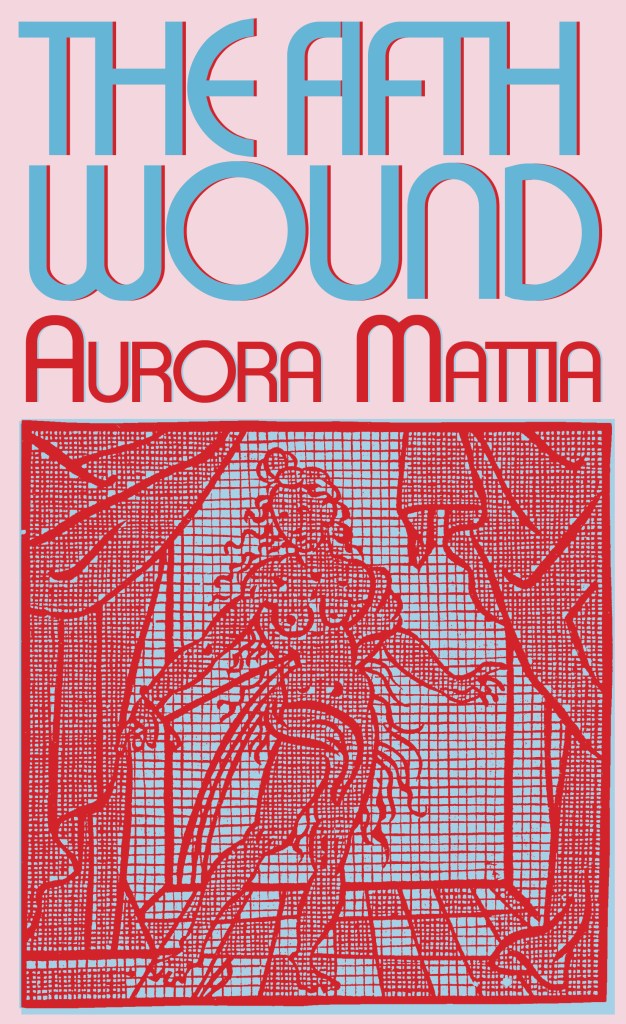
The Fifth Wound by Aurora Mattia, Book Review by Janet Maika’i Rudolph

Dreams are a confluence of lifefragments, swelling and dissolving in waves, perpetually on the verge of meanings. What in Physics is called ‘potential energy,’ I refer to as ‘potential meaning,’ the maximum of which is dreaming.

The Fifth Wound, pg 34

There is so much to like about this book even as it is painful to witness Mattia’s journey. It is also confusing at times which might be by design because life, itself, is so confusing. The prepublication material describes this book as a love story between Aurora and Ezekiel. Both Ezekiel and Aurora begin by describing themselves as “fairies.” Ezekiel remains so, Aurora transitions. She calls herself a tgirl or a transgirl.

Mattia leads a life that refuses to be boxed into any “norm.” The vulnerable wounds that she collects as she navigates this challenging path are both internal and external. Ezekiel and Aurora know and love each other both before and after Mattia’s gender confirmation surgery. It takes some work to understand the hardships of those who don’t fit into societies’ norms; these are norms that too often float through our consciousness often without our even being aware. I believe that wrestling with such issues expands our humanity and for this (but not this alone), The Fifth Wound is an important book.


Continue reading “The Fifth Wound by Aurora Mattia, Book Review by Janet Maika’i Rudolph”

Prehistoric Feminine Icons

In this blog post I’d like to take you with me on a recent visit to the special exhibition “Arts and Prehistory”* in the Museum of Mankind (Musée de l’Homme) in Paris.**

Like the Feminine Power in London exhibition I wrote about last year, this is another ode to human imagination and creativity in connection to the mystery of life.

The exhibition features women figurines and cave paintings from dating between 26.000-34.000 years old, and I wonder how these prehistoric icons can inspire us to look at female bodies today…

Continue reading “Prehistoric Feminine Icons”

Re-Anointing the Body by Eline Kieft

How ‘at one’ are you with your body, and what reasons might there be if your body-sense got separate(d) from your soul-sense?

This piece starts with the difference between feminine and masculine spirituality, and introduces a few reasons why living in a physical body isn’t always easy.

It then invites a shift to the beloved body and how we can start to re-instate our body as a sacred place and love it from within.

Continue reading “Re-Anointing the Body by Eline Kieft”

From Footbinding to Abortion and Beyond – This Has to Stop! by Janet Maika’i Rudolph

Children’s Museum of Indianapolis

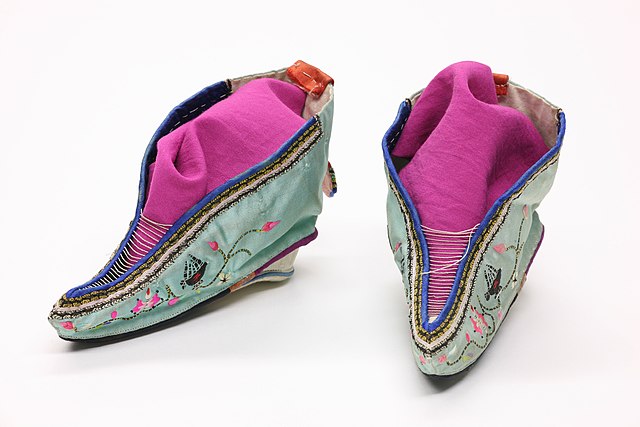
My husband, Marty, is a retired podiatrist.  He worked in pockets of New York City that were poor and largely immigrant. When he first started his practice, he treated women from China whose feet had been bound. Despite being officially outlawed 1912, footbinding was still being practiced well into modern times. He saw these patients in the 1970s and 80s.

For those who don’t know what it is, young girls, as young as 3-5 would have the bones in their feet broken and then the feet bound with cloth strips. Every few years, the feet would be broken again until the desired result was created. To create that affect, the toes would be flattened against the bottom of the foot and arch would be so broken and damaged that the heel would curl back to the front of the foot. At each of the breakings the girl would need to learn to walk again.  One can only imagine that pain of walking on foot bones that had been repeatedly broken. And here is an especially chilling part. The mothers would do it to their own daughters. I won’t go into further gruesome details because they can be easily looked up on the internet.  It left the girls crippled for life.

Continue reading “From Footbinding to Abortion and Beyond – This Has to Stop! by Janet Maika’i Rudolph”

Scars Of The Body by Mary Gelfand

Despite the distances involved, throughout my adulthood, I regularly visited my parents.  As their home was small, I often found myself seated at the kitchen table with my mother while my father watched TV in the adjacent living room. During those visits, it was not unusual for my mother to come and stand behind me and begin working her fingers into my thick dark hair. 

I knew why she did this—she was looking for my scars, hidden under the abundance of my hair but still visible to those with patience. Two scars are hidden by my hair.  When I was three, I received a glancing blow from a horse’s hoof which cut my scalp causing it to bleed profusely. When I was six, I fell out of a tree in our back yard and cut my scalp again. Maternal fingers remembered where those scars should be, and Mom would weave her fingers through my hair until she found each scar.  Then she would lovingly stroke each spot several times and return to her seat.  Even at the time it seemed like she was offering a blessings to my wounds.

Continue reading “Scars Of The Body by Mary Gelfand”

From the Archives: Women’s Bodies and the Bible by Janet Maika’i Rudolph

Moderator’s note: This marvelous FAR site has been running for 10 years and has had more than 3,600 posts in that time. There are so many treasures that have been posted in this decade that they tend to get lost in the archives. We are beginning this column so that we can all revisit some of these gems. Today’s blogpost was originally posted May 20, 2019. You can click here to see the original comments.

Trigger Alert:  The bible on its face is quite violent to women.

Amidst the ugliness that is American politics in general and abortion politics specifically, I began to look for guidance to understand what is happening. I ended up pulling out two books that I read long ago. The first is Woe to the Women-The Bible Tells Me So by Annie Laurie Gaylor. Gaylor, in turn, was inspired by the work of Elizabeth Cady Stanton in her The Women’s Bible which was originally published in two parts (1895 and 1898).

I had forgotten how inspired I have been by both books. Together, they motivated me to begin looking at how the bible is a foundational paradigm of our culture. I started researching how translations have been altered from original meanings. I have already written a few blogs about how the representations of Eve have been changed to strip Her of the roots of Her original power. Take a look here and here.

Continue reading “From the Archives: Women’s Bodies and the Bible by Janet Maika’i Rudolph”

Carol P. Christ’s Legacy: “LOVE PATRIARCHALISM”—ITS UNDERSIDE IS HATE

Moderator’s Note: We here at FAR have been so fortunate to work along side Carol Christ for many years. She died in July this year from cancer. To honor her legacy as well as allow as many people as possible to read her thought-provoking and important blogs we are pleased to offer this new column to highlight her work. We will be picking out special blogs for reposting. This blog was originally posted September 3, 2012. It is surprisingly current.You can read it along with its original comments here

Where patriarchalism trumps love, when push comes, shove often follows. The underside of love patriarchalism is hatred of the independence of women. 

We are told that it is the duty of a loving father and husband to protect his wife and children.  In exchange, good wives support their husbands and good children obey their fathers.  The bottom line of patriarchy is control.  The fight over abortion is a fight about men’s right to control women.

I have spent much of the past few weeks wondering why so many Republican men hate women.  Why do they want to deny the right to an abortion to a 12 year-old girl raped by her father, to a 21 year-old college student gang raped at a fraternity party, to a 33 year-old woman who submitted to a violent boyfriend she did not know had poked a hole in his condom, or a to a 41 year-old woman who offered a cup of coffee to the man who came to her house to fix the electricity, but who said “no” when he assaulted her.

Continue reading “Carol P. Christ’s Legacy: “LOVE PATRIARCHALISM”—ITS UNDERSIDE IS HATE”

Last Tuesday Night by Marcia Mount Shoop

It’s been just over a week. Last Tuesday night to be exact. That’s the night the four of us huddled around our beloved companion of sixteen and a half years and said goodbye. 

Buck became a part of our family when he was three months old. We were living in Oakland, California at the time. My son was five and my daughter had just turned one. My husband was coaching for the Raiders and he was gone all the time. It wasn’t a great time to get a puppy on paper—but our hearts said otherwise, so we did. 

Just a little over a year earlier I had said goodbye to Tino. He’s the Blue Heeler that found me in a dream when I was living in Santa Fe, New Mexico. That morning I woke up and just had to get a puppy. It was a visceral pull. And I went to the Santa Fe Human Society and there was the puppy from my dream. He didn’t look like any dog I had ever seen until my dream the night before. 

Continue reading “Last Tuesday Night by Marcia Mount Shoop”

Feminist Parenting About Sexuality Part 4: What to tell my daughters by Trelawney Grenfell-Muir

In this blog series, we have discussed:

—The importance of admitting how painful this subject is

—Reminders that I am NOT saying all men are bad or maleness is bad, because men and maleness are truly inherently beautiful and divine

—The necessity of facing honestly just how scary and horrifying the epidemic of violence against females is in our world today

—The truly evil, vicious destruction pornography is causing to female bodies and male psyches in training many, many males to rape and abuse females, and grooming females to normalize and comply with rape and abuse by males

Continue reading “Feminist Parenting About Sexuality Part 4: What to tell my daughters by Trelawney Grenfell-Muir”

Loving Venus, a poem by Marie Cartier

Dedicated to Carol Christ, 1945-2021, who taught so many of us how to love the Goddess


She is called “Nude Woman” and currently lives
in her natural museum house in Vienna.
Nude woman. She is art, but she is not in an art museum.
And there are questions:
why was she originally painted red? Why are her breasts so large?
Why is her stomach so large?
Why does she fit in a human hand?
What was her purpose?
Was it to entice men, or to comfort women?
Historians disagree.
Is her hair woven? Or is it a hat?
Why does she have no eyes? No feet? Why is she there?

Continue reading “Loving Venus, a poem by Marie Cartier”