Tree of Life: The Festival of the Trees in an Age of Treefall by Jill Hammer

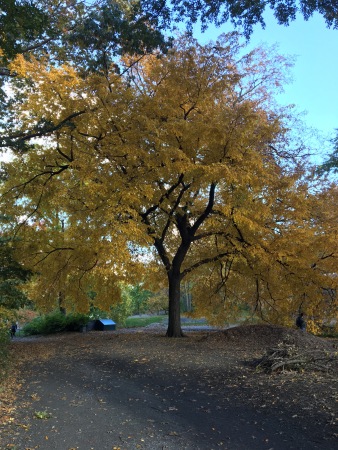
Almost every day, I walk in Central Park.  There are certain trees there I’ve come to know: the gnarled cherry trees by the reservoir, the bending willows and tall bald cypress by the pond, the sycamores that drop their bark each summer, the hawthorn not far from Central Park West.  Lately I’ve been taking photos of the trees to try to capture their essence, their posture in the world.  The trees around me feel like friends, which is what an ancient midrash (interpretation/legend) called Genesis Rabbah says about trees: that they are friends to humankind.  To me, they’ve always been a central manifestation of Mother Earth.

Currently, the national parks in the United States have no staff because of the government shutdown. Some people have taken the opportunity to cut down the rare and endangered Joshua trees in the Joshua Tree National Park—just for fun, I guess, or as a trophy of some kind.  Meanwhile, President Bolsonaro of Brazil recently has indicted that he wants to remove protection for the rainforest, in order to allow development.  It appears that my friends the trees have enemies.  Sometimes the enmity is for personal/corporate gain, and sometimes the enmity seems to have no reason at all.

Continue reading “Tree of Life: The Festival of the Trees in an Age of Treefall by Jill Hammer”

Vayigash: Lessons from Joseph’s Behavior by Ivy Helman

29662350_10155723099993089_8391051315166448776_oParshah Vayigash covers Genesis 44:18 to 47:27.  It involves the reunification of Joseph with his brothers and his father, the immigration of Jacob’s entire family to Egypt and Joseph successfully leading Egypt through famine.  In other words, the parshah provides the backdrop for how the Israelites become slaves in Egypt.

Any mention of women is confined to verses 46: 14-26.  They are not active participants, but are remembered as mothers and (a few) daughters and help explain the size and development of Jacob’s family.  It is most striking that they are mentioned at all as the text is heavily preoccupied with sons.  Nonetheless, according to the account, Jacob’s family has 70 members and a seemingly very small number are women and daughters.

Clearly it comes as no surprise that this text is highly influenced by its patriarchal roots and we could dismiss it for that reason.  Nonetheless, it has become a project of mine in this blog over the past few months to find redeeming qualities and food for thought within these texts.  In other words, despite its sexist pitfalls, there are still holy insights and life lessons as my previous blogs attest. Continue reading “Vayigash: Lessons from Joseph’s Behavior by Ivy Helman”

Just Show Up by Katie M. Deaver

Happy Midterm Election Day 2018!!

The first article I ever wrote for Feminism and Religion, (“I Never Thought That I Would Need to Be a Part of History,”) ran just a couple of weeks after the inauguration of the current President.  As I sat writing this Monday afternoon, I kept trying to find some new or more exciting way to talk about voting in today’s election, I couldn’t help but go back and take a look at that first article.

As I wrote in that article, I never really imagined that I would need to be a part of history.  As a scholar of theology and feminism I certainly understand that we are a long way from being a truly inclusive society. We still need to fight oppression and push for the acceptance of all those who are othered in our society, but somehow our current issues and “battles” seem so much larger than they did only a couple of years ago.

Continue reading “Just Show Up by Katie M. Deaver”

I Believe Dr. Blasey Ford by Anjeanette LeBoeuf

Anjeanette

I had a completely different post that I was going to submit for my FAR contribution this month, but that went out the window on Thursday September 27th with the Supreme Court Justice Nomination hearings of Brett Kavanaugh and the testimony of Dr. Christine Blasey-Ford. And with the Friday’s senate committee’s vote to allow for Brett Kavanaugh to be one step closer to being sworn in as a Supreme Court Justice, I am reminded once again how important our work here on Feminsmandreligion.com is. It has put a spotlight on the pervasive and pernicious rhetoric that surrounds sexual violence, toxic masculinity, and hatred.

Continue reading “I Believe Dr. Blasey Ford by Anjeanette LeBoeuf”

Poem: #MeToo, We Re-Member by Marie Cartier

I need the grandmothers to help me

re-member my rage.

Cross stitch. Double knot.  I sew it back on. The raggedy parts I let fly loose

when I thought it was OK to not be “so angry.”

“Boys will be boys.”

And so then, girls will be angry.

And we will re-member—our rage.

I need the great aunts, and all the old women with the signs that read,

“We are still protesting this shit.”

I need them, this herstory to help me

re-member my rage, feel it strong and tight. Cross stitch. Double knot. Those women re-member

me. I am that woman. She is me.

Our rage is a song.

After all this time, we are still singing it. Our rage

is a river and we swim in it, even if it’s upstream. There is a fierce mermaid goddess,

Yemaya. She protects us. She knows

our rage is our best defense.

Our rage is a

swarm of bees. Not yet extinct. Our rage

is holy. Terror. Continue reading “Poem: #MeToo, We Re-Member by Marie Cartier”

Lessons from Shofetim by Ivy Helman.

29662350_10155723099993089_8391051315166448776_oThis is the first part of a series of reflections on the weekly Torah portions.  For those of you unfamiliar with Judaism, we read the Torah in sections.  There are 52 parshot (or portions), one parshah (portion) is read each week (most often during Shabbat morning services).  It is common for rabbis, prayer leaders or someone of the congregation to offer reflections on the week’s parshah at Shabbat services.

The parshah for this week is Shofetim.  It is Devarim/Deuteronomy 16:18 – 21:9 and will be read this Shabbat, 18 August.  Shofetim discusses a range of topics: setting up of a system of judges to make important decisions for Israel; the entitlements of the Levites; the rules of warfare; the importance of justice and just governments; and the acknowledgment of G-d as the true and highest Judge.  It also warns Israel against false prophets and practices of idolatry.  Shofetim contains a number of well-known verses including ‘justice, justice you shall pursue…(16:18),’ and notorious punishments like “…a tooth for a tooth; an eye for an eye…(19:21)”  Continue reading “Lessons from Shofetim by Ivy Helman.”

On Chronic Illness and Justice by Ivy Helman

29662350_10155723099993089_8391051315166448776_oFor almost four years, I’ve been living with the long-term effects of an inner ear lesion.  The lesion is long gone but its side effects are not.  Throughout the day, I feel a combination of unsteadiness and sudden, unpredictable sensations of movement.  On better days, the unsteadiness is almost non-existent and the feelings of movement are minimal.  On worse days, I’m troubled with a type of brain fog that makes it hard to concentrate as well as disrupting unpredictable sensations of being on a boat that can’t pick one direction in which to move.  It’s frustrating, tiring and demoralizing.

Summer is the season of worse days.  There is really nothing I can do to feel better.  Even staying well-hydrated and taking it easy often doesn’t steady the boat.  So, instead, I often continue my life as normal.  Then, I lay in bed at night and hope sleep comes soon. Continue reading “On Chronic Illness and Justice by Ivy Helman”

Religious Practice and Epistemic Justice by Vanessa Rivera de la Fuente

feeling-measured-on-faith

One of the topics that has captured my deep interest during the last year is Epistemic Justice – and its absence, epistemic injustice – a concept which I reflect on often, since it has become a backbone idea in the approach of my work, my activism, my diagnosis of the situation of women in the global south and my vision of the world in which I would like to live. These reflections that I share with you do not intend to articulate a strictly academic presentation. They are my “thinking aloud” and don´t pretend to be completely right nor to establish a truth; rather they express the progress of a personal searching.

I speak as a Muslim feminist who loves to read and write about Feminism and Islam, but is not an academic nor aspires to be recognized as such in this field, although she writes papers and offers lectures in her own capacity on that matters. I speak as a community educator and social entrepreneur, who believes in feminism and spirituality as liberation tools. Since I accepted Islam, I took the experience gained in my work for the political empowerment of grass roots women to nourish an activism in the field of religion and gender justice. Continue reading “Religious Practice and Epistemic Justice by Vanessa Rivera de la Fuente”

“The Burning Lava of a Song” by Joyce Zonana

Aurora’s autobiographical narrative is a passionate paean to poets as the “only truth-tellers, now left to God”; she celebrates them as agents for personal and social transformation. As we come to the end of this National Poetry Month in the U.S., where truth is under siege, it’s worth recalling Aurora Leigh and its daring exploration of poetry, gender, divinity, and social justice.

jz-headshotI was in graduate school when I first read Aurora Leigh, Elizabeth Barrett Browning’s fiery 1856 epic about a young woman claiming her vocation as a poet despite Victorian society’s patriarchal strictures. The poem was not on any assigned reading-list; I’d simply stumbled across it while doing research for my dissertation. The opening lines brazenly assert the speaker’s authority and ambition:

OF writing many books there is no end;
And I who have written much in prose and verse
For others’ uses, will write now for mine,–
Will write my story for my better self . . .

Encountering those words, I was immediately possessed by Aurora’s voice and vision, a welcome change from all the male poets and critics I’d been reading. I devoured the verse novel’s nine books in one night. The poem became the centerpiece of my dissertation, and I studied and enthusiastically taught it for years.

Continue reading ““The Burning Lava of a Song” by Joyce Zonana”

Remembering MLK’s Life, not Death by Gina Messina

Gina-MD-5-UrsulineYesterday marked the 50th anniversary of the assassination of Martin Luther King, Jr. Thousands gathered at his memorial and many more rallied across the U.S. to honor King’s commitment to civil rights and non-violent action. His message continues to resonate in a nation that has never ceased to struggle with complex issues related to race, gender, sexuality, religion, and so on. 

While the Land of the Free is invested in honoring King’s death, we could instead be focused on how he lived. As Rev. Jesse Jackson explains, 

He mobilized mass action to win a public accommodations bill and the right to vote. He led the Montgomery bus boycott and navigated police terror in Birmingham. He got us over the bloodstained bridge in Selma and survived the rocks and bottles and hatred in Chicago. He globalized our struggle to end the war in Vietnam.  How he lived is why he died. Continue reading “Remembering MLK’s Life, not Death by Gina Messina”