

 In the past few weeks, there have been renewed debates throughout the US about death with dignity laws and the role of government is providing or securing access to health care. The tragic story of Brittany Maynard and the incessant election-year politicking about the Affordable Care Act (Obamacare) have made issues about human suffering more visible and volatile than usual. These are topics I deal with in two courses I am teaching this semester–one about Christian ethics and the other about bioethics.
I truly admire those who work in the presence of suffering daily by caring for others. It’s difficult to even talk about suffering in the classroom day after day. My intention behind doing so is for my students to resist simplistic responses by either valorizing human pain and suffering or retreating to escapism. I caution them about using religion to legitimize suffering when it accompanies from evil, yet encourage them to see the meaning in suffering as well. We try to maintain the fine line of affirming the experiences of those who claim to gain strength or some other good from their pain without crossing into discourse that names the pain itself as something good. We debate whether there can be any way of discussing suffering as redemptive. We discuss disparities in medical treatment and health care along economic, racial, gendered, cultural, and international divides and what the responses of clergy, medical providers, and everyday people to remedy them.
Through these heavy debates, I’ve gained more clarity about the ways that suffering is often a result of human injustice and I’m deeply saddened by it. Continue reading “Responding to Human Suffering by Elise M. Edwards”
 Every year, several churches in my area set aside a Sunday morning service to celebrate “The Blessing of the Animals.” Parishioners bring animals (mostly dogs) with them to church. The service centers around St. Francis, a Catholic friar and preacher (1181-1226), known for giving us the Christmas crèche, an artistic display prominently figuring Mary, Joseph, shepherds, and angels. St. Francis soon added cows, donkeys, and sheep to his art. He said, “Surely the animals praised the new Messiah just as the shepherds and angels did.” The bulletin of one of the local churches participating in the celebration said, “In honor of this blessed saint [St. Francis] of the church we gather today with our animals, here and in spirit–our pets, our service animals, police dogs and horses, zoo animals and all God’s creatures and give thanks for what they do for us and for what they mean to us.”



 Each month on Feminism and Religion, I feature a
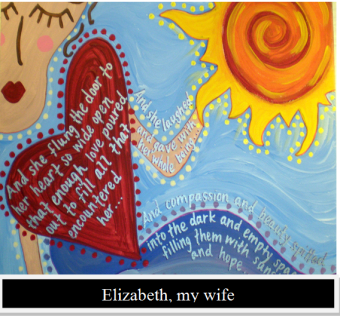 I would like to dedicate this post to all the holy women who fill our lives, yet whose stories we never hear. Because it is not only these seemingly famous women—these heroines of feminism—who are holy and whose stories matter.

 In my last post, I shared with you my wonderment at the power of music to speak for us when we lack speech and to touch us when we are beyond reach. Now, I experience wonderment at the power of silence. For, it was silence that in the end helped my father-in-law, who was truly my father, to shed his mortal coil. After the noise of caregivers and nurses, of talking and encouraging, of wailing and whispering, there was a window of silence when I sat alone with him, stroking his forehead lightly. I knew he would be free in that quiet to exhale, and with that final breath, he too became silent.
 It’s not so easy any more to control the parameters of Islam and the way it is practiced by those who wish to stuff their opinion down the throats of other Muslim citizens, be they minorities or majorities across the globe.
 Can we think of the voting place as an altar where we hole-punch a prayer to the honored dead?

