The Ancestors Live in Us by Carol P. Christ

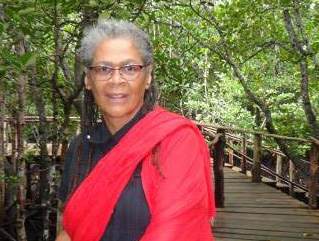
Carol Christ in LesbosOn the recent Goddess Pilgrimage to Crete women had the option of riding up a winding road on a mountainside in the back of a farm truck singing “She’ll Be Comin’ ‘Round the Mountain” or could choose to go with the guard in his closed automobile.

That evening one of the older women who had chosen to ride in the car said, “I saw how much fun you were all having, but I have done that before. This time I was happy to let the rest of you do it.”

“That’s exactly how I feel about death,” I responded. “Some people want to live on after death, but I don’t. I am happy to let others do it. The only thing that would upset me would be if life did not go on after me.” Continue reading “The Ancestors Live in Us by Carol P. Christ”
Anne Hutchinson, America’s First Feminist Theologian: 1591-1643 by Carol P. Christ

Carol Christ in Lesbos“She had rather been a husband than a wife; and a preacher than a hearer; and a magistrate than a subject.” Reverend Hugh Peter of Salem

Anne Hutchinson was banished from the Massachusetts Bay Colony for heresy in 1637 and excommunicated from the Puritan Church of Boston in 1638. Her banishment came just three years after she, her husband, and eleven living children arrived in America seeking the freedom to practice their religion as they saw fit. Governor Michael Dukakis pardoned her in 1987. Historian Howard Zinn called her a true American hero.

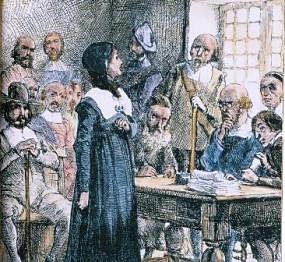
anne hutchinson trialI managed to get through graduate school in Religious Studies without ever having studied the theology of Anne Hutchinson,* though I vaguely remember references (probably with smirks of disapproval) to the “Antinomian Controversy” which is associated with her name. I recall Anne Hutchinson’s name because of an article published in Feminist Studies in the 1970s, when I had just begun to study women and religion. However it was not until recently that I learned of her place in history through reading American Jezebel by Eve LaPlante.

Hutchinson was accused of theological errors in her trials. The Calvinist doctrine of predestination figured heavily in the accusations. But the real issue at stake was that Anne dared to follow her own inner knowing, to articulate it theologically, and to teach her views against the grain of the Puritan authorities in Boston. Continue reading “Anne Hutchinson, America’s First Feminist Theologian: 1591-1643 by Carol P. Christ”

O Madre Nostra Cara by Kaalii Cargill

kaalii-pic-edit

My historical novel, DAUGHTERS OF TIME, traces a line of mothers and daughters through 4000 years as they carry the way of the Goddess from ancient Sumer to the present day. In 1926, a daughter in the lineage is born in Southern Italy:

“Maria’s family had lived in the village and surrounding area for longer than anyone could remember. Like all the girls of her village, she grew up a Catholic, yet on Christmas Eve she gathered with the other women to perform a ritual in the Church that no man was allowed to see. The words she spoke would have been familiar to her many, many times great grandmother, Meh-tan, who once met a Queen in Ursalimmu.It did not occur to Maria that the ritual was not in keeping with the teachings of the Church; it was what her mother and all the mothers before her had done on Christmas Eve to honour the Great Mother.“

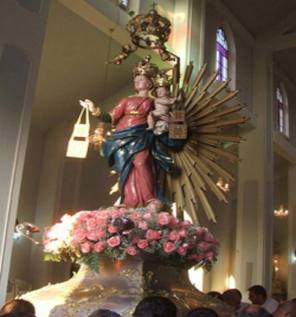
Five years after writing about my fictional Maria, I stood in the church in Calabria where my grandmother Carmella once met with the other women on Christmas Eve. And the Great Mother was still there – the Madonna del Carmine a Varapodio, whom the people call “O Madre nostra cara.”

Kargill

The transition from Goddess to Madonna is very tangible in Calabria . . . Continue reading “O Madre Nostra Cara by Kaalii Cargill”

Writing: Changing the World and Ourselves. By Ivy Helman

I still remember the first tim20140903_180423e I read Mary Daly’s Gyn/Ecology. It awoke something within me. Her use of language, the power of her writing and the ease with which she created new words taught me so much about the world around me and about the way the language, and subsequently its use in writing, shapes lives, choices, abilities and destinies. She also taught me about myself.

I was hooked, but not just on Mary Daly. Shortly after I finished her book, I moved onto other feminists writing about religion like Katie Cannon, Judith Plaskow, Alice Walker, Carol Christ, Rita Gross, Gloria Anzaldua, Audre Lorde, Adrienne Rich, Margaret Farley and Starhawk to name just a few. All of them, in fact every feminist I’ve ever read, has shown me the way in which words have power and how words speak truth to power. Ever since, I’ve wanted to be the kind of writer whose words carry a power that not only affects people but also inspires a more just, more equal, more compassionate and more humane world. In other words, I wanted to be a writer activist.

Yet, I’ve always carried around with me a sneaky suspicion that people don’t consider writers true activists. If you aren’t holding a sign, screaming or participating in some sort of public demonstration or civil disobedience, then you have no right to call yourself an activist. Is that really true? Continue reading “Writing: Changing the World and Ourselves. By Ivy Helman”

Fannie Lou Hamer’s Commitment to Life by Elise M. Edwards

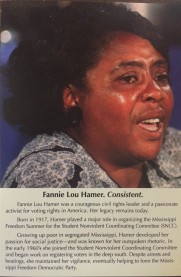
Elise EdwardsA few weeks ago, I came across a postcard that I was given at a conference last year. I got the postcard (advertisement?) because it has a picture of Fannie Lou Hamer on it, and in my home and office, I like to display images and quotes from inspirational women, especially black women. Hamer was a sharecropper from rural Mississippi who became a leader within the civil rights movement in the United States. I was happy to have something with her likeness on it. It was only later that I looked at the text on the front and back of the card, which read in part, ”Often called the ‘spirit of the Civil Rights Movement,” Hamer worked tirelessly on behalf of the rights of others—including the unborn. [She said,] ‘The methods used to take human lives such as abortion, the pill, the ring, etc. amounts to genocide. I believe that abortion is legal murder.’” I realized then that the card was distributed by an organization called Consistent Life, who, in support of a “consistent ethic of life,” is “committed to the protection of life threatened by war, abortion, poverty, racism, capital punishment and euthanasia.”

I was conflicted about the ushamere of Hamer’s image for this organization’s purposes. It is true, Hamer did have those views about abortion and birth control. But I did not know if her image and story was being manipulated for a particular political and religious agenda—one I do not align myself with. I put the card in a box of other images and quotes. I didn’t display it, but I didn’t throw it away, either, which is why I came across it again a couple weeks ago as I was cleaning and decorating my home office. I had the same misgivings about the image as before, and I set it aside again. Continue reading “Fannie Lou Hamer’s Commitment to Life by Elise M. Edwards”

Halfway… by Sara Frykenberg

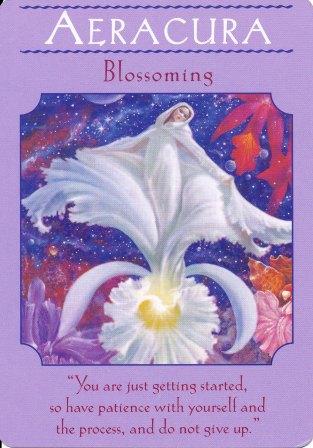
Sara FrykenbergThe title of this post is meant to reflect where I am in the semester, temporally speaking: halfway. Actually, the idea that I am halfway is a bit of a shock to me, considering I feel like I just started! I have a goddess oracle card sitting on my desk that reads: “Blossoming: You are just getting started,” reminding me to be patient with myself as my work takes shape this semester. But seven of fifteen weeks in, I think its time to pull a new card.Aeracura
When the word “halfway” popped into my head, though, I realized this is also a struggle I am having right now. I feel halfway—I answer “yes and no” to every emotional question. I sleep halfway, working even in my dreams. I am halfway okay: one week I am very down and the next, I feel just fine. And sitting on my patio this weekend, unable to sleep, I thought to myself: you are less than halfway full; and realized I that didn’t know what to do to fill myself up.

Continue reading “Halfway… by Sara Frykenberg”

She Alone Was There In The Beginning: Nature Creatrix by Stuart Dean

Stuart WordPress photoI concluded my last post by suggesting that “Creator” in the Declaration of Independence (DI) should have been ‘Creatrix.’  Though ‘Creator’ imbues the DI with a bit of quasi-scriptural authority, the possessive pronoun “their” before it effectively limits the full benefits of creation to men.  That alone should have precluded even the suggestion that the DI effectively endorses Christianity or that it constitutes the basis for a civil religion.

Quite obviously that has not been the case, but that should not be taken to validate the misogyny the DI manifests.  ‘Creator,’ the masculine form of the Latin noun derived from the verb ‘to create’ (‘Creatrix’ is the feminine), is unambiguously masculine in a way that ‘God’ simply is not.  Its appearance in the DI raises the suspicion that it was selected to underscore the masculinity of “Nature’s God,” the phase used in the DI’s opening paragraph.  Surely some of the signatories of the DI knew their Latin authors well enough to know how peculiar it is to speak of Nature as having or needing a God.  Perhaps they wanted to clarify things. Continue reading “She Alone Was There In The Beginning: Nature Creatrix by Stuart Dean”

The Season of Pilgrimage by amina wadud

amina - featureThis weekend those of us not performing the ritual pilgrimage, or Hajj, will enjoy the Festival of the Sacrifice of Eid al-Adha. Celebrated on the 10th day of the 12th lunar calendar month, it tends to creep up without warning, since we operate on the solar Gregorian calendar. The next day I jump a plane to Southeast Asia so my attention is already diverted.
The sacrifice here refers to Prophet Abraham’s botched contract with God over his first son. Muslims stick with the sheer biology that it was his first son, Ishma’il rather than Sarah’s first biological son, Isaac as recognized in Christianity and Judaism. It’s political, I won’t go there.

Instead I want to focus on this veneration of things masculine across all three Abrahamic faiths with the attention surrounding this particular patriarch. For example, I recall an Eid sermon which dwelt at length on Abraham circumcising himself in full adulthood without anesthesia. All I could think was, WHO should care about that? This particular manhood seems to excel over any reminder of his humanity, or of his devotion to monotheism in a community steeped in Idol worship. Continue reading “The Season of Pilgrimage by amina wadud”

Reciprocity, Empathy, and Reconciliation: The Roots of Human Morality in Our Primate Ancestors by Carol P. Christ

carol mitzi sarahA link to a talk called “Moral Behavior in Animals” by Franz de Waal recently found its way into my email inbox. I am a big fan of Franz de Waal because his findings confirm what I always believed—that animals are intelligent. I followed the link and other suggested links and spent most of the evening listening to de Waal.

De Waal began his studies of animal behavior at a time when instinctual behaviorism was academic orthodoxy: the idea that animals can think and feel was “poo-pooed” by “scientists.” As de Waal observed ironically, everyone who has a pet knows better than that. But academic researchers continued down this path, expressing contempt for ordinary people who thought their pets were intelligent and the likes of de Waal who suggested that scientists might be colossally wrong.

De Waal’s discovery that chimps almost always “reconcile” after fights by touching hands, hugging each other, grooming, and even kissing, led him down “the garden path” to his discovery that what he calls the “two pillars of morality”—“reciprocity and empathy”– are found in primate social systems and in those of other higher mammals including dolphins and elephants . Continue reading “Reciprocity, Empathy, and Reconciliation: The Roots of Human Morality in Our Primate Ancestors by Carol P. Christ”

Domestic Violence: The Sin that Sin Created by Kelly Brown Douglas

Rev.-Dr.-Kelly-Brown-Douglas - Version 2In these last several weeks, the horror that one out of four women will encounter domestic violence- sometimes referred to as “intimate partner” violence- in their life time has come to the national forefront. Indeed, women are more likely than men to be killed by their “intimate partner:” one in three women who is a victim of homicide is killed by an intimate partner. While sixty percent of domestic violence incidents occur in the home, this is not where domestic violence begins. It is the perhaps inevitable result of a culture of violence against women. It is the violence that violence creates.

This is a culture of violence in which women’s work continues to be grossly undervalued. One third of all women are living in or near poverty, what has been described as “the brink of poverty.” Two-thirds of minimum wage workers are women. The average white woman is paid 77 cents for every dollar her male counterpart man makes; for African American women it is 64 cents and Hispanic women 55 cents for every dollar made by white men. Women devote more than double the hours as men to “unpaid interactive children care.” Women over 65 “are twice as likely as men of the same age” to live in poverty—primarily because they are full or part-time caregivers. A 2013 “State of the World’s Mothers Report” ranked the United States 30th of the 30 best countries in the world to be a mother, based on indicators such as economic status, political opportunities and universal health care. And what this report makes most clear is that the status of children reflects the status of their mothers. This means that at least 28 million children are living in poverty in the United States.

As for physical violence, one in four college aged women experiences an attemptted or actual date rape. Forty-two percent of women who have been date raped consider suicide. In the Shriver Report, Sister Joan Chittister suggests that in the United States, “rapes in military and rapes on college campuses go unpunished because ‘boys will be boys,’ and winning wars and football games are more important than protecting the integrity of the women who are victims of rape.” These statistics represent nothing less than systemic and cultural violence against women and their children.[i] And, such violence is a sin. Continue reading “Domestic Violence: The Sin that Sin Created by Kelly Brown Douglas”