Years ago, in an early postpartum blur, I took a crack at writing a piece on an old personal blog about the question of an at-home mother’s claim to the feminist label. The process of writing it was really an opportunity for me to work out some of my own thoughts about my lived feminism within the framework of my life at that moment as a mother who was at home full time with three young children; a toddler and a brand new set of infant twins. I was completely unprepared for what happened in the comments section of my personal online musings.
While many self-identified feminist mothers seemed to resonate with the underlying personal themes of my post, many, many other feminists felt the need to comment on what they saw as my harmful attempt to justify choice feminism; a feminist theory they felt needed to be forcefully shouted down. While some of the comments were jarring, to say the least, they did serve to introduce me to the concept of choice feminism and the critiques surrounding it. I did not necessarily agree with the style or content of many of those comments, but they did deepen my thinking around reconciling my lived experience of at-home motherhood and my ethical commitment to feminism.
Last week, I listened to an episode of Krista Tippett’s series On Being that featured an interview with poet Marilyn Nelson. I am not very knowledgeable about the world of modern poetry, but I am familiar with Nelson’s work. A couple years ago, I wrote about Fortune’s Bones: The Manumission Requiem, Nelson’s poetic composition about Fortune, an enslaved man whose owner rendered his body into a skeleton for medical training. Fortune’s identity and history had been erased across centuries as his remains were displayed. Community concerns eventually led to a multi-disciplinary academic, artistic, and community effort to honor the man and, in 2013, put his bones to rest. Isaye M. Barnwell, a musician formerly of Sweet Honey in the Rock, developed a cantata and choral work for Fortune’s Bones. These developed into a series of artistic performances and community events that demonstrate the power of art to speak through and for those who are marginalized—even in death. Disparate communities joined together to ponder Fortune’s life, and it was powerful.
In the On Being interview, Nelson spoke about “communal pondering,” and I’ve been repeating this phrase to myself since then. It identifies a form of creative activity and a spiritual way of being that I am deeply committed to, and have not been able to name. Communal pondering occurs when a group of people are listening together and are opening up new paths for discourse and action by the engaged reflection that takes place within that listening.
“Let the beauty we love Be what we do
There are hundreds of ways to kneel and kiss the Earth.”
–Rumi
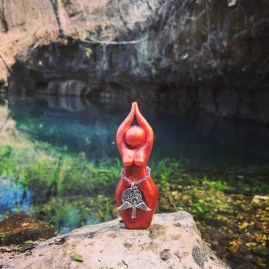
Introductory note: At the end of 2016, my parents purchased a piece of land about one mile from where I already live (they live one mile further away than that). In addition to woodland and meadow, this land has two springs, three creeks, a cave, and ¼ mile of river access. While I have been deeply connected to the land of my birth, the Missouri Ozarks, for a long time, and have written about that connection in multiple past posts for FAR, this new-to-us land has offered a new opportunity: the chance to get to know another section of land “from scratch,” deeply, wildly and well, and to become wise stewards of it for the time in which it is in our care. It is also the first time I have been able to so closely and intimately observe the origin source of a body of water. Previously not giving it much thought, I now have the daily privilege of observing the source of the flow as I watch water emerge directly from the ground. First, there is simply none and then, suddenly, a deep blue pool constantly bubbling as water rises to the surface and flows away on its long, long journey to the sea. This essay is a series of three vignettes as I spend this year immersing myself in relationship with this land.
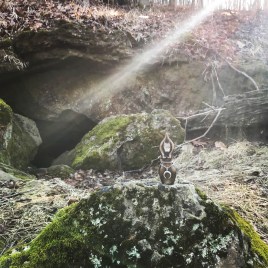
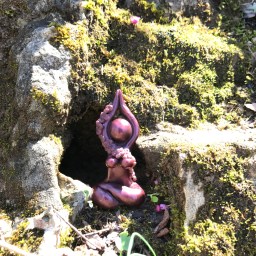
We walk along the nearly vertical hillside hanging onto small trees for support. Finally, though we almost miss it, we spy the opening to the cave nestled behind several mossy stones. The sun is still on the rise above the tree line and the rays filter through the trees so one ray is pointing directly at the cave entrance. We crawl inside, bumping our heads and scraping our backs as we wiggle into this womb in the earth. Once inside, the chamber enlarges so we can stand up. Unlike other caves we have experienced in this area, the only human signs we find are a single bottle cap, a glass bottle, and two sets of initials carved into a rock. In the dark silence we hear the sound of water dripping steadily. I make my way further into the cave, acutely aware that this is living cave and being careful not to step on the fresh, wet, cervix-shaped beginnings of new stalagmites on the floor. At the back of the cave, I find her. A Madonna-like stone column, glistening with water. In the silence of the cave, I quietly sing Ancient Mother to her, as tears well in my own eyes.
I am of this earth for this earth and by this earth.
We skirt carefully along the bank of the creek, making our way to the largest spring. Over three million gallons of water a day flow effortlessly from this small, deep pool nestled quietly in the middle of the woods. I am stunned by the magnitude of this flow as I stand there with my husband, my head resting on his shoulder, hawks wheeling overhead, redbud trees in full bloom. It has never seemed more clear to me how very “small” we are, but a blink of an eye to this spring and its countless years and countless gallons of water, not caring whether it is witnessed in its work or not, but simply, continually, creating and producing. I try to explain this feeling aloud, but words fail me. It is a humbling sensation, not a depressing one. The actual emergence of the water at this origin point of the river is nearly invisible, the continuous gentle, small popping of bubbles on its surface, the only sign that something significant is happening here that distinguishes this body of water from a pond or pool. Yet, those never-ending bubbles rapidly expand to a wide, swift-moving creek, which joins the river and another smaller spring-fed creek to continue to make their way southward across the state. We smell something sharp and see a dead armadillo by the roots of a giant sycamore. We hear a shrill cry and look up to see two bald eagles riding the currents of air high above us. We are so small. So many thousands of years of water have passed, but we are here right now.
Unfathomable eons
Glacier time
I am just a blink of an eye
But I can sit, and watch, and wonder.
We scramble along the uneven terrain on the rocky and wooded hillside, slipping, laughing, and looking. I am exhilarated by the simple thrill of exploring the world right here in front of me. We find tiny flowers. I kneel by the roots of fallen trees. We stop to admire moss on stones. We find gigantic black snake napping in the sun. A complete turtle shell. A shed antler. Each moment feels like a new opportunity to “kiss the earth.” I sing Reclaiming’s song-version of the Rumi quote over and over and as I kneel in each spot to see what it has to show me, in each, I kiss my fingers and press them to the earth. I see all the kissing going on around me…the sun filtering through branches, the fiddlehead ferns kneeling to kiss the earth, the roots wound through rocks, the trillium and bloodroot blooms pushing up between leaves, the water seeping out of the ground and flowing down the hill, the dogwood blossoms opening to the sun, the moss covering stones, the fallen trees stretched along the slope.
“And that is just the point…how the world, moist and beautiful, calls to each of us to make a new and serious response. That’s the big question, the one the world throws at you every morning. ‘Here you are, alive. Would you like to make a comment?’”
–Mary Oliver
We emerge from our walk to find morels growing alongside the path (morels are wild, edible mushrooms found for about two weeks in Missouri each spring and considered a delicacy by many). The afternoon suddenly becomes even more rewarding and we stoop and peer through fallen oak, sycamore, and elm leaves looking for the telltale conical form of these forest treats. We quickly discover that we must tune in and “listen” for the mushrooms, so to speak, or we’ll walk right by them, none the wiser. The moment I start thinking about anything else, I stop finding any. Once I settle into my body and the moment and really look at the world again, there another morel will be.
“I think this is how we’re supposed to be in the world … present and in awe.”
–Anne Lamott, Bird by Bird: Some Instructions on Writing and Life
Molly has been “gathering the women” to circle, sing, celebrate, and share since 2008. She plans and facilitates women’s circles, seasonal retreats and rituals, mother-daughter circles, family ceremonies, and red tent circles in rural Missouri and teaches online courses in Red Tent facilitation and Practical Priestessing. She is a priestess who holds MSW, M.Div, and D.Min degrees and finished her dissertation about contemporary priestessing in the U.S. Molly and her husband Mark co-create Story Goddesses, original goddess sculptures, ceremony kits, and jewelry at Brigid’s Grove. Molly is the author of Womanrunes, Earthprayer, and The Red Tent Resource Kit and she writes about thealogy, nature, practical priestessing, and the goddess at Brigid’s Grove.
The warrior spirit is not only the coherent ability to resist circumstances outside of one’s making; but the ability to fight the war within all of us thus managing discomfort and chaos with the force of authenticity.
Recently an enlightened friend on social media reminded me of the importance of not only portraying an awakened consciousness in the fight towards enlightened morays in an age of fascist’s dictatorships but actually waking up to unresolved veracities.
Hurriedly, I searched for a working definition of enlightenment consistent with my Christian beliefs. I finally found several however, none exactly measured up to the values that are interlaced within scriptures and thus are founding principles of Christianity and religious fundamentals.
There are quite a few post-apocalyptic shows out these days. The Last Man on Earth is one example, a television series that is set in 2020, a year after a deadly virus has wiped (almost) everyone out. A handful of people have natural immunity, which the main character, Phil (Will Forte) soon discovers after spray painting billboards across the U.S. with the message “Alive in Tuscon.” It seems to be a lonely life for Phil before he realizes he isn’t really the only person left alive, but he can choose any mansion to live in, drive any car on the empty, open roads, and the grocery stores are abandoned for his taking (only non-perishables are really edible though). There are downsides such as no electricity, no running water, and an end to all of the other modern-day conveniences that an urbanite would be used to, which were, in the past, handled by “someone else.” It would be much better if a farmer or botanist were left behind, but I guess it is supposed to be relatable to most of us.
Watching this show has compelled me to think about other apocalypses in sacred literature, mainly Noah and the global flood. I always have thought it was rather chilling that gods were created to be such harsh punishers of humankind. In the Qur’an, this story is used as one of many examples of the communities that were sent a messenger but disobeyed and so endured the promised wipe-out. It always seemed strange to me that God would be discussed to be so violent when the immediate messages in these literatures were that human beings should be kind, charitable, and moderate with each other. Continue reading “The Last Man on Earth, Noah, and the Fantasy of Humanity’s Destruction by Elisabeth Schilling”
It is, I think, quite common knowledge that most Jewish holidays relate to the seasonal cycles of the Earth. Sukkot celebrates the fall harvest. Chanukah sheds light on the winter darkness. Tu B’Shevat marks the end of the dry season and so begin the prayers for rain in Israel. For Purim, we throw off our winter doldrums and let off a little steam to settle our cabin fever. Pesach is no exception: welcome spring: birth, renewal and even creation. The leaves return to the trees, baby animals are born, flowers bloom, warmer weather arrives and somehow the possibilities of the coming summer are endless.
In fact, the associations between Pesach and spring are many. Arthur Waskow in Seasons of Our Joy explains the origins of the connections (pages 133-139). There were probably two different seasonal celebrations – one of shepherds and one of farmers – that came together around the time of the Babylonian exile into one festival which we can see in Exodus 12 – 13: Pesach. Farmers in preparation for the harvest of spring wheat cleared out the old crumbs and fermentations of the last year to make room for the new. Shepherds celebrated the arrival of baby sheep and their flock’s fertility in general by slaughtering a sheep, putting its blood on their tents and dancing around a fire. Continue reading “The Coming of Spring: Reflections on Pesach and Judaism by Ivy Helman”
In many ways, I’ve thought of the myriad Holy Women Icons I’ve painted as mediators, guides who accompany us, women who have shown us the way. Whether they enliven us to create, inspire us to sustain, or embolden us to empower, these holy women have taught me to rage, praise, hope, endure, persist, love, and laugh. Recently, though, I discovered that none of the Holy Women Icons I’ve researched, written about, or painted have helped me to grieve. Surely, many have experienced grief, or give us tools for coping with the grieving process, but no Goddesses of Grief filled my heart when I needed it most.
Last month, amidst my worries about walls and bans and words that exclude, grief came along and sucker punched me in such a way that I continue to grasp for mediators, guides, and ways to cope amidst tremendous sadness. On March 6, 2017 my little brother, Carl, died. An addict for much of his adulthood, his recent addiction began spiraling out of control over a year ago and he refused to go to rehab. My family worked hard to try and reach out to him, to open him up, to offer him support, but he refused to let anyone in, drowning his anguish in blackouts and overdoses. Though we filled his life with tremendous love, he also experienced pain—externally and internally—that he never shared with anyone. The drug of choice for the past year—duster—runs the risk of cutting off the oxygen to the brain every time it is used; in fact, there are instances of people dying the first time using duster. And this is precisely what happened when my mother found my brother. My beloved single-mom, Mary, became Our Lady of Sorrows, as she held the lifeless body of her 33 year-old son. Our lives will never be the same and the grief is overwhelming. Continue reading “Painting a Goddess of Grief by Angela Yarber”
With the Sun in Aries and then Taurus from late March through mid-May, representing Spring and the renewal of all things creative, it is a good time to think about the evolution of the goddess Sedna who created the walruses, seals, and new kinds of fish to feed her Inuit tribe which until then had to make do with bearberries, seaweed, and arctic moss. Sedna’s name means “provider of food,” but of course her creations came at a very dear price.
Her father, in a moment of patriarchal panic, cut off her fingers to separate her from their lifeboat kayak during a storm in which he could only think to save himself, as he was the chief of the tribe. As Sedna fell deeper and deeper into the sea, she was surprised that, instead of feeling frightened, she felt more like her real self than ever before. She saw her father (who had lied about killing her first love) and the “bad crow” husband he had selected for her instead, for who they were, and she saw her fingers, as they tumbled down with her, turn into wondrous, powerful animals.
When she got to the bottom of the sea, her bones had been purified by her blood and the salt water of her tears, and her skeleton was radiant. She quickly put on body weight, of a sea kind, and with the help of her sea-children she made herself ruler of the under-water world.Continue reading “Sedna in Spring by Anna Marie Laforest”
In 2011, the Anglican Theological Review published arguments for and against same-sex marriage. “A Theology of Marriage including Same-Sex Couples: A View from the Liberals,” co-written by Deirdre Good, Cynthia Kittredge, Eugene Rogers, and Willis Jenkins, presents a rationale for same-sex marriage that is surprisingly traditional, grounded in scripture and doctrine, understood and interpreted “in the company of patristic interpreters as well as in the company of readers long silenced by the tradition.” Part of the liberal view explores the relationship between eros and caritas, and how the marriage vows, which “mark marriage as an arduous form of training in virtue,” teach us to love and “offer a means by which God may turn eros into charity.”
As someone for whom eros is both a modality of intimate communion and manifest expression of divine love, the idea that it would need to be transformed into something less sensual, more socially acceptable, seems an arbitrary sanitization that positions eros as untamed and dangerous, in need of redemption by sexless ideals of Christian charity. Admittedly, my aversion to scrubbing eros of its rawness likely comes from my own understanding of the word, which might differ from that of traditional Christian theology, and which is inherently tied to the ways in which I’ve known the divine more deeply through expansive, mystical, erotic experiences that engaged my every sense in the coolness of rivers and grazing touch of mountain breezes.
We know through the body; we sense through our skin and parts and cells and perceive through nerves and fibers and tissue – seismic shocks of color and sound reverberating through our beings in the abstract, or the specific, deep, and warming awareness of divine love washing over our grief, fear, or loneliness. Each of these teaches us about the nature of the universe and of love, about bodies and subjectivity, and (by extension) about God and God’s action in the cosmos. My experience of eros – of the sensual explosion of erotic energy that makes me tremble, lays gooseflesh across every inch of me, and takes my breath as it rises inside my chest and belly – is not limited to sexuality, but comes through nature, art, song, movement, and touch. It is my primary way of experiencing divine love, and needs no purification. Continue reading “Eros, Caritas, and Relationship by Chris Ash”
In the quotes below, you will briefly encounter the words of Donald Trump throughout the years as he has commented on women. You might have read or heard many of these, as I have. Reading them still brings a chill to the spine (please be warned of the misogynist language that follows).
“You know who’s one of the great beauties of the world, according to everybody? And I helped create her. Ivanka. My daughter, Ivanka. She’s 6 feet tall; she’s got the best body. She made a lot money as a model—a tremendous amount.” 2003 Howard Stern Interview
“My favorite part [of ‘Pulp Fiction’] is when Sam has his gun out in the diner, and he tells the guy to tell his girlfriend to shut up. Tell that bitch to be cool. Say: ‘Bitch be cool.’ I love those lines.” 2005 TrumpNation: The Art of Being the Donald
“If Ivanka weren’t my daughter, perhaps I’d be dating her.” March 6, 2006 The View
“While @BetteMidler is an extremely unattractive woman, I refuse to say that because I always insist on being politically correct.” Oct 28, 2012 Twitter
Rosie O’Donnel is “crude, rude, obnoxious and dumb.” July 11, 2014 Twitter
“Why is it necessary to comment on [Ariana Huffington’s] looks? Because she is a dog who wrongfully comments on me.” April 6, 2015 Twitter
I hesitated to start this post with such deprecatory quotes related to women and women’s bodies. Yet, forgetting or camouflaging the misogyny that this administration represents is egregious. These quotes indicate a truth about Trump’s opinion of women: women are to be controlled, possessed, and disparaged. These snippets into Trump’s posture toward women exhibit his misogyny, his disgust of women, and ultimately, his own self-contempt.


 Years ago, in an early postpartum blur, I took a crack at writing a piece on an old personal blog about the question of an at-home mother’s claim to the feminist label. The process of writing it was really an opportunity for me to work out some of my own thoughts about my lived feminism within the framework of my life at that moment as a mother who was at home full time with three young children; a toddler and a brand new set of infant twins. I was completely unprepared for what happened in the comments section of my personal online musings.
 live (they live one mile further away than that). In addition to woodland and meadow, this land has two springs, three creeks, a cave, and ¼ mile of river access. While I have been deeply connected to the land of my birth, the Missouri Ozarks, for a long time, and have written about that connection in multiple
  spy the opening to the cave nestled behind several mossy stones. The sun is still on the rise above the tree line and the rays filter through the trees so one ray is pointing directly at the cave entrance. We crawl inside, bumping our heads and scraping our backs as we wiggle into this womb in the earth. Once inside, the chamber enlarges so we can stand up. Unlike other caves we have experienced in this area, the only human signs we find are a single bottle cap, a glass bottle, and two sets of initials carved into a rock. In the dark silence we hear the sound of water dripping steadily. I make my way further into the cave, acutely aware that this is living cave and being careful not to step on the fresh, wet, cervix-shaped beginnings of new stalagmites on the floor. At the back of the cave, I find her. A Madonna-like stone column, glistening with water. In the silence of the cave, I quietly sing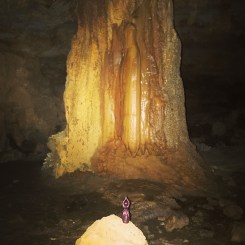
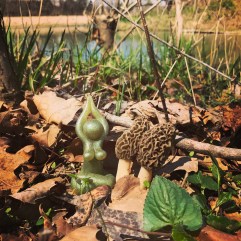 about two weeks in Missouri each spring and considered a delicacy by many). The afternoon suddenly becomes even more rewarding and we stoop and peer through fallen oak, sycamore, and elm leaves looking for the telltale conical form of these forest treats. We quickly discover that we must tune in and “listen” for the mushrooms, so to speak, or we’ll walk right by them, none the wiser. The moment I start thinking about anything else, I stop finding any. Once I settle into my body and the moment and really look at the world again, there another morel will be.
 Molly has been “gathering the women” to circle, sing, celebrate, and share since 2008. She plans and facilitates women’s circles, seasonal retreats and rituals, mother-daughter circles, family ceremonies, and red tent circles in rural Missouri and teaches online courses in
 There are quite a few post-apocalyptic shows out these days.
  It is, I think, quite common knowledge that most Jewish holidays relate to the seasonal cycles of the Earth. Sukkot celebrates the fall harvest. Chanukah sheds light on the winter darkness. Tu B’Shevat marks the end of the dry season and so begin the prayers for rain in Israel. For Purim, we throw off our winter doldrums and let off a little steam to settle our cabin fever. Pesach is no exception: welcome spring: birth, renewal and even creation. The leaves return to the trees, baby animals are born, flowers bloom, warmer weather arrives and somehow the possibilities of the coming summer are endless.
 In many ways, I’ve thought of the myriad
  With the Sun in Aries and then Taurus from late March through mid-May, representing Spring and the renewal of all things creative, it is a good time to think about the evolution of the goddess Sedna who created the walruses, seals, and new kinds of fish to feed her Inuit tribe which until then had to make do with bearberries, seaweed, and arctic moss. Sedna’s name means “provider of food,” but of course her creations came at a very dear price.
 In 2011, the Anglican Theological Review published arguments for and against same-sex marriage. “

