We’ve all been there.
Sitting around the tree watching the kids open presents. Attempting to enjoy a holiday meal with extended and immediate family that you may or may not have traveled thousands of miles to see. Trying with every fiber of your being to not talk about the elephant, or red hat, in the room.
We’ve all been there.
Sitting around the tree watching the kids open presents. Attempting to enjoy a holiday meal with extended and immediate family that you may or may not have traveled thousands of miles to see. Trying with every fiber of your being to not talk about the elephant, or red hat, in the room.
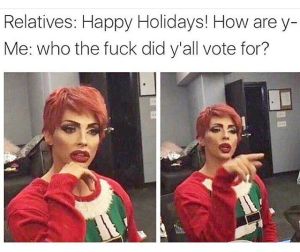
I get it. It is hard to not go home for the holidays. It’s also hard to sit at home and watch every one of your friends post online about their dinners, get-togethers, and other joyous events while you sit at home. I also understand that many of us, as a result of our sexual and/or gender identity, or maybe our political preference, don’t feel comfortable going home or, can’t go home. This is not ok and that is why it is so important that we all have our chosen families to be with during these times of communal gathering or more importantly, ways to cope while we are at home in these uncomfortable situations to make sure we take care of ourselves and make it out the other end.
Because this blog comes out on Christmas Day, I wanted to give you a few tips that I do to self-care in these situations. Remember, there is no right or wrong thing to do. I encourage you all to make your own list. The only thing that matters is you take care of yourself!
John’s Top 5 Tips for Dealing with “Those” People
-
Your car is your friend – Seriously, I cannot count the # of times that I have found myself driving around for that extra 5 minutes to just collect my thoughts or calm myself down. If you need to, jump out to your car and sit back and relax for a second or drive to a gas station (Kwik Trip in Wisconsin is my go-to) and pick up a soda to drink.
-
Drink (if you can) – look, I know not everyone drinks (or is from Wisconsin) but sometimes you just need to make yourself a cocktail (responsibly). However, if you are going to drink, remember that old adage: loose lips sink ships. If you get too loose, you may say something you regret (or didn’t plan on saying; I’ve been there).
-
Bathroom Sanctuary – Sometimes you may not need to use the restroom but you need a place to go and just lock the door, check Facebook, call a friend, or simply breath. The bathroom is the perfect place to do that. Find it. Use it (even if you don’t have to).
-
Dinner Conversation – Before I go anywhere, I always brush up on a few facts. How are the Packers doing? How about the Milwaukee Bucks? Can you believe they STILL haven’t finished that construction? No matter if you’re traveling somewhere near or far, if you think you need to make sure you can participate in dinner conversation without bringing up the two forbidden topics (Politics and Religion), then do so!
-
Push Back – Ok, sometimes it is ok to engage. I mean, how are we ever going to get out of this great divide if we don’t talk to each other. Now, that doesn’t mean it will go over or there will be some type of magical aha moment but it is ok to say something, especially when your crazy Aunt/Uncle/Cousin/Second Cousin/Random Friend of Cousin who no one invited starts spouting off some nonsense (like Mexico

paying for Trump’s wall because that just isn’t going to happen). If you feel safe enough to push back and say something, especially when someone if being completely and totally rude and inappropriate, always make sure you have an exit strategy. That is either a friend you can call, a room you can go to, or a nap you suddenly want to take. No matter what, if you do choose to engage always remember to a.) Speak calmly and slowly at all times (Republicans are triggered when you yell and provide them with too many facts too fast); b.) Make direct eye contact; c.) Make sure you always have something to take a long sip from afterward to prove you made your point.
I have to admit, I am quite lucky. I know I have written a lot on this site about what has happened to my family since the election of the Fascist-in-Chief. Luckily for me, I surround myself during these times with people who openly love me, my views (for the most part), and allow me to be myself, or simply, we just don’t talk about “it” because they clearly know now that we were right about Trump and his cronies. I don’t have to use these tips because the people they apply to, don’t really come around our holiday gatherings.
However, if there is one thing that I learned, it is that this election has cost us each something. Whether that was a friend, family member, or a part of yourself that you never think you’ll be able to get back, we need to respect these losses and the pain that comes with them. I promise you that it will get better (heck, better starts on January 3, 2019). We have a long way to go until 2020 (I mean, a LONG way to go) but I know we will all get there together, one way or another because there are better Christmas and holidays to come where we won’t have to use these tips and tricks to survive anymore.
So, from my family to yours, Merry Christmas and Happy Holidays! I’m thankful for each and every one of you this holiday season (unless you voted for Trump).
 John Erickson is a Ph.D. Candidate in American Religious History and holds two MA’s from Claremont Graduate University. John serves as a commissioner on the California Commission on the Status of Women. He is President of the Hollywood Chapter for the National Organization for Women, a boardmember for the City of West Hollywood’s Lesbian and Gay Advisory Board, a board member for the ACLU of Southern California, the Legislative Action Chair for Stonewall Democratic Club, and a board member for the National Organization for Women.


 Sitting in front of the computer, I slowly and intentionally insert earbuds, click to start my favorite writing playlist, and open up Microsoft Word. I feel the tips of my fingers resting lightly on the keys, and notice the slight give of each printed square, glossy in the middle from months of 80 words per minute. I lightly tap my fingers on the keys, not pressing enough to type a letter, body motionless except my fingers, watching the absolute stillness of the screen, exploring the edge between pressure and performance with slow, shallow breaths, finally noticing the moment when the edge is breached, the key catches, and a letter appears on my screen, taking it in with satisfaction.

 Since I wrote
 At the lovely small Chanukah party I attended earlier this month, I did not taste the latkes, those delicious potato pancakes fried in oil and typically served with sour cream and applesauce. My hostess offered them to me repeatedly, proudly noting that she’d used her Polish grandmother’s recipe. But I politely said “no thank you,” I’d just started a diet. “Who starts a diet in December?” someone asked. Someone else pointedly wondered “How can you not eat latkes at Chanukah?” but I quietly insisted that I needed to refrain. I promised, though, that I’d have some next year, once I’d shed the extra pounds that were making me uneasy in my own body.


 Last year when I was newly in love, I found myself wondering if my boyfriend would ask me to move to Crete to be closer to him. Pondering this possibility, it suddenly dawned on me that I was ready to move on. I had been living in Lesbos for twenty years, and I never expected to leave such a stunning island. I have an incredibly beautiful home that I renovated at great emotional cost. Nonetheless, I had been mildly depressed for a number of years and seriously distressed for three.
 Feminism and Religion