The Dog and the Divine by Ivy Helman

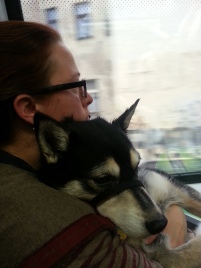
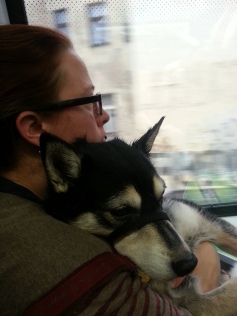
20151004_161012When I was in high school, I once gave a speech summarizing what I had learned about G-d through my dog.  I still chuckle at the idea.  I cringe sometimes and wonder what others thought of the piece.  Oh, the seeming immaturity of such an idea and perhaps naiveté.  I’m still embarrassed by my high school self.
The connection, on which I drew, included some of the ways I had come to love my four-legged friend as well as the way I interpreted his actions as love for me.  I remember I had a list of ten things my dog had taught me about the divine.  There was definitely a mention of unconditional love, being happy to see me, probably something about not being angry or ever holding a grudge, sharing secrets, perhaps a lesson on patience, and, of course, many more which I can’t remember.  This is beginning to sound like my blog post about Hanukkah, isn’t it? What were the other two nights?  What were the other six comparisons?  Oh, never mind. Continue reading “The Dog and the Divine by Ivy Helman”

Epona – Goddess of the Land by Deanne Quarrie

celtic-horseDeanne QuarrieThis week I bought a pendant that caught my attention.  It is Celtic knot work of horses, meant to represent Epona.  This triggered my interest in Epona and off I went to learn more.

Epona is a goddess from Gaul.  Sadly, any information about her from those early days of worship are lost to us. This is the case of the most ancient deities from that region and time in history. It is thought that she was picked up in Gaul by the conscripted soldiers of the Roman Army who saw a depiction of her upon her horse and they adopted her. Since this army rode across the land on horseback, she was the perfect deity to pay homage to and so, she traveled with them. She soon made it to Rome and is one of only a few deities, not originally Roman, to be worshiped in the Roman Empire. Continue reading “Epona – Goddess of the Land by Deanne Quarrie”

Body of Nature by Oxana Poberejnaia

oxanaIn the medieval European philosophy, woman’s body was seen as a vessel filled with sins, while man was regarded as a more spiritual being. This is one of the reasons why the concept of body is reassessed in feminist studies and why body is elevated in neo-paganism and Goddess spirituality. My fear is that nowadays body can be treated as an instrument for social advancement.

OLYMPUS DIGITAL CAMERA

We still live in a society that is deeply hostile to women’s bodies. Alla Demidova, an actress I respect for her talent and her critical mind, did a programme of Christmas-related poetry. I could not listen to more than five minutes of it.

The poems have been all written by men. I am not saying that men do not have the right to write about birth. I am saying that our prevalent image of Christmas should not be based on male view alone. In this sense I much better like the Carol from “The Vicar of Dibley” (one of my favourite British comedy series, about a female Vicar), which describes the movement of baby Jesus through Mary’s birth canal.

Continue reading “Body of Nature by Oxana Poberejnaia”

“Respect: Dualism Subversion and So Much More in Survival Reality Television,” by Ivy Helman.

20151004_161012In “Ecofeminism and Wilderness,” Linda Vance believes that Western society defines wilderness by “… the absence of humans, we are saying, in effect, that nature is at its best when utterly separated from the human world. The idea of wilderness is thus an extreme manifestation of the general Western conceptual rift between culture and nature,” (62).  Reality television shows, focusing on survival or living off the land, often reproduce this dualistic way of thinking.

At the same time they reproduce another of Vance’s concerns, “I would argue that wilderness recreation “re-creates” more than the self: it also recreates the history of the conquest of nature, the subjugation of indigenous peoples, the glorification of individualism, the triumph of human will over material reality, and the Protestant ideal of one-on-one contact with G-d. And as for the elements of physical challenge and risk, I think it goes without saying that they appeal most to those for whom day-to-day mobility is a given, and for whom danger isn’t always close at hand,” (71).  However, by presenting this dichotomy, many of the shows also subvert the ideal of untouched wilderness, challenge the notions of human abilities and highlight our lack of embeddedness and embodiment when it comes to survival situations. Continue reading ““Respect: Dualism Subversion and So Much More in Survival Reality Television,” by Ivy Helman.”

Synchronous Wisdom: Face-to-face with a Fisher by Kate Common

Kate Common headshotLast month I came face-to-face with a fisher.

It happened while writing my first published essay, a project that triggered fears within me about writing in more public venues. The essay pushed me out of the comfort zone of my typical academic voice. This both energized and terrified me, so I went to the woods for invigoration and clarity. The trails were empty that afternoon. I breathed in solitude and soft winter light and decided to speak, voicing statements of boldness and courage: “Be bold. Create despite fear. You can do this.“ And then I saw it, an unfamiliar creature, about the size of a medium dog, moving quickly into my periphery. It leapt onto the trail, landing fifteen yards ahead, midway up a low hill.

fisher_photoThe elevation difference brought us face-to-face. I found myself staring into a fierce, furry-brown, teddy bear face. It exuded a stout confidence and an instinctual danger thumped. Eye-to-eye, neither of us moved. What was this thing? Suddenly from the reservoir of memory a recognition emerged—it looked like a wolverine. But wolverines aren’t in these woods, right? Fifteen unflinching seconds passed and then it leapt back into the woods. I stood mesmerized by the beauty and surprise of it—this was not something ordinary. Continue reading “Synchronous Wisdom: Face-to-face with a Fisher by Kate Common”

More Than Just an Image by Jassy Watson

jassyI spent 2015 teaching an Intentional Creativity program ‘Wisdom of the Goddess” to an intimate tribe of women creatives from our local community. In December we held an end of Year Art Gala displaying a portion of the work which saw over 100 paintings of Goddesses created over a 10-moon period.

The program was divided into the cycles of Creation, Transformation and Celebration, as inspired by Hallie Inglehard’s book “The Heart of the Goddess”. Each month, through ritual, visioning and painting, we explored a Goddess that represented these cycles; Eve, Anjea, Demeter, Cerridwen, Kali, Persephone, Aphrodite, Ochun and finally, our Inner Goddess.

It took great courage for the artists to display their paintings in public. It is often hard to explain this work because it requires such deep and thoughtful exploration of one’s inner world along with a commitment to a creative practice that favours personal growth and discovery over outcome. It can be difficult finding the language to elucidate on this process that is not just about the act of painting.

It is painting to grow and heal.

It is sacred.

It honours and empowers women.

It inspires authentic creative expression.

It unites one with self.

It connects one back to the earth.

It transforms.

It reveals.

The show was a great success. A gallery full of Goddesses was surely a sight to behold! It was a humbling experience to be out and proud about our creative work in our regional, agricultural, largely conservative community. I feel it is imperative for the restoration of female empowerment to be remembering and re-imagining the Goddess by way of image and it was through Her that these astounding women artists found the courage to put their heart and soul on the wall for all to see.

The influence that image has is far-reaching and cannot be under-estimated. Image is a universal language that evokes emotion and can go as far as mobilising the masses and even change the course of history. The famous photo of ‘Phan Thi Kim Phuc’ running naked down a road after a napalm attack during the Vietnam War is but one outstanding example.

As I reflected on the years work however, I was reminded that while these paintings carry with them incredible insights and powerful messages of change, growth, discovery and transformation, the Goddess is so much more than just an image; and certainly more than just an image to mass-produce and sell. While “the strength and independence of female power can be intuited by contemplating ancient and modern images of the Goddess” (Carol P. Christ in ‘Why Women Need the Goddess’), it cannot be forgotten that She is the sacred made immanent in the natural world, expressed in the diversity of all forms of life and death. We seek Her, sometimes even travelling to the ends of the earth to find Her, forgetting that She is everywhere. She is you and me and Her sacred sites are found in our own backyards.

With this in mind I recently returned to some creative investigations I had begun a few years ago exploring woman in nature and the Goddess as the body of the earth through paint. The earth speaks and I am listening to Her stories and bringing them to the canvas to re-affirm my sense of wonder and respect for nature. My aim is to awaken an ancient memory of the sacred relationship between human and nature, for now, more than ever, it is critical that this relationship be restored. In doing so, the earth may once again be seen and valued as a living, breathing body that sustains and nourishes all life rather than being merely a commodity to be devastated and destroyed in the name of capitalism and greed. Further, these images are reminders of the interconnectedness of all life; we are not separate from the earth, but part of its’ intricate web.

The following image was inspired in part by Terry Tempest Williams ‘When Women Were Birds’ but is also an image born from a revelation I had many, many years ago when I first starting seeing woman in nature, especially in the body of trees.

When women were birds FINAL


“We are the birds eggs. Birds eggs, flowers, butterflies, rabbits, cows, sheep; we are caterpillars; we are leaves of ivy and sprigs of wallflower. We are women. We rise from the wave. We are gazelle and doe, elephant and whale, lilies and roses and peach, we are air, we are flame, we are oyster and pearl, we are girls. We are woman and nature. And he says he cannot hear us speak.

 But we hear.”

 Susan Griffin, Woman and Nature: The Roaring Inside Her

Jassy Watson, who lives on the sub-tropical coast of Queensland Australia, is a Mother of four, passionate organic gardener, Intuitive/Visionary Artist, Intentional Creativity Coach and a student of Ancient History and Religion at Macquarie University, Sydney. She is the Creatress of Goddesses Garden Studio & Gallery; a small school for the Sacred Creative Arts. Jassy teaches regular painting workshops in person, nationally, internationally, and online based around themes that explore myth, history, earth connection and the Goddess. Her latest SOULSCAPES (TM) exploring woman in nature will be on show at ‘Dreaming Into Being’, Percolator Gallery, Paddington, Brisbane April 5th-11th. You can see her work at http://www.goddessesgardenandstudio.co

The German Diotima by Stuart Dean

Caroline Schelling
Caroline Schelling

The title of the essay Über die Diotima (hereafter, the ‘Essay’ (translation here (pp400-419))) by Friedrich Schlegel (hereafter, ‘Friedrich’) suggests it is focused on Plato’s portrayal of Diotima in the Symposium.  That portrayal, though, is but a starting point for Friedrich, who attempts to demonstrate that Diotima was a particular type of woman he associates with other ancient Greek women, including Sappho.  The Essay is ostensibly of little relevance today, largely because knowledge of ancient Greece has evolved substantially since Friedrich’s time.  In particular, a compelling case has been made that far from being related to ancient Greek women, Diotima is a fictional figure used by Plato “to vanquish Sappho” (Jantzen, Foundations of Violence, p193).

Yet, the Diotima Friedrich principally had in mind was not the one in Plato’s Symposium, but rather Caroline Schelling (hereafter ‘Caroline’), who was–for a time–his sister in law.  On the third anniversary of his meeting Caroline he wrote a letter to her, reminding her of that anniversary and thanking her “for everything you have done for me and my development” (Caroline was almost a decade older than Friedrich, who was then in his early 20s, and yet to establish a name for himself as a scholar).  Towards the end of his letter he asks her to read the Essay “once more and mark in pencil those passages in which you believe a small change might be necessary.”  While his ‘once more’ suggests Caroline had previously given him input, the fact that in a letter to her from almost a year earlier Frederick refers to her, somewhat flirtatiously, as the “independent Diotima” relative to her ‘god’ (Frederick’s brother, August) confirms his identification of her with the subject of the Essay. Continue reading “The German Diotima by Stuart Dean”

Ananke’s Promise by Deanne Quarrie

Deanne Quarrie, D.Min.I have recently been looking at the Goddess Ananke. Ananke and Her consort Khronos, were primal energies emerging from chaos, producing the world egg and then wrapping themselves around it causing it to burst. Out of that egg came the world and all that it contains. Just imagine, the world being formed by two energies – those of Inevitability or Necessity and by Time. How simple and yet how complex.

The story of Ananke and Khronos is large. Those ancients who held onto this story were not speaking of small things. This is the creation of a Universe. And yet, in the theory of “as above – so below”, we can look and see Ananke and Khronos at work in our lives all the time.

Time and Inevitability – perhaps everything can be broken down into these two principles. With Time and Inevitability, we are born, we age and we die. A life is led, perhaps filled with love, perhaps many things. As children we play and learn and eventually become adults. We marry. We have children. Some step into careers and choose not to procreate, rather putting their energies into work and other kinds of relationships, still creating, just not procreating. Also, it is possible that some of those lives will follow a darker path into poverty, criminality, envy and greed. It is hard to know at birth, the path that will be followed by a child. And yet there is a certain amount of inevitability that when a child is born into a life containing a dark poverty of spirit, that the child may not thrive in healthy wholesome ways in adulthood. Continue reading “Ananke’s Promise by Deanne Quarrie”

Do You Believe in Magic? by Deanne Quarrie

I went online to dictionary.com and pulled three definitions for the word “magic.”

The art of producing illusions as entertainment by the use of sleight of hand, deceptive devices, etc., conjuring.

To pull a rabbit out of a hat by magic.

The art of producing a desired effect or result through the use of incantation or various other techniques that presumably assure human control of supernatural agencies or the forces of nature.

Any extraordinary or mystical influence, charm, power, etc.

The magic in a great name; the magic of music; the magic of spring.

The first definition is the one that most people think of when the word is used. The second is what people think storybook witches and wizards do and the third, a great way of using the word when talking about marvelous things in life.

I am going to toss out definition number one because, while valid, it just isn’t the kind of magic I want to discuss. Continue reading “Do You Believe in Magic? by Deanne Quarrie”

Why Is Pizza Round? The Black Goddess of Rome by Stuart Dean

The remains of an ancient Roman bread pie from Pompeii, carbonized in the eruption of Vesuvius in 79 CE
The remains of an ancient Roman bread pie from Pompeii,
carbonized in the eruption of Vesuvius in 79 CE

The poem Moretum (discussed in my last post) narrates the preparation of a meal that can be characterized in modern English as ‘pizza.’  Round flatbread is baked; to go on it, a cheese spread is mixed.  The details of the narration are such as to create a recipe of its ingredients and related cooking instructions.  

The most important ingredient, however, is not an ‘ingredient’ as such, but a shape.  The bread, the cheese, and the cheese spread are all round.  That by itself might not seem remarkable, but the Latin terminology (words from which ‘orbit’ and ‘globe’ derive) is identical to then contemporary astrological terminology.  The bread is even scored into quadrants, symbolizing, among other things, the four elements and the quadrants of an astrological observer’s circle. 

The ancient audience of Moretum would have recognized in all this the world view of the Italian poet from southern Campania, Parmenides.  Though the only poem he is known to have composed is in Greek, the combination of the fact that he likely wrote it while in Italy and that it had over the centuries since its composition become one of the most influential philosophical works of pre-Christian antiquity meant Parmenides had special importance to Romans.  It is not surprising Moretum has the same meter and many of the poetic images as are found in the poem of Parmenides. Continue reading “Why Is Pizza Round? The Black Goddess of Rome by Stuart Dean”