Notes from the ‘Field’ in August 2026, part 2 by Sara Wright

Part 1 was posted last week. You can read it here.

Choosing Change:
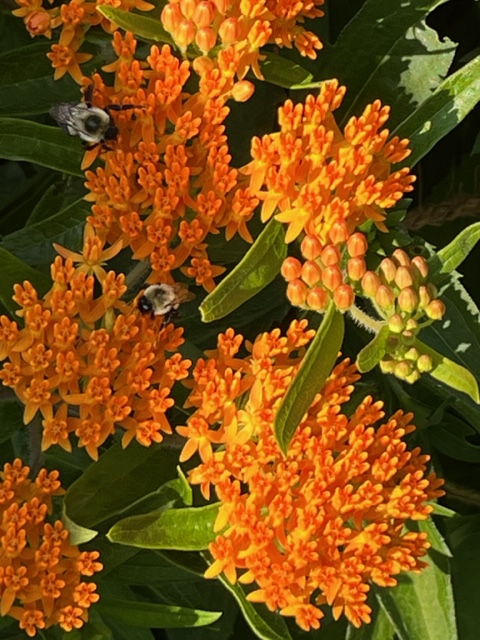
Sara’s favorite bees

Because of such poor air quality Coalie and I walk in the morning when the air is clear or isn’t as toxic as it will be by afternoon. For the last two years the ozone level has skyrocketed due to unchecked deforestation, and the ever- worsening particulates burn my eyes.  Headaches strike as soon as the air begins to thicken. As a result, summers have become another challenging season with me prioritizing clean air over outdoor time. My Coalie has a small set of lungs and mine are aging.

 Although making this transition has been hard on the naturalist who thrives in the woodlands, the outcome is that we have adapted. I am grateful (and guilt -ridden) that raging fires are not at my door. I sense that the trees around me know their sisters and brothers are burning. I also note that when the air quality deteriorates Coalie wants to come indoors of her own accord. The lack of bird song on any day that the air is polluted is astonishing. My guess is that poor air quality is very apparent to all non – human beings.

I used to complain about my sensitivity to moderate air quality. Now I am grateful that my body makes it clear that we belong indoors, not even on the porch on ‘bad air days’ which are increasing in severity. It troubles me to watch others running or biking on the roads for fun.  Virtually all other outside work is done with air polluting machines contributing mightily to the problem. The exception is a person like me who chooses to do outside chores by hand. But only on days when the air is relatively clear. But I still drive a car.

Continue reading “Notes from the ‘Field’ in August 2026, part 2 by Sara Wright”
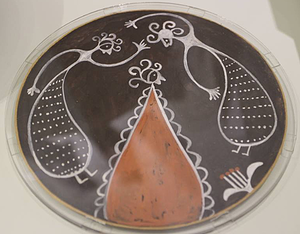
The Legacy of Carol P. Christ: Dance of the Bees: Reading the Language of the Goddess

This was originally posted on Dec 1, 2014 and then reposted on July 11, 2022

bee women dancing cropped

The image from an ancient Cretan bowl (c.1700 BCE) from the Sacred Center of Phaistos pictured here has often been interpreted as an early depiction of Persephone’s descent or rising. But are clues from later Greek mythology pointing in the right direction in this case?

Recently, my colleague Mika Scott posted the Phaistos bowl image on our Goddess Pilgrimage Facebook site in conjunction with the bee pendant from Mallia. This juxtaposition led me to think again about the importance of bees and pollination in agricultural societies and to offer an alternative reading of the symbolism on the bowl.

In her important work The Language of the Goddess, Marjia Gimbutas taught us to “read” the language of the Goddess in the artifacts of Old Europe through a process of careful comparison of imagery and motifs, making use of what she called the archaeo-mythological method. This method finds that clues in later mythology and folklore can unlock the symbolism of ancient artifacts. Another possibly more important part of the method involves careful attention to plants and animals and their cycles of birth, death, and regeneration, which are portrayed on the artifacts.

Continue reading “The Legacy of Carol P. Christ: Dance of the Bees: Reading the Language of the Goddess”

A CALL TO CELEBRATE TREES by Janet M Rudolph

Olive Tree from the studio of Judith Shaw. Judith has a special offer to purchase this artwork as a giclee print through August 24th. Details below.

With the trees burning around the world, in Canada and the US as well as in Europe and Africa, Asia, South America and more, it seems to be an especially important time to be with the trees, to recognize our kinship, and to celebrate them.  

To see just how bad the fires are around the world, below are the links to two maps that are kept in real time.
NASA Greenpeace

I don’t know when and where the initial hatred of trees began, but I would tag the Bible as an early and influential proponent of destroying trees.

The viciousness against trees appears to have grown out of a desire to erase Goddess worship in Biblical lands. The terms for Goddess groves were Asherot and Ashereem named after the Goddess Ashera. An individual tree was called an Ashera. The charge given to the people was to cut down everyone. 

And ye shall overthrow their altars, and break their pillars, and burn their groves (Ashereem) with fire; and ye shall hew down the graven images of their gods, and destroy the names of them out of that place.
Deuteronomy 12:3 KJV

But ye shall destroy their altars, break their images, and cut down their groves:
Exodus 34:13 KJV

Continue reading “A CALL TO CELEBRATE TREES by Janet M Rudolph”

Notes from the Cauldron of Change, by Molly Remer

Mirabai Starr writes that to be a mystic is to “harvest the bounty of your own soul garden,” a place that is “both wild and tended,” sometimes lush and sometimes arid.

As summer’s heat presses in
and the clamor of growth and change
rises to a peak of abundance and urgency,
we may begin to hear a summons
from deep within.
The cauldron call begins,
at first a whisper
and then an irresistible song
that leads us away from the to-do list
and into a mystical realm
in which dreams and desire meet
and begin to bubble into possibility.
May we grant ourselves space
for descent,
even in the middle of all that
is hot and bright and beautiful.
May we listen to the yearning we feel
to explore the depths,
stepping out of the light
and into the cool shadows
that beckons us to steep.
Right here,
right now,
in the middle of all that swirls,
is when we are invited to stop,
to put our ears back down
to our souls
and listen hard.
It is now that we are invited
to step into the cauldron of change,
to sink down
and in
and let everything we are carrying
soften and melt away
while we remember how it feels
to simmer in everything
we have made,
all that we love to taste
and serve.

For years now, August has been my “Cauldron Month,” a dedicated time in which I take my life into the metaphorical cauldron of being, to reflect, to re-collect, to reconnect, to consider what I’m “simmering” in, what is bubbling and brewing in my days, and what needs to be scooped out of the pot. It is time in which I review the year to date and consider where I’m going, what I’m savoring, and what I’m dishing up to serve.

Continue reading “Notes from the Cauldron of Change, by Molly Remer”

The Legacy of Carol P. Christ: Belonging to the Land

This was originally posted on November 17, 2014

Carol Christ in Lesbos

I believe that we can restore our hope in a world that transcends race by building communities where self-esteem comes from not feeling superior to any group, but from one’s relationship to the land, to the people, to the place, wherever that may be.—bell hooks

In these words from her poignant memoir-reflection-analysis Belonging, bell hooks suggests that rather than creating identity by comparing ourselves to others, whether in the academy, in communities, or in the larger society, we would do better to root our identity in the land.

Hooks “left home” in rural Appalachia in order to pursue “higher” (why do we call it that?) education including a Ph.D. which enabled her to teach at prestigious universities in the urban north. Despite her considerable success as an academic and a black feminist, hooks suffered persistent depression in the cities where she taught. Eventually she diagnosed her dis-ease as a longing for the home she had left behind, specifically as a need to connect with the traditions of her ancestors, the mountains, and the land that had sustained them since the end of slavery.

Hooks asks if one of the reasons that so many black people have failed to thrive in the urban north has to do with the loss of connection to the land and ancestral traditions that occurred with twentieth century migrations to the north. Though black people—and hooks herself—hoped to find greater freedom and dignity in the north, hooks wonders if the price they paid was too high.

Continue reading “The Legacy of Carol P. Christ: Belonging to the Land”

The Turning of the Wheel by Sara Wright

Today Grace enters. The air is clear, the window open. One hummingbird hovers at my window. Every twig is covered with lush green leaves and every time I gaze into the green, I feel that gratitude pulsing through me – the wonder of being alive. A brilliant green frog inhabits my toad pond. Last night a Datura blossom literally opened before my eyes etched with pale lavender – a moonflower of exquisite fragrance and beauty. If anything, I appreciate these moon blossoms more than I did in the desert.

My bee garden is humming, saturated with crimson, deep orange, yellow, pink, a cacophony of color and sound. I say sound because I also imagine that I can hear the flowers singing their song of abundance, gratitude, and praise to all there is…

The first lemon lily pods are ripening, green apples bend the trees low, grapevines are heavy with new fruit, and columbine spikes are bursting with seed that I scatter between the cracks of   stones. Diminutive pale pink poppies keep popping out of a tangle of ajuga runners and fledglings hug the cabin.  The forest birds have quieted. Some will soon be migrating but stillness blotted out the forest trills when the deadly smoke first filtered in. Little gold birds flit back and forth, sunbursts singing up the dawn. The Mourning Dove waits for me at twilight…

Continue reading “The Turning of the Wheel by Sara Wright”

Miriam MacGillis Discusses Thomas Berry’s View of the Universe, Transcribed by Janet Rudolph

Introduction: Miriam MacGillis is a modern-day prophet who not only holds a broad understanding of cosmology but brilliantly expresses it. She was an early colleague of Thomas Berry, introducing many people to the Story of the Universe. I have had the great honor of transcribing the tapes of her lecture series called Education for a Small Planet from 1986. Below is an excerpt from Tape 1B. It is edited for clarity. Excerpts from tape 1A can be read here and here.

***

Thomas Berry speaks about three principles which have been at the heart of the unfolding of the universe from the beginning. They are very simple and can’t be separated. I’m just separating them now [to discuss them]. In reality they’re three in one. They are extremely simple. Very often, the simplest things are the hardest things to grasp. But once we really begin to reflect on them and their implications, it’s so logical, so clear, so simple.

The first is the principle of differentiation. When we talk about the universe and its guidance system, this principle becomes even more highly articulated when we get to the Earth. It’s a very simple dynamic. Literally, all it means is that from the very beginning everything that is, is differentiated. You couldn’t have a universe unless there was differentiation of its elements. Because hydrogen and helium and carbon or whatever, grow into more complex structures . .  it’s because they are different that they interact with each other and in that interaction cause each other to change. They cause each other to break down from being what they are in their simple state. In the dying of what they were in their simple state, they change and become transformed into something more complex.

Continue reading “Miriam MacGillis Discusses Thomas Berry’s View of the Universe, Transcribed by Janet Rudolph”

She Changes Everything She Touches: A Reflection on Love and Loss, part 2 by Sara Wright

part 1 was posted last week, you can read it here.

How much I like clipping by hand. Surprised by this realization I feel satisfaction rising. I was bored by this task as a child. I am delighted to meet a bevy of fat nubbly toads who appear out of the overgrown ground covers and in between sun warmed stones. Both child and ‘old woman’ feel happy that none will get mowed down by a polluting gas guzzling machine. The Peace of this Land that we belong to steals over us. Less is more. I’ll tackle the patch of bracken later, or maybe not until tomorrow. In this weather   accomplishing one simple chore a day is enough.

Well not quite. I am creating a serpentine path of fieldstone that stretches from my front door to meet the path that climbs the hill. My original intention was to have someone ‘more professional’ do the work, but they were too busy so here I am, an almost eighty-one-year-old woman, creating a mosaic out of cracked stone! ‘I am the artist’ I say, as I carry a few more irregular rocks down from the huge pile sitting in front of the garage eyeing the mosaic for the perfect fit. Illumination strikes when wind hits the stones. Blowing seeds, withered crabapple bits, pine needles and leaves into the cracks I see what is happening. Small plants like violets, creeping charlie, ground ivy, and catmint will find niches in the soil that is being created before my eyes.  Mosses will follow in the shade. Ah, Nature is going to help me craft a unique and imaginative fieldstone floor. Each time it rains the stones flatten out becoming more stable. That same feeling of satisfaction steals over me again. Vaguely I think that I may be doing something else besides laying stones in an artistic way and trusting that Nature will fill in the cracks, but I am not clear just what this might be. All I know is that it doesn’t matter how long this project takes. Process has taken precedence. This much feels just right.

Continue reading “She Changes Everything She Touches: A Reflection on Love and Loss, part 2 by Sara Wright”

What is a Glorian? Almost a Review of Terry Tempest’s book by Sara Wright

There is something deeper than hope that is calling us writes Terry Tempest Williams internationally acclaimed naturalist, environmentalist, and author in The Glorians. When we focus our attention on what she calls the ‘holy ordinary’ we are transported into a new way of being.

 A Glorian can be a life changing dream like the one Terry had that inspired the title of this book. “Your vow is to create the Epic Documentation of the Glorians,” she was told as she reached the top of  a tower by way of a spiral staircase.  “What the hell is a Glorian” her father asked. A Glorian can be a  moment, memory, an animal, plant, root, eclipse, an encounter with self or with others, an ordinary or non -ordinary experience that pulls us into the Now when the cloak of linear time falls away, and presence is all there is.

Terry shares her experiences with Glorians throughout the book but refuses to define who or what they might be believing that each person’s perceptions are different.

Continue reading “What is a Glorian? Almost a Review of Terry Tempest’s book by Sara Wright”

Falling into Spring by Sara Wright

The glorious
white stars
waited in vain
for rain
for miner
sweat
mason
or bumblebee
to feast
on pollen
sacred to All
after three days
petals
drooped
golden
eyes shut
pearled
almonds
fell
one by one
next year’s
compost
soaked in
unshed
tears.
Perhaps
Bee Goddess
has a plan
Changing Woman
transforms
Sky Woman
holds the
seeds …
clasping
bloodroot
spears
and
buds
wrapped in
gray shawls
she may
yet
choose
to
intervene.

Continue reading “Falling into Spring by Sara Wright”