A while back I gave a talk on feminist trinitarian theology to an audience of mostly progressive academics, including feminist and womanist scholars of religion. In the course of analyzing what I called the ‘trinitarian imaginary’ in Christianity and its often-patriarchal and masculinist forms, I suggested that transforming that imaginary might require recognizing the hypothetical character of theological statements until the eschaton, a theme that has been developed in depth by a German theologian named Wolfhart Pannenberg. Now, Pannenberg is decidedly neither a feminist nor a progressive theologian. To name just one example: in his three-volume Systematic Theology, his few explicit references to feminist or female theologians include a brief mention of Mary Daly (volume 1, p. 262) in connection with a critique of feminist theologians for projecting (!) masculinity into God in their readings of divine fatherhood, and a critique of Valerie Saiving and Susan Nelson Dunfee’s positions on the traditional Christian doctrine of sin as pride (volume 2, p. 243). So when I mentioned Pannenberg as a resource in my talk, one of the feminist scholars in the audience audibly gasped and flinched – it became clear in the Q&A that she had significant concerns about whether I could count as a feminist at all. After all, to mine someone like Pannenberg for constructive feminist theological work might imply an endorsement of his other positions, or might entail taking over aspects of his system that would taint my own project in anti-feminist directions – all legitimate concerns. Continue reading “When Feminists Disagree by Linn Marie Tonstad”
Category: God-talk
A Pro-Science, Skeptical Woman Speaks by Kile Jones
In my last post, “Feminism and Religion: Where Do I stand?” I talked about how I support an atheistic, secular, and liberal feminism that criticizes organized religion and certain religious beliefs. After reading the comments and responding to them, I figured that having a brief interview with a woman who holds these sorts of views would be a good way to introduce them to this blog. I met Anondah Saide at a course at Claremont Graduate University titled, “Evolution, Economics, and the Brain,” taught by the Executive Director of the Skeptics Society and Founding Publisher of Skeptic Magazine, Dr. Michael Shermer. Anondah was the TA for the course, and I found her comments in class to promote science, reason, and skepticism towards religious and spiritual claims of all kinds. So without further ado, here is the interview: Continue reading “A Pro-Science, Skeptical Woman Speaks by Kile Jones”
Second Class Rape Victims: Rape Hierarchy and Gender Conflict
Deconstructing masculinity isn’t the key to solving social, sexual, and domestic violence across the world but it is a step worth taking when attempting to engage men in affecting change to stop these violent actions since men, statistically are the perpetrators of such crimes that both cause such outcry as well as perpetual silence.
The most disturbing part of the 2006 documentary Deliver Us from Evil isn’t the fact that Father Oliver O’Grady is rewarded by the Catholic Church with a new congregation in Ireland after his short stint in prison for the rape of dozens of children in the 1970s, but rather the hierarchy of gendered victimization which is often created throughout the various rape cases that are both reported and unreported throughout history.
I am often troubled by the ways in which rape cases are discussed and deconstructed via mediums such as blogs, online communities, social media networks, the news, and popular culture. No series of events troubled me more than the Jerry Sandusky trial, but more importantly, the ways in which the young boys and adult men who were subjected to Sandusky’s abuse quickly overshadowed the other rape cases that are reported on a daily basis, specifically those involving young girls and women. Continue reading “Second Class Rape Victims: Rape Hierarchy and Gender Conflict”
On Pronouns and Liberation in the Classroom by Ivy Helman
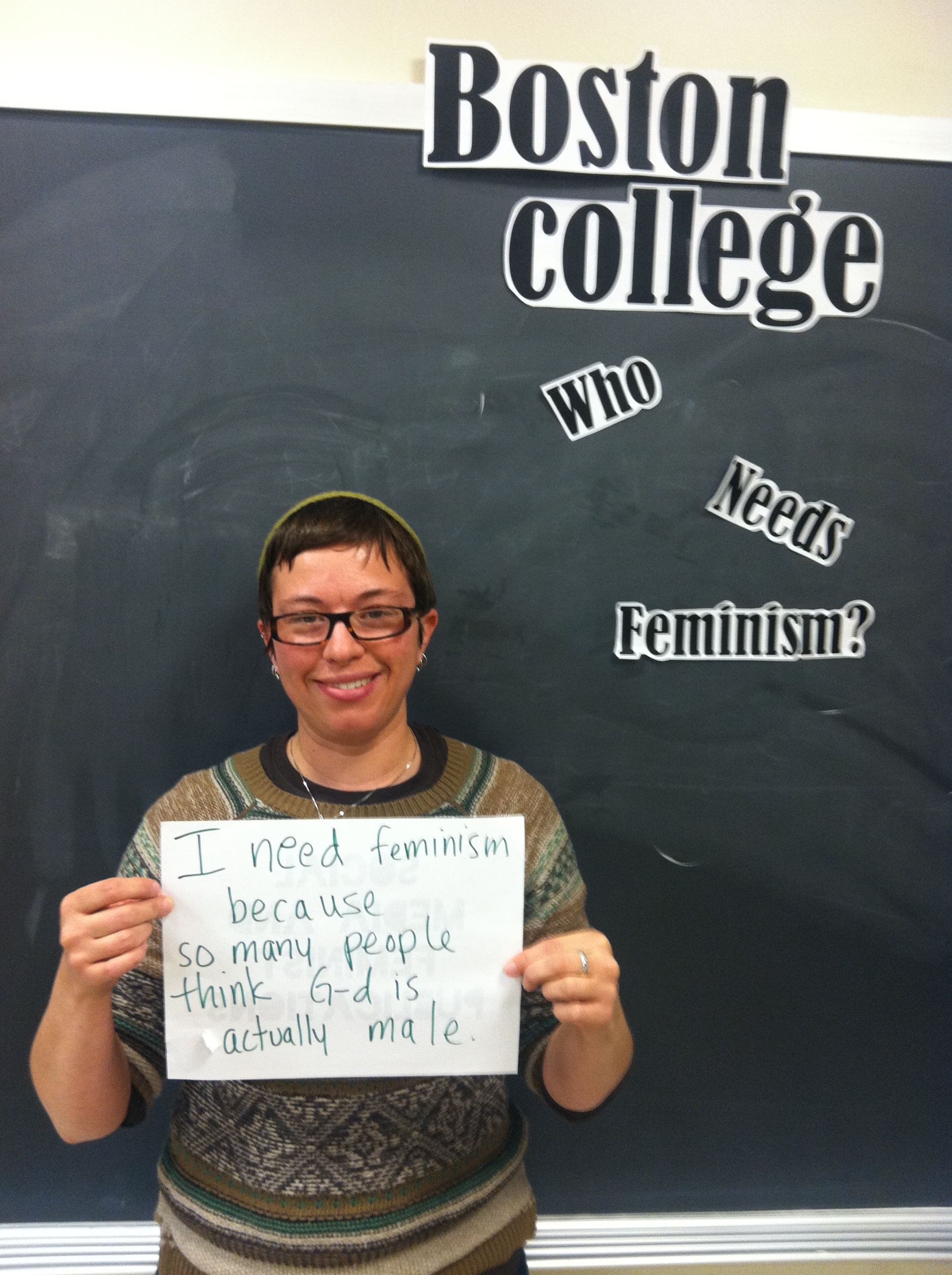
In my introduction to Christianity class, almost every one of my students (who come from diverse religious backgrounds – primarily Roman Catholic, Protestant and Muslim), continues to believe that the best image if not the only appropriate image for G-d is male. When probed they may speak generically about G-d as genderless, an entity or spiritual presence of some kind, yet conclude by affirming their belief that G-d is male often by adding something along the lines that G-d is best described as Father. Some go so far in these affirmations that they articulate G-d’s maleness as fact. It never fails that every semester I struggle with how to address this basic feminist issue within the classroom.
At least as early as 1973, Mary Daly, in Beyond G-d the Father: Towards a Philosophy of Women’s Liberation, articulated the problematic basis of the relationship between gender and divine imagery. She argues that “If G-d in ‘his’ heaven is a father ruling ‘his’ people, then it is in the ‘nature’ of things and according to divine plan and the order of the universe that society be male-dominated.” In other words, if maleness is associated with divinity, then the power, domination and running of society by men seems to be divinely ordained. Continue reading “On Pronouns and Liberation in the Classroom by Ivy Helman”
Please Excuse Me for Having a Penis: Taking a Back Seat to Privilege and Power by John Erickson
Male feminists must be aware that we not only engage in an ongoing struggle against sexual and gender inequality, but more importantly an ongoing fight with ourselves.
I have often struggled with that little voice, call it my conscience if you will, that speaks to me during times of distress. Although I consider myself a proud feminist, I still struggle with aspects of what I call, internalized misogyny, or more aptly defined as a male born characteristic trait that imparts the idea that men are not only dominant but also more powerful than the other 50% of the species.
For many reasons, I believe religion is one of the main culprits of this growing evil, one that we all witnessed throughout this last election cycle. However, instead of placing blame solely on religion and images of the male Godhead we have to begin deconstructing the sociological consequences these subconscious social, sexual, religious, and gendered norms have on men but more importantly men who identify as feminists. Continue reading “Please Excuse Me for Having a Penis: Taking a Back Seat to Privilege and Power by John Erickson”
Exposure by Elise M. Edwards
Before I feared too much disclosure, but now I seek to channel revelations of

personal experiences into exercises that inform the moral and intellectual agency of everyone in the classroom, including me.
I have always been a bit nervous when people share personal experiences in non-intimate settings. For the past several years, I’ve been in an academic environment where people routinely discuss and reflect upon significant life events. There were times that I was very uncomfortable listening to classmates discuss abortions, first sexual experiences, and encounters with racism. Even though they did not use graphic or disturbing language, I questioned the appropriateness of sharing intimate details of one’s life in a classroom.
So when I was preparing to teach my own course on Christian Ethics, I was careful to define a course policy that related to sharing and participation. In part, it reads: “While students are encouraged to use the course material to reflect on their own experiences and develop their own theological-ethical perspectives, sharing intensely personal reflections is not required – in fact, it is discouraged to maintain the professional atmosphere of the classroom.“ In class, we discuss conceptions of God and religious faith as they are applied to complex issues like sexuality, racial reconciliation, war, and medicine. The potential for conflict and personal attack is always present in the classroom because we often have deep commitments and personal beliefs on these issues, so I wanted to curb the amount of personal reflection that occurs in the corporate setting.
Over the course of the semester, though, my perceptions have changed due to well-written memoirs and personal statements I have read recently, the profound statements my students have shared, and the teaching philosophy I am developing. Whereas before, I feared too much disclosure, now I seek to channel revelations of personal experiences into exercises that inform the moral and intellectual agency of everyone in the classroom, including me. Continue reading “Exposure by Elise M. Edwards”

Translations of the Bible (and Translators) are Important to Women by Jennifer Sharp
One of the most interesting topics is the theory that YHWH’s roots may be found in information about the ancient Goddess IO, and that YHWH is an inclusive name for an inclusive deity.
Some years ago I read the Bible and objected to passages about women. That was when works by Ruether, Stone, Daly, Schüssler Fiorenza, Eisler, etc. became available. I read all of the feminist writers I could find. Because of this reading, I looked up biblical passages in different Bibles. I began to notice something rather curious. A passage in one Bible would say “she did it” – the same passage in another Bible would say, “he did it.” “This,” my current minister would say, “This is the word of God. You can believe in it.” “Believe in it”? Which biblical passage was I supposed to believe – the “she” or the “he”?
Being a questioning person, I got serious. I searched the University of Wisconsin bookstore shelves for required reading in Hebrew and Semitic studies, acquired references listed in bibliographies of those books, read about the development of the biblical text, purchased interlinear Bibles, Hebrew and Greek grammars, analytical lexicons, concordances, commentaries, and more English versions of the Bible and eventually took a class in Hebrew. Continue reading “Translations of the Bible (and Translators) are Important to Women by Jennifer Sharp”
“From Teshuvah to Justice: Jonah’s Call to Change” by Ivy Helman
(I offer here an abridged version of the sermon I gave on Yom Kippur (5773) at Temple Emanuel in Lowell, MA. The full version will be available on their website soon. The book of Jonah is always read on Yom Kippur in the afternoon service as the Haftorah. It is rather traditional that someone (usually the Rabbi) offer an interpretation of it. Temple Emanuel asked me this year. I thank the congregation for the honor and I hope my words offered them, and now you, food for thought.)
Scholars believe the Greek philosopher Plato lived between 428 BCE and 348 BCE. The Allegory of the Cave is one of Plato’s most famous stories. It illustrates the effects of a change in knowledge, education and experiences on the human being. Some of you may know it or have read it at some point but for those of you who don’t, let me offer a very brief summary.
There are human beings shackled to a cave in a way that they can only see the wall directly in front of them. Continue reading ““From Teshuvah to Justice: Jonah’s Call to Change” by Ivy Helman”
Process Thought: Feminist Friendly Metaphysics by Xochitl Alvizo
To be is necessarily to be in process and engagement with the lure of creative advance (that is, with God). In this sense, God is the poet of the world continually luring the world toward its full be-coming.
“It all goes back to one’s metaphysics.” That is what my TA said in the first theology class I took during my masters program. We were discussing our theological statements in class – a statement that outlines our individual understanding of God, humanity, sin, etc. – presenting them to one another for feedback and discussion. As we argued and discussed (“How can you possibly believe that?”) our TA made the case that our theological statements and the varying differences among them were largely determined by our particular metaphysics – that is, they are determined by whatever we hold to be the nature of existence. That is to say, if science studies the physical world, metaphysics is the result of asking questions about the underlying reality of that physical world – about the nature of the physical world and by extension all of existence. As one can imagine, not all metaphysics are created equal, but all of them are theories with enormous implications. Continue reading “Process Thought: Feminist Friendly Metaphysics by Xochitl Alvizo”
Imaging God by Tiffany Steinwert
There are some words a mother never wants to hear. For me, those words came one evening as I tucked my 3 year old son, G, in to bed. We had just finished reading God’s Dream, a children’s book by Bishop Desmond Tutu, and were discussing what God might want us to do. The conversation went something like this:
G: “I think God wants me to share.”
Me: “I think so too. God likes sharing.”
G: “ “Yeah, He likes it when I share.”
SCREEEEECH!!! Insert here the sound of the needle suddenly scratching and falling off the record.
He?
Where did G get that? With two theologians as parents, G’s religious world has been carefully and intentionally constructed since birth. Nowhere ever did we refer to God as “He.”
Perhaps it was just a slip of the tongue, a mistaken pronoun, an unintentional lapse. God/dess knows I pride myself on my child’s gender fluidity. I take his vacillating male and female pronouns as a sign of early queer, gender non-conformity. Though, I suspect others might interpret that as part of normal verbal development. You choose.
Whether intentional or unintentional, I decided to nip this in the bud once and for all. Continue reading “Imaging God by Tiffany Steinwert”